Robert Richards
Title: Partner, Transwestern RBJ
Age: 58
Experience: 29 years
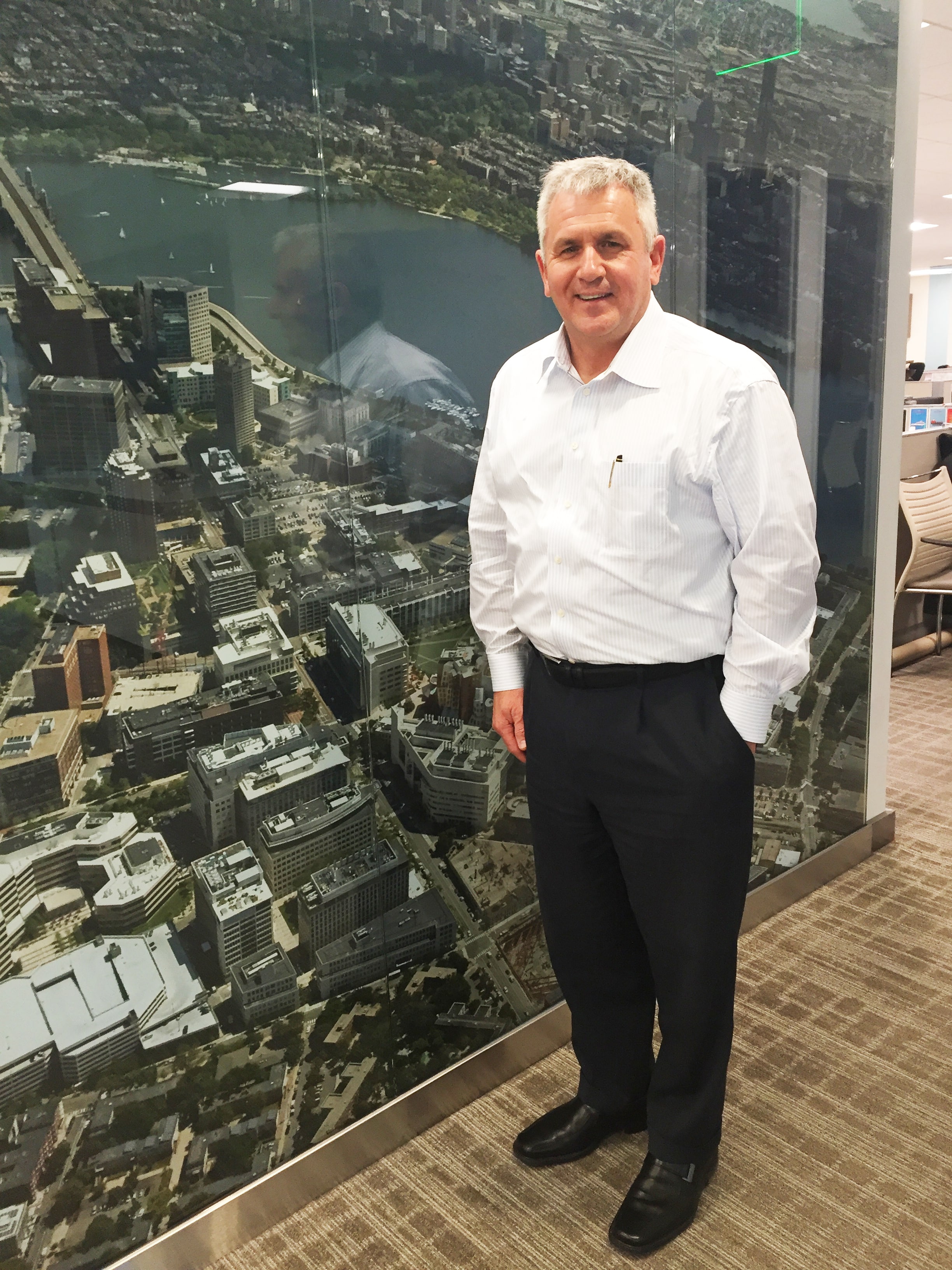
Robert Richards was a TV sportscaster before getting into commercial real estate, another industry where it’s important to keep track of the winners and losers. As a partner at Boston-based Transwestern RBJ, Richards helps lead a firm that specializes in tenant representation, including the region’s red-hot life science sector. A Norwood native, Richards graduated from Dartmouth College and had stops in local TV in upstate New York and at CNN in Atlanta before joining Spaulding & Slye in the late 1980s. He worked for Fallon, Hines & O’Connor before forming Richards, Barry, Joyce & Partners in 2001. Transwestern acquired the company in 2013.
Q: How would you describe Transwestern RBJ’s niche in the commercial real estate landscape of Boston?
A: It’s definitely changed from the Richards Barry Joyce days. Our clients were looking for us to continue to add value outside of a traditional real estate brokerage. Our goal and place in the market is to be involved in the biggest, most complicated deals, mostly on the tenant side. We have a very strong life sciences practice. The operation has grown. When Transwestern acquired us we added a property management group. It was important to me, when we sold the company, that no one lose their job because of the merger. We were very fortunate Transwestern didn’t have an operation in Boston and they’ve been fantastic and let us run our business.
Q: Blackstone was a big office landlord here and now they’re back in the Boston market with the acquisition of BioMed Realty. How does that affect the Cambridge lab market?
A: Blackstone are extremely bright, insightful real estate investors so we would imagine it will be more of the same. BioMed’s done a fantastic job of managing their portfolio and you add the financial strength of Blackstone, I see it only getting potentially bigger and better.
On the tenant side we just represented Baxalta when they came to town, Bristol-Myers Squibb at 100 Binney St. that Alexandria Real Estate Equities is building, Harvard Medical School and Dana-Farber Cancer Institute. The peaks that are hitting East Cambridge are having an impact on all markets. For some of the younger life science companies, if you are going to have to spend $70 triple-net to be in Cambridge, you can be in the suburbs for $38 to $40.
Q: Have you seen any dropoff in biotech tenant demand with the recent stock market turmoil?
A: None whatsoever. When you think about these companies, they have a technology or a concept that’s competitive in nature. They can’t afford to sit on the sidelines and wait for the right moment. If anything, that whole ecosystem remains stronger than it’s ever been. Cambridge has 1.5 million square feet under construction, close to 80 percent of which is preleased.
Q: One of the trends in the downtown office market is the increasing popularity of low-rise space. What’s driving that?
A: The urbanization effect continues. You’re seeing that in the low-rise and class B space. Ten years ago, a tech company in Cambridge didn’t ask what was happening in Boston. Maybe the Back Bay. Now 80 percent of the tech and life science companies in Cambridge want to know what’s going on in Boston and more specifically the Seaport. I was just talking to one of my partners today, when you look at what’s happening in East Cambridge and Kendall Square and what’s happened in the Seaport, it’s just incredible.
I was not a believer when Mayor [Thomas] Menino had this vision of the Innovation District that it was going to be the least bit effective. Now the Seaport is as hot or hotter than Kendall Square, which is the hottest life sciences market in the world. Seven years ago we were all sitting around saying, “Oh my God, we’re losing all of our corporate headquarters. We’re going to be the regional sales office capital of the East Coast.” Now we’ve got every big life science company with a major presence in Cambridge and Lexington, and we’ve got companies like GE saying “Boston’s where we want to be.” Novartis, Bristol-Myers Squibb, Pfizer [are] sending a lot of people up here, Shire [is] bringing a lot of people from Pennsylvania. We would have struggled for one of those seven years ago, so what a spectacular turnaround for our city.
Q: Is Boston running the risk of overbuilding with all of the large tower and mixed-use projects that are proposed or under construction?
A: There’s always a danger to that. The people coming to town, do they want to be at the top of a 50-story tower, or in more funky cool Millennial space? The real estate market is cyclical. The reason you’re seeing development is there’s finally stability in the market and pricing levels. But those are constantly battling the inflation we’re seeing in construction pricing. It’s raw materials and labor costs. I’ve heard of construction pricing increasing 1 percent a month.
Top Five Fish Richards Likes To Catch:
- False Albacore
- Bonito
- Dorado
- Striped Bass
- Tautog