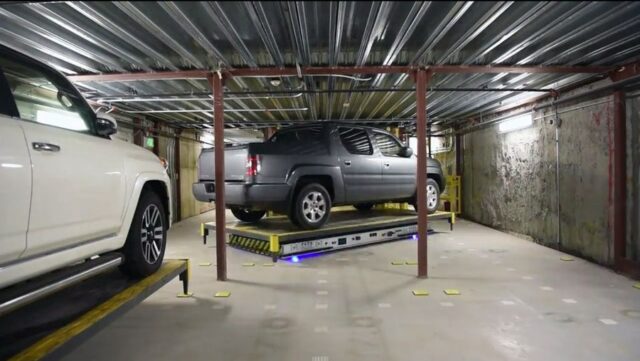
Developers Anchor Line Partners and JLL are installing 235 automated spaces as part of their renovations to Boston’s 1 Post Office Square office tower. Photo by James Sanna | Banker & Tradesman Staff
The ever-rising cost of land and construction in Greater Boston is leading many developers to opt for automated parking garages in new condominium, office and mixed-use projects alike.
The majority of new parking garages being built or renovated today continue to be old-fashioned “drive-in, drive-out” structures with no sophisticated machines, hydraulic systems and AI programs required.
But technology that just 10 years ago seemed like something out of a sci-fi movie is starting to make inroads: automated parking systems that can move cars up and down, backward and forward, left and right, until they find an open space to park a car – or retrieve a vehicle at its owner’s command.
For these systems, no drivers are required. Just a smartphone app.
Condo Developers Blaze a Trail
The technology has actually been utilized, in one form or another, in Europe since the early 2000s.
But it’s only been sporadically deployed in Boston over the past five years or so, such as at the Boulevard condos at 110 Broad St. in downtown Boston, where 48 spaces are now automated, and the 214 Market St. condos in Brighton, where more than 30 spaces are automated.
But later this year, one of the region’s largest private automated-garage systems is scheduled to open at One Post Office Square, where developers Anchor Line Partners and JLL are installing a 235-space “fully automated” parking system as part of the major renovation of the downtown office high-rise.
“We reviewed a number of [parking] options and we decided this was the best way to go,” said Ben Heller, executive managing director at JLL. “The system we’re installing is much better for users. It’s easier. It’s faster. It’s safer.”
And there are other large automated-garage systems on the way in the region, tied to residential projects, such as 50 spaces at City Realty Group’s under-construction 50 Leo Birmingham Parkway condo project in Brighton and another 150 spaces at Allston Square. City Realty previously installed the automated-parking system at 214 Market St. in 2018.
Cliff Kensington, director of acquisitions at City Realty, said automated parking garages have definitely come of age, at least in urban areas in Greater Boston.
“They’re almost at the point of being ubiquitous,” he said. “They’re more accepted these days.”
Developer New Boston Ventures opted for an automated parking system for 48 vehicles at its Boulevard condo project in Boston. Photo courtesy of Commodore Builders
Low-Cost Option ‘Like Tetris’
Two types of automated garage systems are competing for developers’ business: fully automated and semi-automated, with the latter systems also known as “puzzler” or “stacker” systems.
The fully automated system is generally more complex and aimed at larger garages, such as those at One Post Office Square and 110 Broad St.
In fully automated systems, residents and visitors drive their cars into “entrance” compartments. Cars are left on top of platforms, or “trays,” via elevated, and lifted to different floor levels of a garage. The cars are then zipped around on automated “sleds,” which are equipped with digital sensors to avoid collisions, to various empty spaces, where they’re parked and later retrieved.
“Drivers don’t see where their cars are going,” said Art Stadig, senior vice president of Walker Consultants, a parking consulting firm in Boston. “In a fully automated system, it’s all hidden behind a screen, if you will.”
Semi-automated systems aren’t as technically sophisticated, and usually are designed with three or four cars parked next to each with built-in spaces directly above them – thus the “stacker” nickname. At least one space is always kept empty – and the AI software system moves cars around, up or down, left or right, on platforms until it “finds” an empty space to put a car.
“It lifts and slides cars around, like a puzzle,” said Rob Law, a project manager and associate at Finegold Alexander Architects, which has helped design a number of projects that have included automated parking-garage systems. “It’s sort of like playing Tetris.”
Unlike a fully automated system, a person using a semi-automated system can view the automated parking and retrieval processes as they unfold. Both systems are controlled by sensors, remote control or by simple smartphone apps.
Below-Grade Bargain Proposition
Car parking and retrieval times depend on the size of the system. Semi-automated systems can take anywhere from 20 to 45 seconds, according to industry executives. Fully automated systems can take about five minutes, depending on the size of a garage.
To save themselves time, car owners can use phone apps to launch the retrieval process minutes before they arrive at a garage.
Park Plus, Robotic Parking, Unitronics and Wohr are some of the major automated-parking system makers, according to Stadig at Walker Consultants.
From a developer’s standpoint, the main benefit of either a fully automated or semi-automated system is its cost. A fully-automated system can run $65,000 to $100,000 per space, depending on the size of a garage. A semi-automated system can cost anywhere from $20,000 to $40,000 per space.
With costs rising ever higher for land and excavation for underground parking garages, the price of non-automated underground spaces can now reach $100,000 or more per space in a tight urban setting. So, the cost benefits of automation are obvious.
Peter Vanko, founder and principal of Vanko Studio Architects, said it’s all about the economics when it comes to automated parking garages in largely urban areas.
“People are desperate for space,” he said.
Vanko’s firm is the designer of a proposed 24-unit apartment building at 38 Hichborn St. in Brighton, where eight “puzzler” parking spaces will be installed. The Boston Planning & Development Agency approved the project on Feb. 10.
One other advantage of automated parking systems: Since platforms are already electrified, they can easily be outfitted with battery recharging outlets to handle electric cars of the future.
“They can easily incorporate electric outlets,” said City Realty’s Kensington. “Adapting them to electric cars is no problem.”