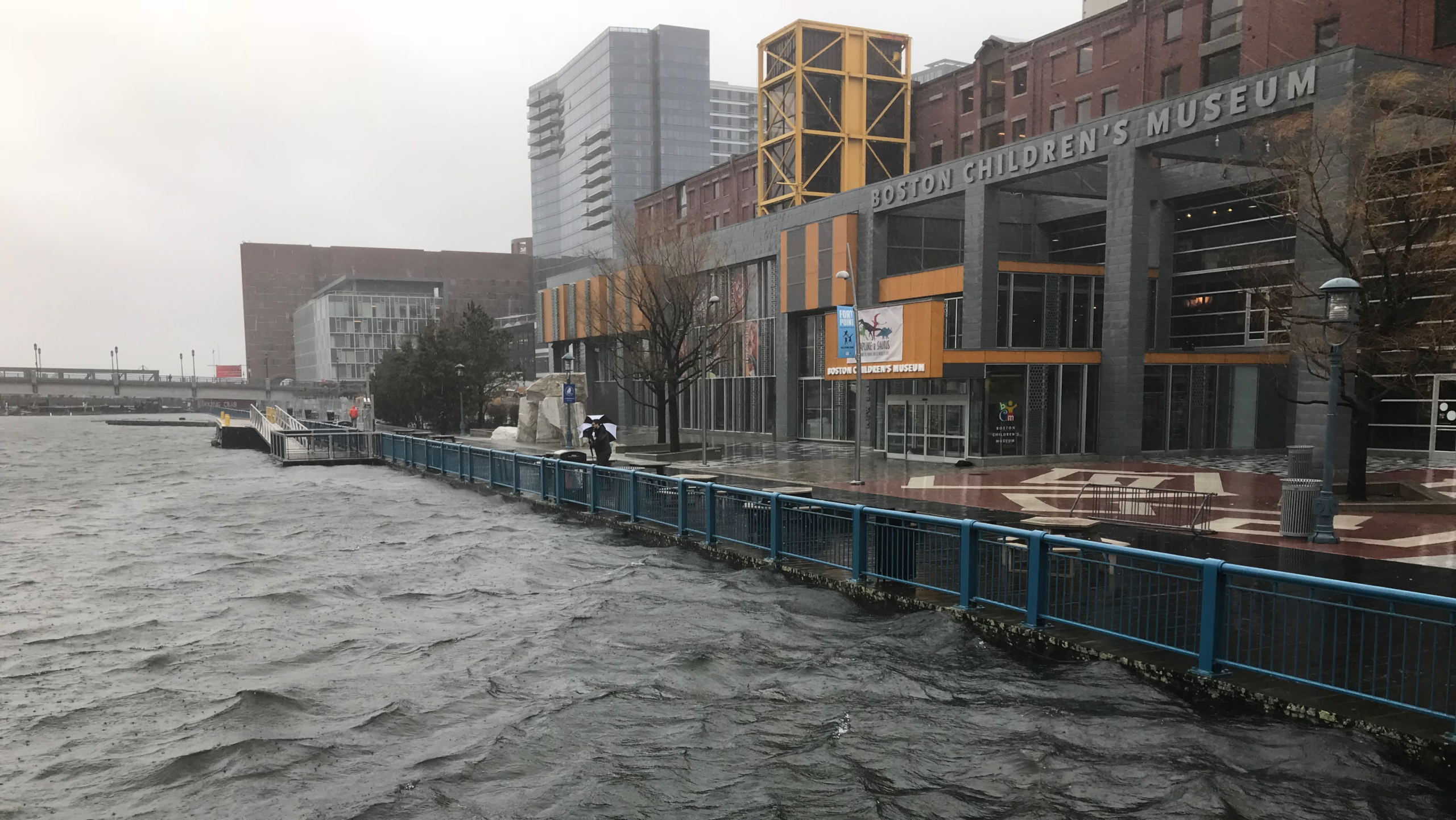
A 2018 coastal storm combined with high tides to flood the Boston Children’s Museum’s entrance, setting in motion a $15 million resiliency projects. Photo courtesy of Boston Children’s Museum
As she sought donations for a nearly $15 million coastal resiliency project, Boston Children’s Museum CEO Carole Charnow got a consistent set of replies from local philanthropies.
“Why don’t you move?”
“Why doesn’t the city and state pay for that?”
“How are we going to fund you when everybody else is going to be asking us?”
Relocating the museum wasn’t a practical solution, given its prime Seaport District location that provides convenient access to visitors from a wide region, Charnow said.
But their questions pointed to the magnitude of threats facing waterfront property owners in Boston, who have dodged potentially devastating flooding in coastal storms over the past decade. The city and federal governments’ long-term solution – a massive storm barrier along the waterfront – isn’t expected to begin construction until the 2030s at the earliest.
In the meantime, property owners such as the museum and New England Aquarium are investing in short-term flood-proofing projects and watching the weather forecast with a wary eye.
“It did take a while to talk people into” private donations, Charnow said. “What tipped it was they started to see the detailed plans come to life and see that this is achievable.”
A $7 million gift from the New Balance Foundation pushed the project over its fundraising target.
Construction began on the first phase this month, designed to protect lower levels of the 1888 converted warehouse in Fort Point that’s served as the museum’s home since 1979.
“We have gotten so far ahead on this, we are considered a demonstration project by the city and state of how buildings can protect not only themselves, but also their neighbors,” Charnow said.
A Bomb Cyclone Wake-Up Call
The museum hired Boston-based design firm Sasaki after close calls with nature in the previous decade. Fort Point Channel spilled over the Boston Harborwalk in front of the main entrance during a 2018 coastal storm. Flood water flowed behind the museum on Sleeper Street into a crawl space.
Although the museum was spared major damage, an anonymous donor provided seed funding for a master plan, laying the groundwork for the construction that started this summer. Years of fundraising ensued, led by Charnow and staff.
“It was a warning sign that we were vulnerable, that we had to do something,” Charnow said.
The current construction includes installation of a synthetic rubber membrane elevated more than 4 feet along the building base to prevent flood waters from entering the basement on the Sleeper Street side. It coincides with a city-sponsored project converting Sleeper Street into a one-way street with wider sidewalks.
Next year, critical mechanical equipment will be relocated to higher floors. And a cistern will be installed in a current loading dock area, with capacity to store 2,507 cubic feet of flood water and gradually drain it back into the channel.
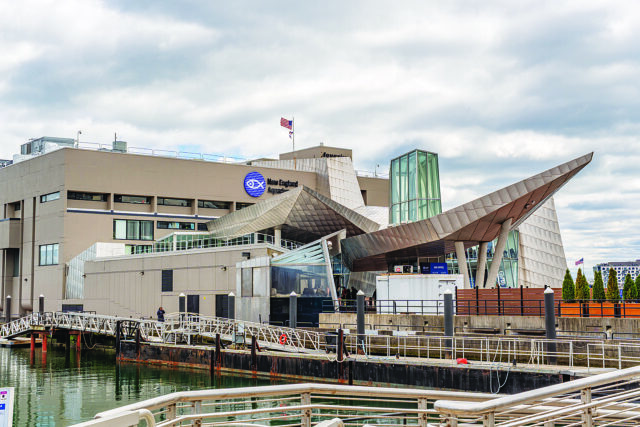
The New England Aquarium, shown here in 2025, is spending $8 million to protect itself from a harbor that’s expected to rise 40 inches by 2070. iStock photo
The project also required Landmarks Commission approval for alterations to the building exterior.
“We got support from the Fort Point neighborhood,” Sasaki Associate Principal Marta Guerra-Pastrian said. “If we don’t protect these neighborhoods, there is not going to be a building to protect.”
A future phase, also designed by Sasaki, would create an elevated berm and living shoreline in place of the boardwalk that runs between Congress Street and Seaport Boulevard. The project could double as an outdoor classroom for climate education, Charnow said.
Designs are still in the preliminary stages, and will be integrated with plans for the city-owned Martin’s Park playground located directly to the north and other district-wide defenses that could be included in an Army Corps of Engineers-led project to protect the entire harbor.

Steve Adams
Aquarium Takes Stock of Vulnerabilities
Another nonprofit that attracts over 1 million annual visitors to Boston is paying its own freight for immediate resiliency projects.
The New England Aquarium is spending $8 million to protect its Central Wharf facility, which is hemmed in on three sides by harbor waters that are expected to rise approximately 40 inches by 2070.
“We’re in the center of climate change and flooding and king tides, so this isn’t something new for us,” said Kimberly Fontes, the Aquarium’s chief of staff and business operations.
Past flooding had corroded a steam pipe that delivers Vicinity Energy steam heat to the property and its marine life exhibits, and had to be replaced last December. This year, basement HVAC systems are being elevated to the rooftop. In the past year, the Aquarium acquired deployable flood barriers that can be moved into place ahead of major storms.
“We look at risk levels. What are the highest risks?” Fontes said. “The steam pipe rose to the level of a project that needed some immediate attention.”
The Aquarium is reviewing the proposed path of the Army Corps of Engineers’ flood barrier, during a public comment period which expires Sept. 18, to ensure that the public sector’s response to resiliency matches its own plans. It’s updating its own campus master plan to reflect the latest climate and flood risks.
“We feel strongly about that. This is a community-wide project,” Fontes said. “It can’t be just us alone.”