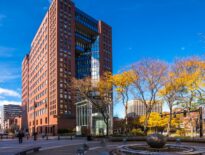
Image courtesy of Stantec
After nearly a year as homebound office workers, few can deny the importance of engaging with our colleagues in an office, lab or research setting to spark more ideas, foster strategic thinking, encourage mentoring and drive projects forward.
However, what’s less understood is how the workplace environment and location are equally impactful. We are clearly moving away from the days workers were sequestered into office-only districts like downtown high rises, office parks or isolated life sciences clusters.
So, why are companies rethinking where they want their life sciences operations? The answer is clear: competition for talent. In both urban and suburban environments, dynamic neighborhoods are a major new draw in the race for talent. This shift has prompted the evolution of Boston’s most historic neighborhoods, like the South End.
Primarily known as a residential neighborhood dotted with historic brownstones, the South End is also home to cultural institutions, art galleries and an outstanding culinary scene, from the beloved and informal Flour Bakery + Café on Washington Street to destination restaurants like Coppa and Toro run by the James Beard Award-winning duo of Ken Oringer and Jamie Bissonnette. The neighborhood has long been a beacon of diversity and inclusion, known for welcoming the LGBTQ+ community.
Now the South End is evolving once more, this time as a new cluster for the life science industry, representing a significant change from many of Boston’s other hubs for scientific innovation. Most were drawn to relatively unoccupied locations without the established infrastructure, culture and community prevalent in South End.
Capital Infusion Drives Expansion
Venture capital funding for life sciences companies increased by 61 percent in 2020, with 28 percent of all therapies in development across the U.S. located in Greater Boston. The number of biotech companies essentially doubled in the past decade and, in the last five years alone, regional employment at biotech research and development companies has grown by 54 percent according to an estimate by EMSI. All those companies need smart, creative and driven employees of all types.
To attract and retain the brightest employees – not just those responsible for groundbreaking new therapies, but also those supporting the sales and marketing, regulatory, manufacturing and other needs – life sciences companies want to be where the action is. Employees want a quick commute (by walking or public transit) to work, easy access to amenities like dining, art and culture, as well as the capacity to mix and mingle with employees from other sectors.
Exchange South End exemplifies this new way of thinking about what makes a successful life sciences district. The first Boston life sciences community of its kind to spring up in a thriving residential and cultural scene, it is a stone’s throw to robust academic medical infrastructure for idea transfer and partnerships. In fact, six of the top 13 NIH-funded independent hospitals in the U.S. are within 2 miles of the site. And with easy access to Interstate 93 and the Massachusetts Turnpike, as well as the Back Bay commuter rail station, more than 49,500 life sciences professionals are within a 60-minute commute to the site.
Neighborhood Is a Hub

Matt Daniels
Both in its location and its collaboration-focused design, Exchange South End is a hub for connection. But what makes the campus most unique is the character and fabric of the South End neighborhood with its vibrant entertainment and cultural scene. The area offers a diverse selection of restaurants, art galleries and markets as well as walkability and accessibility to both the MBTA and major highways. The South End is well-poised and organically built to serve the region’s most talented, creative and diverse companies.
Exchange South End infuses its campus with the character of the neighborhood by incorporating features not typically found on life science campuses, but are crucial for community. A children’s playground, water play fountains, comfortable furniture, warm nighttime lighting and food trucks make the space welcoming to everyone, whether they work in the buildings, live in the neighborhood or are just visiting. The highly urban ground floor will offer cafes, restaurants, outdoor events and seasonal programming.
Exchange South End embodies the future of life sciences development, building on the strengths of an established neighborhood and incorporating a new, cutting-edge element of life science innovation.
Matt Daniels is brokerage lead and executive managing director for JLL Boston.