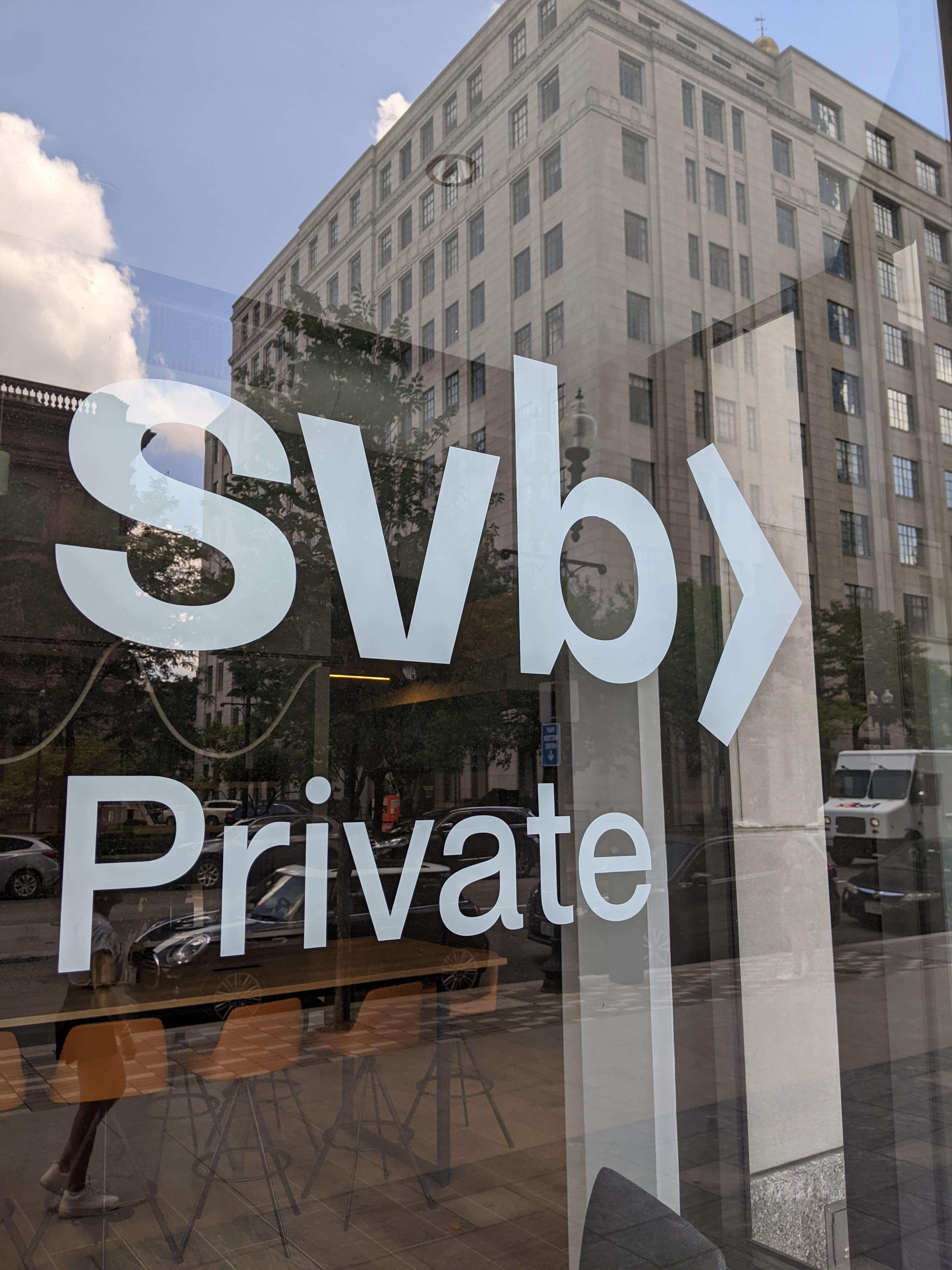
The offices of SVB Private, as Boston Private Bank & Trust was rebranded following its purchase by Silicon Valley Bank, in Boston's Back Bay. Banker & Tradesman file photo
Editor’s Note: The FDIC sized Silicon Valley Bank shortly after this story was published. Please follow coverage of that news here.
Stocks are dropping Friday as worries about the banking system outweigh a highly anticipated report that showed pay raises for workers are slowing and other signals that Wall Street wants to see of pressure on inflation cooling.
The S&P 500 was 0.8 percent lower in early trading, a day after it tumbled to one of its worst drops of the year. The Dow Jones Industrial Average was down 162 points, or 0.5 percent, at 32,091, as of 9:44 a.m. Eastern time, while the Nasdaq composite was 1.1 percent lower.
The sharpest drops in the market were coming from the financial sector, which tumbled sharply for a second day.
The stock of SVB Financial, a $212 billion-asset Silicon Valley bank that caters to the industry surrounding startup companies, has plunged more than 60 percent this week as it raises cash to strengthen its financial position. That has led to some concerns that a broader banking crisis could erupt. Trading in SVB’s stock was halted Friday morning. SVB bought then-$9 billion-asset Boston Private Bank for $900 million in 2021, rebranding the local bank’s offices as “SVB Private” and giving it a major presence in the startup-heavy Boston region.
As the Fed raises its benchmark interest rate, the value of bonds, typically a stable asset, are starting to fall. That is not typically a problem as the declines lead to “unrealized losses,” or losses that are not counted against them when calculating the capital cushion than banks can use should there be a downturn in the future.
However, when depositors grow anxious and begin withdrawing their money, banks sometimes have to sell those bonds before they mature to cover the exodus of deposits.
“We envision a need for another large-scale sale of securities from its [held-to-maturity] portfolio, if rates move materially higher than the current forward curve implies,” Raymond James analyst David Long said about SVB in a note to clients.
Larger banks do not face the same level of threat, but the falling value of bonds can impact their margins. That has helped drive the sector lower this week.
Diversified banks like Bank of America and JPMorgan pulled out of an early slump due to data released Friday by the Labor Department, but regional banks, particularly those with heavy exposure to the tech industry, were in decline.
‘Crashy Vibes of March’
Friday’s losses amplify what strategists in a BofA Global Research report called “the crashy vibes of March.” Markets have been twitchy recently on worries that high inflation is proving too difficult to drive down, which could force the Federal Reserve to reaccelerate its hikes to interest rates.
Such hikes can undercut inflation by slowing the economy, but they also drag down prices for stocks and other investments and raise the risk of a recession later on. Wall Street already in February gave up hopes that cuts to interest rates could come later this year. Worries then flared higher this week that rates are set to go even higher than expected after the Fed said it could soon upshift the size of its rate hikes.
But Friday’s jobs report helped calm those worries. Overall hiring was hotter than expected, which could be a sign that the labor market remains too strong for the Fed’s liking despite the fastest set of rate hikes in decades.
But the data also showed a slowdown from January’s jaw-dropping hiring rate. More importantly for markets, average hourly earnings for workers rose by 0.2 percent in February from January.
That was a slowdown from January’s 0.3 percent gain, and it was lower than the 0.4 percent acceleration that economists expected. This number is crucial on Wall Street because the Fed has said it’s focusing on wage growth in particular in its fight against inflation.
While raises are good for workers struggling to keep up with inflation, the Fed worries too-high gains could cause a vicious cycle that worsens inflation.
Labor Market Cooling, Still Resilient
Among other signs of a cooling but still-resilient labor market, the unemployment rate ticked up to 3.6 percent from 3.4 percent and the percentage of Americans with or looking for jobs edged up by a tiny bit.
Another potential sign of easing inflationary pressure is that “we’re no longer seeing the massively widespread job gains,” said Brian Jacobsen, senior investment strategist at Allspring Global Investments. “Gains are getting more concentrated and that’s an early signal that the labor market momentum is fading.”
Such trends mean traders are swinging back their bets for the size of the Fed’s next rate increase. After earlier in the week thinking the central bank would reaccelerate and go back to a hike of 0.50 percentage points later this month, traders are now betting on a a 65 percent probability that it will stick with a more modest 0.25 point hike.
Last month, it slowed to that pace after earlier hiking by 0.50 and 0.75 points.
The expectations, along with continuing market jitters, helped send Treasury yields sharply lower.
The yield on the 10-year Treasury sank to 3.75 percent from 3.91 percent late Thursday, a sharp move for the bond market. It helps set rates for mortgages and other important loans.
The two-year Treasury yield, which moves more on expectations for the Fed, plunged to 4.63 percent from 4.87 percent. It was above 5 percent earlier this week and at its highest level since 2007.
AP staff writers Joe McDonald and Matt Ott contributed to this report.