Greater Boston housing advocates are hoping to hold the line on recent wins while at least one city is seeing a backlash from zoning changes. iStock photo
Politics and real estate have long been intertwined, but seldom as directly as in the choices that voters face in the ballot box next month.
Debates over housing density and multifamily development are paramount in many local elections in Greater Boston, prompting activists to step up their advocacy and fundraising.
Abundant Housing Massachusetts, also known as AHMA, is endorsing candidates that share its policy goals of increasing housing production. The group has made endorsements in Boston, Medford, Newton, Salem, Somerville and Worcester, all cities where it has affiliate groups that are active in local politics, Executive Director Jesse Kanson-Benanav said.
“In a lot of these communities, MBTA Communities compliance and zoning has elevated the conversation around land-use policy,” Kanson-Benanav said.
And lingering debates over citywide rezoning in Cambridge and Medford are dominating the public conversation leading up to Nov. 4.
In Cambridge, 19 candidates are seeking seats on the City Council, some promising to roll back the historic citywide rezoning approved in February.
Advocates’ Aim: Keep Cambridge Upzoning
A Better Cambridge, a pro-housing production group, is seeking to safeguard the legislation by supporting a slate of eight candidates. It made the selections after distributing a candidate questionnaire on housing issues.
“Housing is always the most important issue in Cambridge elections,” said Justin Saif, a co-chair of A Better Cambridge. “The city does an annual survey and it always shows that housing affordability is the number one issue for Cambridge residents.”
Its fundraising arm, A Better Cambridge Independent Expenditure Political Action Committee, has raised $17,396 since Jan. 1 and spent $1,372, according to its campaign finance report.
The PAC has concentrated on door-knocking campaigns and distributing fliers at MBTA stations, and plans a direct mailing, campaign chair Neil Miller said.
“Sometimes participation in local elections can be low, and it’s especially true for people who are most impacted by the housing crisis: people who moved here recently, people looking for affordable housing, renters and students,” Miller said. “Our goal within the campaign is to reach people who may have been less likely to vote, but may understand the stakes of the housing crisis.”
The group has set a target of knocking on 10,000 doors this year, Miller said, distributing information on voter registration and recent policy changes that encourage multifamily development. It limits individual donations to a maximum of $500.
A PAC affiliated with the Cambridge Citizens Coalition raised $3,411 and spent $7,547 between Aug. 31 and Sept. 30, according to its finance report.
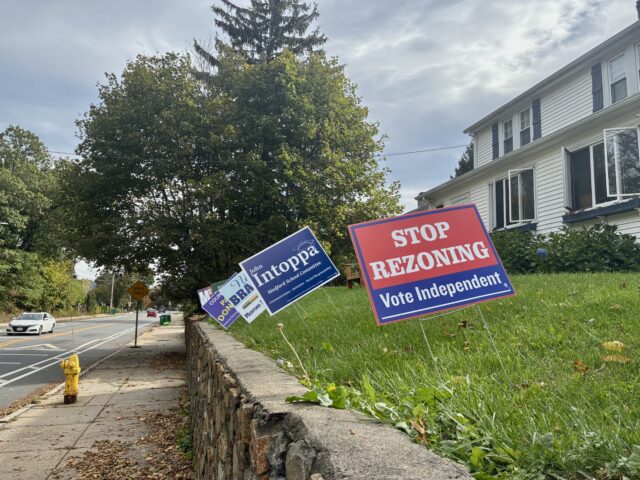
Debates over land-use policy, including a citywide rezoning proposal in Medford, have emerged as a dominant issue in this year’s local elections. Photo by Steve Adams | Banker & Tradesman Staff
Council Votes Not the Final Word
After passage of a landmark rezoning plan in Cambridge this year, both housing production advocates and opponents of additional density are preparing for future battles.
In February, the Cambridge City Council voted to allow 4- to 6-story apartment buildings across the city on parcels which meet certain dimensional requirements. The Cambridge Citizens Coalition, which fought the cityside rezoning, has endorsed seven candidates this fall.
“If some of the challengers are elected, we certainly will be amending the multifamily housing ordinance,” said incumbent City Councilor Catherine Zusy, the only councilor to vote against the rezoning.
Zusy said she will push to roll back the maximum 6-story building heights for projects containing at least 20 percent income-restricted units, and increase the minimum 5,000 square-foot lot sizes for multifamily buildings.
A Better Cambridge, for its part, is eyeing additional policy changes related to zoning and housing production.
Some officials have sought to limit the power of neighborhood conservation district commissions, which currently have the power to block demolition of buildings they deem historic.
The City Council also is expected to take up rezoning proposals allowing greater density along Massachusetts Avenue from Cambridge Common to the Arlington line, and in Porter Square, Saif noted.
AHMA has endorsed seven candidates in Salem, a city which has adopted progressive housing strategies. Last month, Mayor Dominick Pangallo signed an ordinance eliminating parking minimums for multifamily developments with three or more units.
Following recent reforms such as legalization of triple-deckers in Somerville, discussions are starting to percolate about additional density, AHMA’s Kanson-Benanav said. In Newton, housing activists are evaluating whether the current MBTA Communities rezoning has been effective.
“The results thus far have been very minimal,” he said.

Steve Adams
A Backlash in Medford
AHMA has endorsed five candidates in Medford, where opposition to a rezoning proposal may have shaped the results of a preliminary election last month.
After topping the 2023 City Council ballot, incumbent Council President Zac Bears finished ninth in the Sept. 16 preliminary election. Bears had supported a proposal to eliminate single-family zoning in large portions of the city, a process which was placed on hold in July.
Six of the seven incumbent city councilors were endorsed by the progressive Our Revolution group founded by U.S. Sen. Bernie Sanders. None finished in the top three in the preliminary election.
George Scarpelli, the only incumbent councilor who is not an Our Revolution member, topped the ballot.
“The rezoning is the number one concern of all of our residents, and the direction we’re going right now,” Scarpelli said. “My six other colleagues are looking to drive density and force single-family neighborhoods out of the fabric of our community, and it’s frightening.”
Two other non-Our Revolution-endorsed candidates rounded out the top three, including former Council President Rick Caraviello, who called zoning “the third rail of Medford politics.”