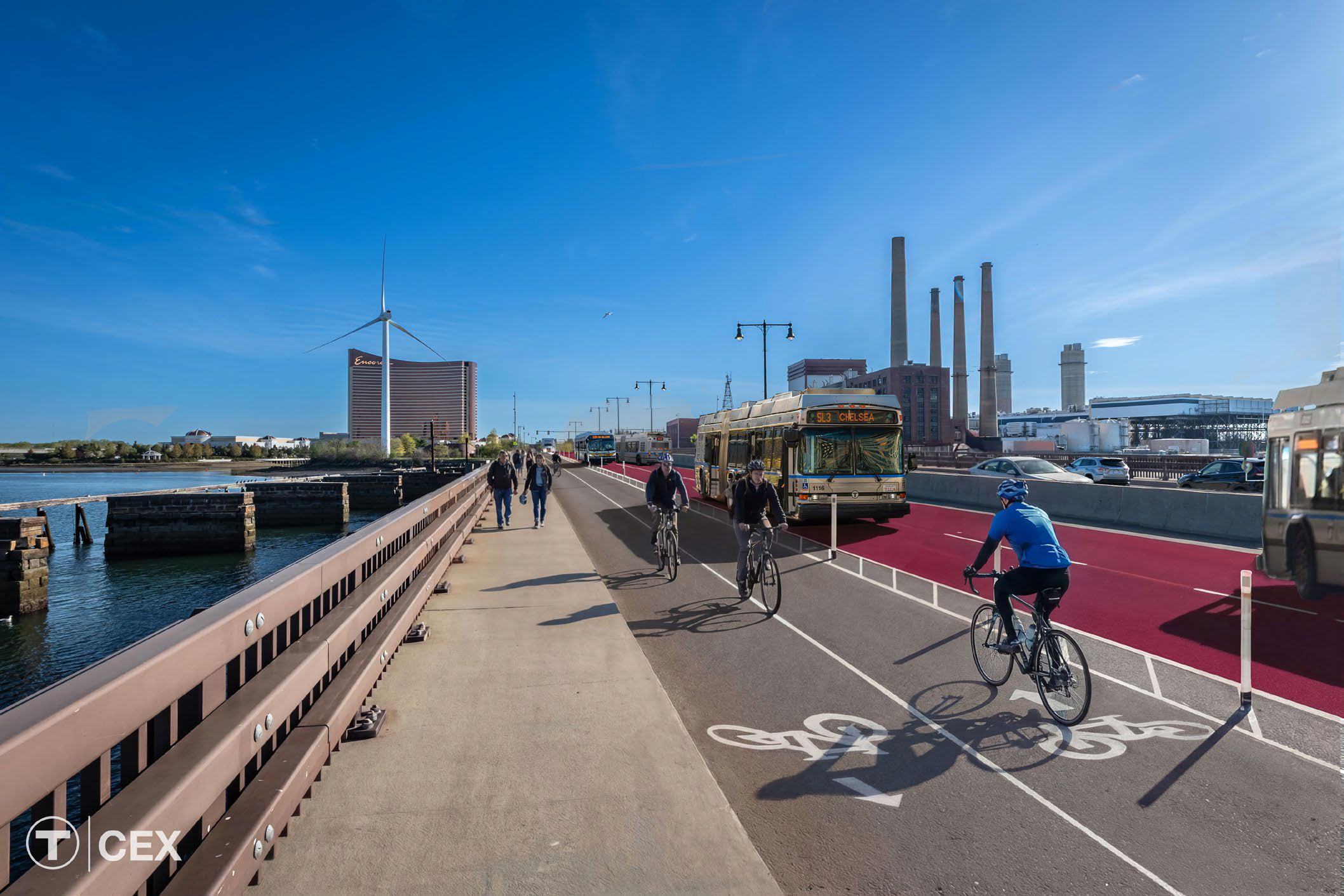
The MBTA is in the early stages of planning dedicated bus lanes between Sullivan Square, the proposed Revolution stadium and points north. Image courtesy of the MBTA
The Kraft Group’s New England Revolution stadium will be a litmus test of recent Massachusetts laws that set a higher standard for developments in areas with significant minority populations and legacies of pollution.
Environmental organizations are asking for iron-clad commitments from The Kraft Group to pay for public transit upgrades that reduce vehicle use and emissions.
“This project does have potential to bring benefits, but it really needs to be built responsibly,” said Paulina Muratore, director of transportation justice and infrastructure at Boston-based Conservation Law Foundation. “The transportation, by far, is what has caught the public’s attention. Communities need more than just assumptions. If the project’s viability requires people to arrive by transit, they need to show their work through enforceable commitments.”
As the project heads to a key state permitting stage, CLF and other organizations are seeking specifics on how up to 25,000 MLS fans per game will safely access the 20-acre site at 173 Alford St. on the Everett waterfront with virtually no on-site parking.
Boston Harbor Now asked developers to work with the Massachusetts Water Resources Authority on a new water transportation hub that could upgrade ferry service to Boston and the South Shore. The ferry terminal could be built at the MWRA’s Alford Street sewer pumping station, which was decommissioned in 1993, and sits next to the stadium site.
Beyond serving the stadium, such a project could ease congested commutes from the northern suburbs, Boston Harbor Now CEO Kathy Abbott said.
“To have a gateway on that side of the river is a really exciting opportunity to bring back some of the water transportation and ferry access that existed back in the day,” Abbott said. “And people will take it. The transportation challenges are so significant, anything we can do to spread the load and get people out of their car, and even out of the trains, would be a big addition.”
Assessing EJ Population Impacts
The review of the stadium takes place under a state climate law enacted in 2021, which requires a more rigorous study of developments in environmental justice, or EJ population communities. Defined by income levels, minority populations and percentage of non-English speaking households, the EJ criteria means the Everett site qualifies.
Many EJ communities are located in areas with high levels of air pollution tied to nearby highways, airports and other emissions sources. Childhood asthma rates are elevated in Boston, Chelsea, Everett and Somerville, four of the five EJ communities in the stadium study area, according to information submitted by The Kraft Group in its environmental notification form to the Massachusetts Environmental Policy Act [MEPA] office.
Since the changes took effect, MEPA reviews can demand air quality monitoring and detailed neighborhood-level data on pollution, CLF’s Muratore said.
The Kraft Group’s air quality analysis should include projected emissions not only from the stadium, but nearby developments such as The Davis Companies’ Docklands district and the Encore Casino’s East of Broadway project, Secretary of Energy and Environmental Affairs Rebecca Tepper wrote in a June 22 document spelling out the scope of the MEPA review.
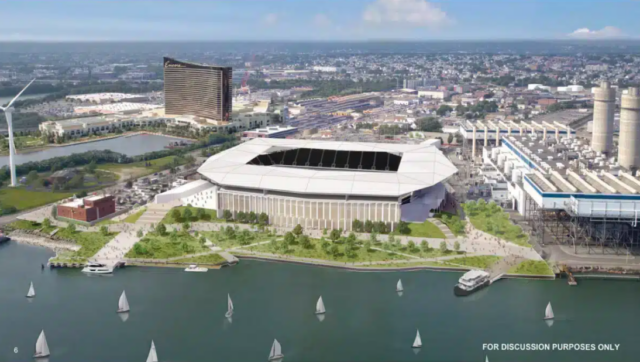
The Kraft Group’s Everett stadium needs to clear permitting hurdles designed to minimize the effects of developments on environmental justice community populations in Massachusetts. Image courtesy of The Kraft Group
Tepper Wants ‘Definitive’ Stadium Plans Aired
CLF, Boston Harbor Now and other local organizations submitted comments to the Massachusetts Environmental Policy Act office as The Kraft Group prepares to submit an environmental impact report [EIR] to the agency.
Developers hope to complete the stadium by late 2029, replacing the MLS team’s home pitch at Gillette Stadium in Foxborough.
But first, Tepper has to sign off on developers’ mitigation plans to deliver thousands of visitors to the former Mystic Generating Station power plant property. The 821,000 square-foot stadium could attract up to 35,000 patrons for larger events such as concerts, according to application documents, and up to 25,000 for sporting events.
In a June 22 document spelling out details that The Kraft Group needs to document in the EIR, Tepper noted a “lack of definitive site plans and information” on the project’s effects and mitigation. Tepper called upon developers to hold a well-publicized public meeting before filing their EIR.
The meeting should present “definitive site plans and quantitative/concrete assessment of impacts, rather than conceptual level information,” Tepper wrote.

Steve Adams
Rubber Meets the Road
Enhanced MBTA and shuttle bus services will be necessary to accommodate stadium visitors, CLF’s Muratore said. Pedestrian infrastructure upgrades are needed, particularly from Sullivan Square to the stadium.
The MBTA is also in the early stages of planning dedicated bus lanes between its Sullivan Square Orange Line station, the stadium and points north. That would serve existing MBTA bus routes, as well as a mooted extension of its Silver Line service between the Seaport, Logan Airport and Chelsea.
“The next phase is really where the rubber meets the road. The draft EIR needs to provide a detailed transportation plan, not just assumptions which we saw in the first round,” Muratore said.
Echoing CLF’s written comments, Tepper noted in the June 22 letter that potential off-site parking “may instead shift traffic to satellite parking locations and surrounding neighborhoods.” She instructed The Kraft Group to specify parking locations and contracts with property owners in its EIR.
Boston Mayor Michelle Wu reached an agreement with The Kraft Group on a 15-year, $48 million community benefits agreement last December. The agreement includes $5 million for upgrades to roads, sidewalks, bike paths and transit in Charlestown before the stadium opens, and $5 million for a transportation infrastructure fund over 15 years.
In a MEPA comment letter submitted in June, Boston Chief of Planning Kairos Shen also focused on transportation impacts. Boston supports expansion of MBTA bus operations as opposed to private stadium shuttles to handle game day passenger surges, Shen wrote. He also asked developers to specify how their transportation plan ties into the MBTA’s Silver Line extension project.