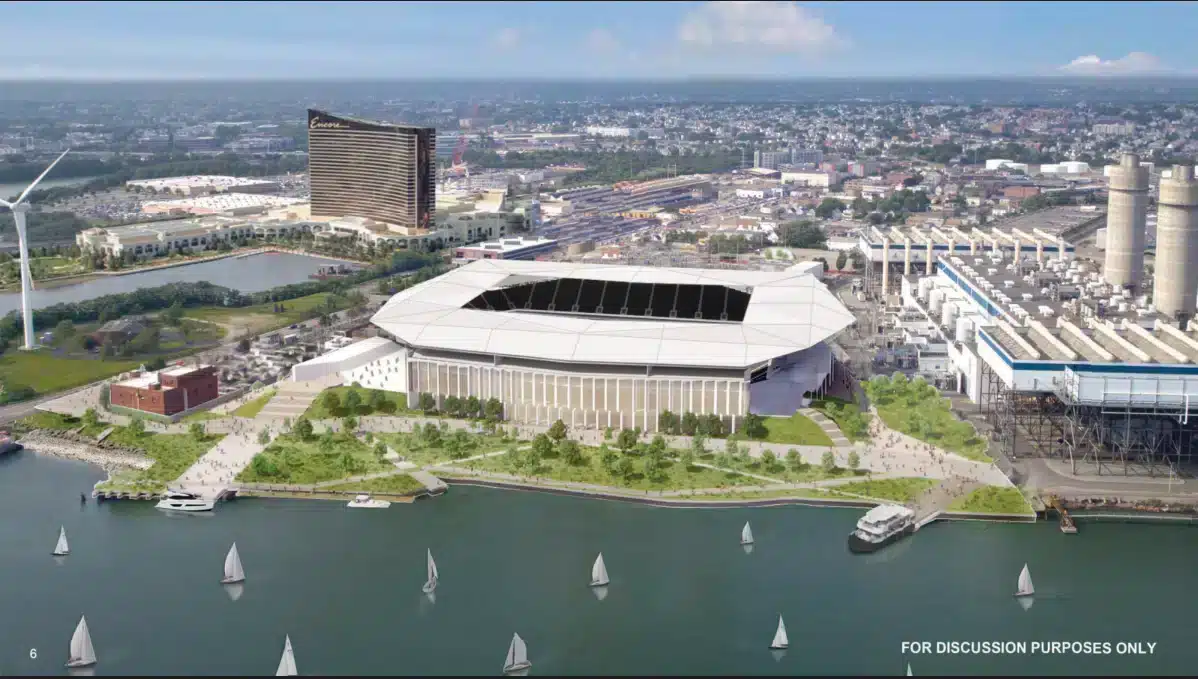
Major real estate proposals on the Lower Mystic River include The Kraft Group's New England Revolution soccer stadium. Image courtesy of The Kraft Group
As the threat posed by rising seas becomes more apparent, Urban Land Institute of Boston/New England has helped surface development strategies that can resist flood waters and storm surges.
Its upcoming “Living Better: Regenerative Design for People and Environment” study is taking that work a step further in adding ideas that, it claims, can restore the environment in the Lower Mystic River basin.
“When you look at the lower Mystic River and specifically Everett and Chelsea, you see a once-in-a-generation opportunity for redevelopment,” ULI Boston/New England Director Catherine Rollins said.
Vast sections of the historically industrial Lower Mystic are in play for large real estate projects in coming years. The Davis Companies has proposed a large mixed-use development on the 100-acre former ExxonMobil tank farm property in Everett, while The Kraft Group is pursuing plans for a New England Revolution professional soccer stadium at the former Constellation Energy power plant property in Everett. And The Flatley Co. has proposed a 1.8 million-square-foot redevelopment of the old Domino Sugar refinery across the river in Charlestown.
The ULI report – scheduled for completion this winter – does not focus on specific properties, Rollins said. It will include “regenerative design” strategies that not only limit the effects of development, but restore ecosystems and communities.
Researchers have studied precedents such as the Living Breakwaters project, which includes 2,400 feet of partially submerged breakwaters installed off the coast of Staten Island, Rollins said.
In 2019, ULI released its “Living With Water” report that included potential coastal resiliency strategies for vulnerable neighborhoods in Greater Boston.
This latest ULI study focuses on the Lower Mystic River sections of Chelsea and Everett, and includes the role of design in driving social equity in environmental justice communities.
Replacement of traditional landscaping with pollinator gardens can restore ecosystems and enhance neighborhoods’ ability to grow produce for sale at local businesses, Rollins said. The report also studies opportunities to expand renewable energy and generate potable water sources, and add jobs in the green economy.
“This is a relatively new concept, and that’s partly why we are doing this project,” Rollins said. “We want to have an impact, and it could serve as a national resource.”