A “waterfall” design element on the façade of EF Education First’s Cambridge office building contains 394 pieces of glass arranged into 42 panels, the largest spanning nearly 900 square feet. Photo courtesy of Skanska
Three years ago, Boston Mayor Martin J. Walsh called on the real estate community to create more architecturally impressive buildings in Boston. Interesting buildings help attract and retain talent because they speak to a company’s brand and culture, often have significant sustainability and flexibility benefits, and improve the aesthetic of the public realm.
Well-known facades, such as Novartis’ stone veil, EF Education First’s waterfall and 121 Seaport’s elliptical design, all require an immense amount of technology, innovation, coordination, safety techniques and planning to become reality.
To complete these complex projects, construction teams and subcontractors must plan early, work close together on execution and safety procedures, potentially source materials from around the world, tap in-house innovation teams and dedicated subject matter experts to oversee constructability and quality control, and advance existing techniques.
Like most cities, Boston has a mix of eye-catching and cookie-cutter buildings. The most striking, memorable structures have provided us with opportunities to employ highly collaborative delivery methods and advance construction techniques, such as multi-trade prefabrication (MTP), up-down construction or using materials in untraditional ways, to move the industry forward and produce remarkable, lasting results.

Bryan Northrop
Novartis Mechanicals Assembled in Everett
At Novartis, we applied MTP, a method Skanska pioneered in Sweden nearly 15 years ago, to increase a project’s overall efficiency by bringing together all its subcontractors, engineers and consultants under a design-assist delivery. All project team members worked with BIM and 3D modeling and built the buildings’ overhead MEP systems and risers in a warehouse in Everett, while simultaneously sequencing delivery and installation at the site in Cambridge. This led to a 15 percent savings in labor cost and reduced onsite installation duration for the overhead MEP systems by 600 percent.
In traditional lab buildings, the primary focus areas are lab spaces, MEP systems and lab layout, but Novartis made a noticeable exception. Designed by architects Maya Lin and Toshiko Mori, Novartis’ facades push the limits of design and engineering. Novartis’ famous stone veil consists of a 23,000-square-foot hand-laid granite block wall that is 32 feet tall, features assorted openings that cover 30 percent of the block wall’s total surface area, and is cantilevered three feet off the face of a glass unitized curtain wall system. Rather than using traditional aluminum louvers, we cantilevered glass louvers with a copper mesh interlayer to manage solar glare and increase the building’s energy efficiency, while adding to the façade’s aesthetic.
Up-Down Construction at 121 Seaport
To deliver Skanska’s 121 Seaport development, which was 100 percent leased prior to completion, on an aggressive schedule, we implemented a technique called up-down construction. The building’s foundation and the excavation of its below-ground parking levels proceeds downward as its superstructure progresses upward. The well-choreographed process resulted in a six-month schedule savings when compared to a conventional bottom-up approach.
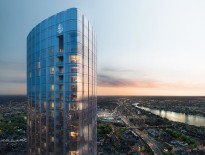
121 Seaport’s elliptical shape eliminates its interior columns, producing extremely flexible floorplans that will offer all occupants sweeping views of the harbor and the city. The design reduces the amount of solar heat gain and wind loads on the building, as well as the amount of shadow on surrounding public parks. 121 Seaport is the most sustainable building ever realized in the Seaport and together with 101 Seaport and Watermark Seaport, rounds off Boston’s most sustainable block.
EF Façade Reflects Company Culture
EF’s waterfall façade reflects its forward-thinking, innovative company culture. To construct the waterfall, which has a surface area of nearly 11,000 square feet, our team arranged 394 pieces of glass into 42 unique panels. The largest of the panels was nearly 900 square feet. We worked with specialty subcontractors who fabricated glass into various configurations and angles.
This process required a combination of scaffolding systems and advanced rigging techniques, in addition to advanced planning, collaboration and additional safety measures for site access.
There are countless reasons why visually interesting buildings are important to a given community – they add value to the public realm, are often more sustainable and efficient, and attract companies looking to differentiate themselves through branding. We’ve created and advanced new construction techniques and technologies to complete some of the most complex facades in the region. As the construction industry continues to push traditional boundaries, the Boston skyline will continue to become even more impressive.
Bryan Northrop is senior vice president at Skanska.