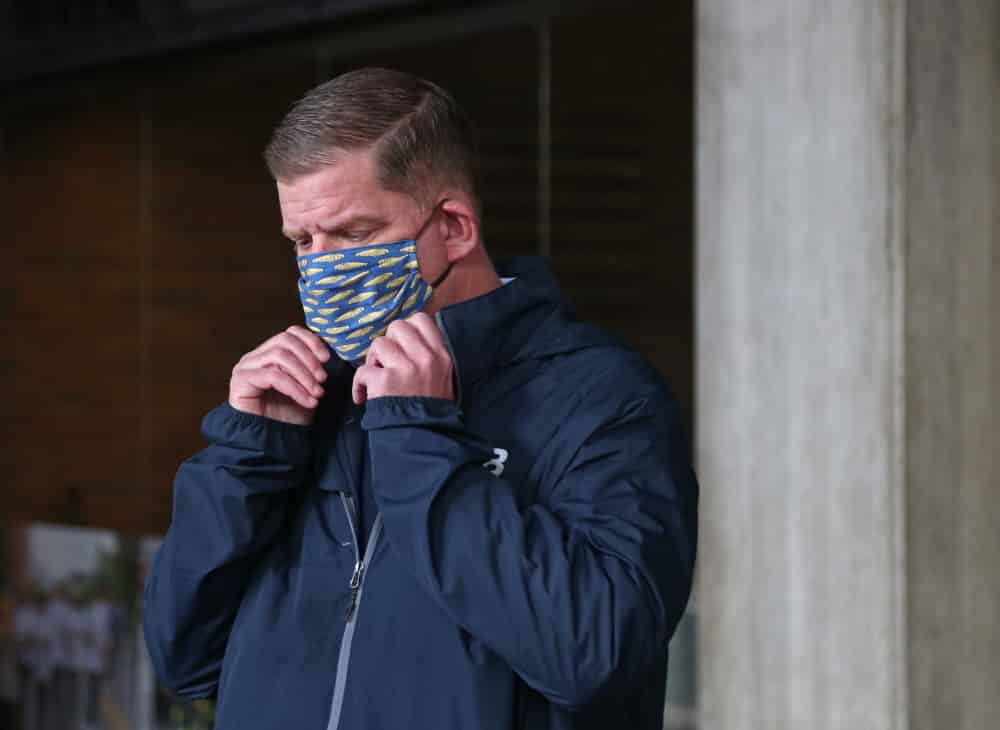
Boston Mayor Marty Walsh puts on a mask following an April 5, 2020 press conference at City Hall, Photo by John Wilcox | Mayor’s Office Photo
The state’s largest city will move into the highest-risk category when health officials release updated COVID-19 transmission statistics Wednesday evening and Mayor Martin Walsh said that a recent and sharp rise in coronavirus activity is due in large part to “irresponsibility.”
The positive test rate in Boston jumped in the last week from 2.7 percent to 3.5 percent, Walsh said Wednesday, and the average number of daily tests has dropped. The mayor said the capital city has not seen an increase like that “in quite some time” and is now dealing with “small outbreaks due to parties, due to college students, due to, quite honestly, irresponsibility.”
“I do get frustrated because here we are today laying down millions of dollars to open school, we have businesses on the verge of bankruptcy, we have restaurants that need to open up, we have arts venues that need to open up, we have people that have to come back to work and we’re in the process of [being] concerned about do we have to shut everything down again because 25 here, 25 there, 25 people over here decided to get together and have a party and raise the number in Boston to get us to the red point,” the mayor said. “That’s irresponsible, so I guess I can say I am frustrated and I’m concerned.”
Boston was colored coded red – indicating a COVID-19 incidence rate of 8 new cases per 100,000 residents or greater – when the state Department of Public Health released updated town-by-town data Wednesday evening. Last week, Boston was previously in the yellow category with an incidence rate of 7.9 new cases per 100,000 residents.
Due to its expected new high-risk designation, Boston will not implement the looser restrictions Gov. Charlie Baker announced Tuesday, which allow indoor performance venues to open with a maximum of 250 people and allow other venues to increase their indoor capacity.
Boston will go along with some of the new allowances – food courts can open with social distancing measures and capacity limits, movie theaters can increase capacity to 50 percent, two people can share a golf cart, and flagsticks can be used at golf courses effective Monday, Walsh said.
He would not commit Wednesday to implement the looser restrictions once Boston’s public health metrics improve.
“Anyone who is upset with me and us in Boston for not doing this, think about some of the decisions you might be making going to a party, think about some of the decisions you might be making socializing,” Walsh said. “The reason we’re doing this is because we’re seeing our numbers go up here in the city of Boston. We want to make sure we stop that increase before it comes to a point where we’re having the entire city shut down again.”
About half of the new COVID-19 cases diagnosed in Boston residents over the last two weeks have been in people aged 29 or younger, the mayor said. He said City Hall has also gotten word of loud parties with more people than are allowed under the city’s gathering limits, especially in neighborhoods like South Boston, Allston/Brighton and Mission Hill, which are home to lots of young people.
In addition to Boston, 22 cities and towns are now in the state’s “red” category: Attleboro, Avon, Chelsea, Dracut, Everett, Framingham, Haverhill, Holliston, Lawrence, Lowell, Lynn, Lynnfield, Marlborough, Methuen, Middleton, Nantucket, New Bedford, North Andover, Revere, Springfield, Winthrop and Worcester.
New additions to that list as of Wednesday were: Attleboro, Avon, Dracut, Haverhill, Lowell, Lynnfield, Methuen, Middleton, North Andover and Springfield. Saugus and Wrentham moved back down to the state’s “yellow” category indicating a 14-day average of four to eight cases per 100,000 residents.