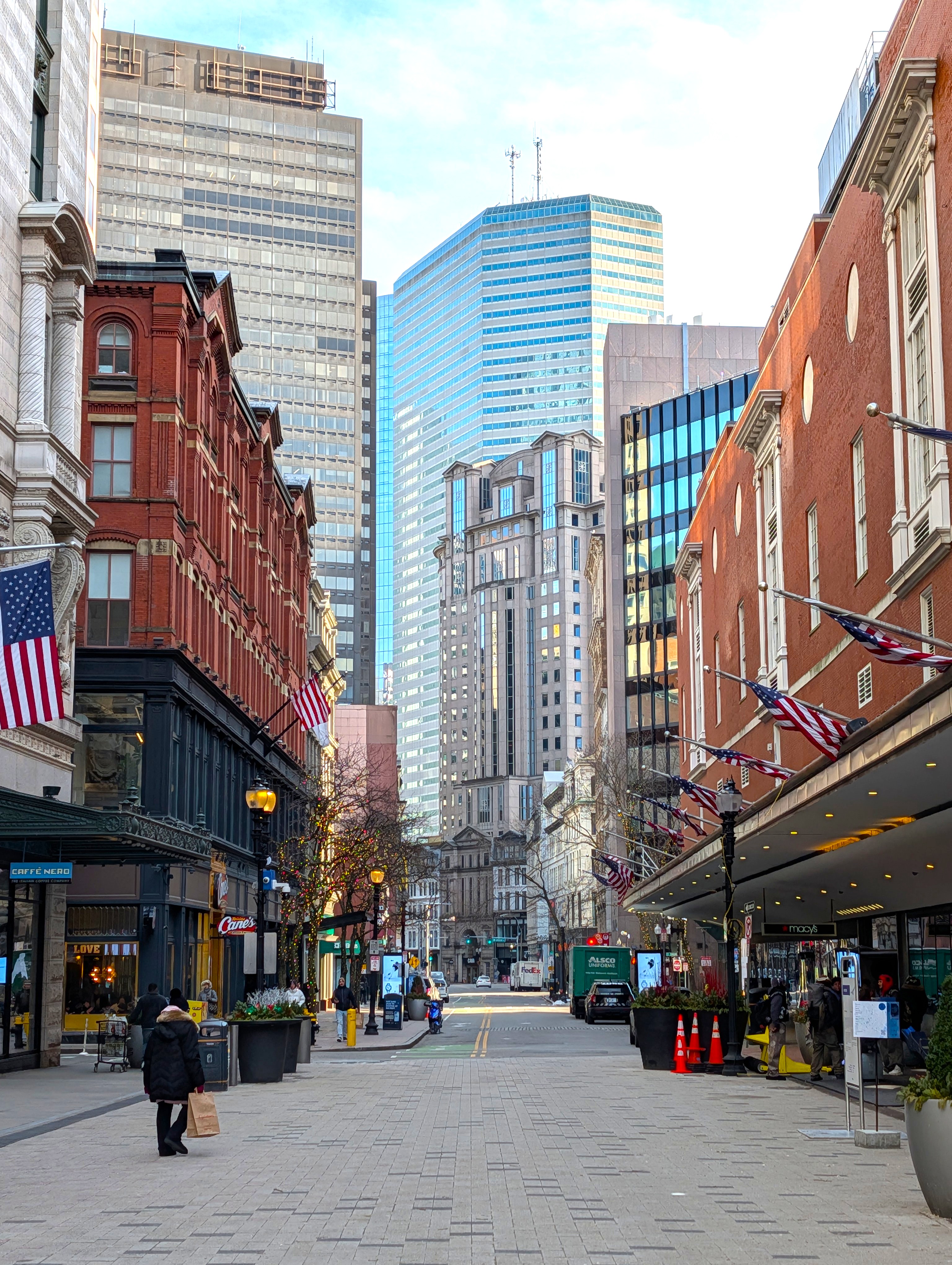
Photo by James Sanna | Banker & Tradesman Staff / File
With data in hand showing improvement in Downtown Boston’s office and retail markets, Downtown Boston Alliance President Michael Nichols credits the residential market as a key factor to a sustained recovery.
The district recently scored a hat trick in three notable metrics of the office market’s performance, compared to other Boston submarkets. According to data compiled by brokerage Newmark, downtown was the only submarket achieving positive net absorption, declining vacancy and rising asking rents in the fourth quarter.
Nichols credits the city’s office to residential conversion program for stabilizing the population base in the urban core. The property tax abatement-fueled program gained momentum in January month as Synergy proposed the program’s largest single project to-date at 294 Washington St.: 255 apartments.
“If you’re looking for places where you will have access to a broad customer base, you have it here,” Nichols said in an interview last week. “You have a high net worth resident base that’s already here, and are rounding out the resident base with the apartments that will come from the conversion program.”
Approximately 200,000 square feet of offices have been converted to apartments thus far, with another 1 million square feet proposed, approved or under construction.
Acquisition of office buildings at discounts have enabled new landlords to reposition properties and add amenities to attract tenants at lower rates, Nichols said.
“People are buying assets at lower basis points, and taking some of that capital and investing it back in the building,” he said.
The DBA district spans 100 acres comprising approximately 34 blocks of the Financial District and Downtown Crossing. Funded through a surcharge on commercial properties, it provides marketing and supplemental services and coordinates events and public art installations designed to increase foot traffic. The latest art installation, Winteractive, runs through March 29.
On the retail side, vacancies have declined approximately 50 percent in the past two years, to approximately 65 locations, Nichols said. Although vacancies linger in the Ladder Blocks off Boston Common, many Washington Street storefronts have filled up or are being prepared to new tenants.
One high-profile arrival preparing for a spring opening is Uniqlo, which will become the first tenant of the former Barnes & Noble building at 395-403 Washington St. under its new ownership, Hudson Group. Skechers is relocating to the former Men’s Wearhouse and Kenmore Army & Navy storefronts on Washington Street after closing its Corner Mall location. And Florence, Italy-based sandwich shop chain All’Antico Vinaio plans to open its second Boston location at 330 Washington St., Nichols said.
“It may just be the density of foot traffic. If you’re looking for a location where you have access to a broad customer base, you have it here,” he said.