Image courtesy of Vanko Studio Architects
For Banker & Tradesman’s latest building tour, we headed to Chelsea, where an all-affordable condominium development’s design turned a corridor into a quiet community space.
The 20-unit project at 150 Williams St., the child of developers Broadway Capital, LandUp Capital and Peter Vanko, will begin closings this summer.
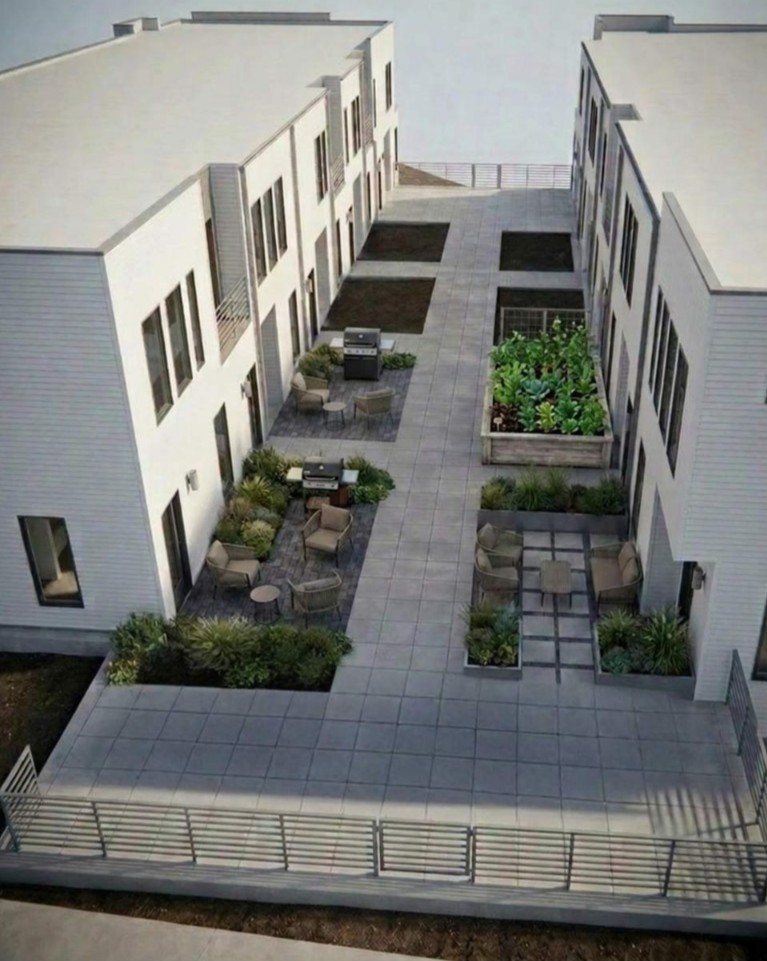
The one-bedroom units sit on top of a half-basement garage sunk into a hillside next to the city’s Admiral’s Hill neighborhood, and open directly – via private stairs, for second-floor units – onto a shared courtyard that also connects to one of the development’s two entrances.
“I have a lot of exposure to the Sun Belt, California, doing a lot of work and looking at warmer environments that open up their circulation,” said Vanko, who’s also the project architect and principal of Vanko Studio architecture firm. “The whole idea here is what would normally be a corridor in a Boston building opens up and becomes a public plaza.”
The first-floor condos will get dedicated space in the courtyard to furnish and plant, Vanko said. During Banker & Tradesman’s recent visit, traffic passing in front of site was barely audible, with one row of units acting as a barrier.
The project’s design and massing was a direct consequence of how it was financed, said Mikael Vienneau, owner of Chelsea-based Broadway Capital. The site, formerly a small warehouse and before that a gas station, was subject to Chelsea’s most restrictive residential zoning category, he said. But city leaders pushed through zoning variances on the condition that the project would be all-affordable, and later contributed money from the city’s Community Preservation Act to finance part of the units. The ultimate design stayed within the dimensional regulations of the underlying zoning, he said.
Other financing came via a $5.5 million grant from the state’s CommonWealth Builder fund, which in its initial guise financed affordable home ownership units that lost affordability restrictions after 15 years, allowing owners to build more equity than traditional affordable condos and houses, whose values are firmly capped at below-market levels to keep them affordable in perpetuity.
The capital stack was filled out by a $3.9 million low-interest loan from the Massachusetts Housing Investment Corp., secured in part by $2 million in Bitcoin owned by Broadway Capital.
The final piece of the affordability puzzle, Vanko said, came from a stroke of luck. Because of the sloping site, he’d already designed a vault space into the project to contain a stormwater management system. When soil contamination was discovered during demolition, the remaining space was converted to store the dirty soil – the contaminants were not water-soluble, Vanko said – on-site by adding a vapor barrier and other protections certified by state environmental regulators. That prevented needing to dispose of the soil at a specialist landfill, potentially costing up to $1 million, Vanko said.