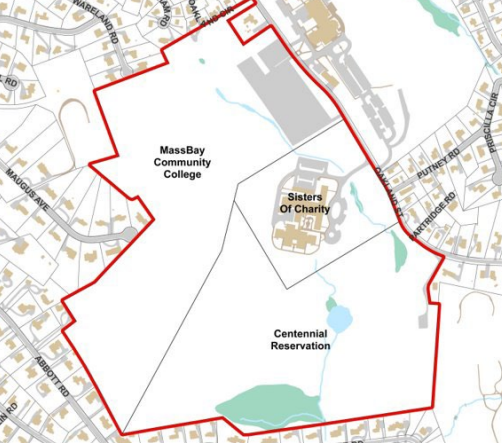
A map of the wooded parcels the state has promised to put conservation restrictions on if housing gets built on a 5-acre parking lot (grey rectangle, upper center). Image courtesy Wellesley Advisory Committee
The Healey administration’s program to turn surplus state properties into multifamily housing faces one of its biggest tests tonight as Wellesley voters take up the fate of a potential 180-unit housing project.
The State Land for Homes initiative launched in 2024 with a goal to sell off state-owned real estate to private developers through a mixture of requests for proposals and absolute auctions, supporting the Healey administration’s target of adding 222,000 housing units by 2035.
In 2025, the state Division of Capital Asset Management and Maintenance announced plans to sell a 45-acre parcel owned by MassBay Community College near Route 9, including a 5-acre parking lot where the housing is intended to be built and a 40-acre wooded area next to the town-owned Centennial Reservation.
Wellesley’s 240-member representative town meeting will debate a non-binding question advising the Select Board to negotiate with the state on the project, including requests for mitigation or restrictions on development. A separate article would authorize $900,000 in legal fees toward a court challenge of the project.
The project is the latest litmus test for Boston suburbs debating higher-density housing development. The Charles River Regional Chamber weighed in last week, posting an open letter to town meeting members urging them to support the 180-unit development option to expand housing opportunities for young people and moderate-income renters.
“Well over half of those who work in Wellesley commute more than 10 miles. This is not due to a lack of demand. It is a function of limited supply. More than 80 percent of Wellesley’s housing stock is single-family,” Chamber President and CEO Greg Reibman wrote in the letter. “However, nearly half of Wellesley’s households are one- or two-person households.”
For the first three months of 2026, the median single-family sales price in Wellesley was $1.83 million, according to data compiled by The Warren Group, publisher of Banker & Tradesman.
Ann-Mara Lanza, a former Select Board member and founding member of the Building a Better Wellesley housing advocacy group, said the Select Board should negotiate details of the project with state officials rather than heading directly to litigation.
“It doesn’t make sense to sue without sitting down at the table first,” Larza said in an interview. “That project in general is a huge opportunity for the town. We have the opportunity to preserve a forest, build units of much-needed housing and a win for MassBay Community College.”
A fiscal analysis by Donald Shepard, a town meeting member and professor at Brandeis University’s Heller School for Social Policy and Management, concluded that revenues paid by a 180-unit development would exceed municipal costs by $1.5 million a year.
The analysis assumes 100 apartments and 80 for-sale condominiums would be built on the site, generating $2.4 million in annual tax revenues.
Two organized opposition groups are warning of potential impacts on the adjacent Centennial Reservation.
The Friends of Centennial hired Boston-based Hill Law, which argued in a letter to MassBay trustees that the project is protected from development under Article 97 of the Massachusetts Constitution which protects conservation land from development. In 1996, the Wellesley Natural Resources Commission asked that the property be designated as open space, and the Select Board responded with a letter of support.
Opponents have warned of the potential impacts on traffic, parking and school costs, and asked for a commitment by state officials not to disturb the wooded portion of the property. Proceeds from the sale would go to the community college, which has indicated it would upgrade its cybersecurity programs.
DCAMM is expected to issue a request for proposals in July for the development.