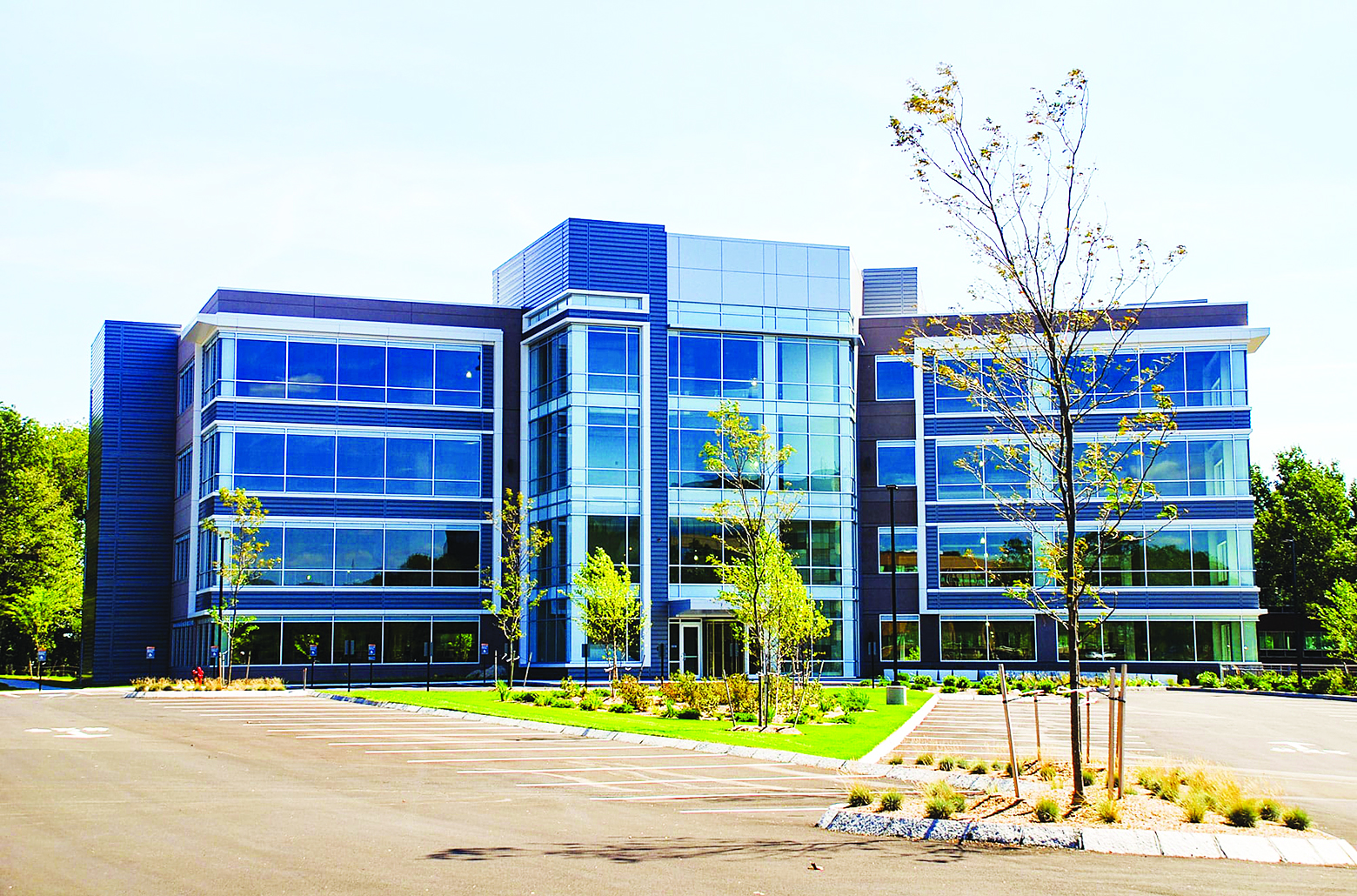
Northeastern University paid $33 million for 4 Burlington Woods Drive, previously known as Burlington Bio Center, where it plans to open a security and defense hub. Image courtesy of The Gutierrez Company
Owner-user transactions continue to demonstrate both strength and breadth, cutting across industries, product types, and geographies. In 2024 the Greater Boston market registered approximately $800 million in total activity, including both acquisitions and dispositions.
That figure, however, was heavily skewed by Moderna’s $370 million acquisition of its Norwood campus. Even so, momentum has carried forward into 2025 – excluding the Moderna transaction – the market is already on pace to surpass last year’s totals.
This year in the office sector, activity has been marked by notable expansions and strategic repositioning. The TJX Companies, a fixture in Framingham since 1976 and currently ranked No. 76 on the Fortune 500 list, began the year by acquiring two office buildings on Speen Street totaling 162,000 square feet for $24.3 million.
The acquisition price was only marginally above what the assets traded for 25 years ago, underscoring both the depth of office market dislocation and the long-term financial advantage for an occupier able to amortize costs across decades.
Similarly, Atrius Health purchased 20 Wall St. in Burlington, a 53,000 square foot medical office building, for $22 million in April. Northeastern University also stepped into the market with the $33 million acquisition of 4 Burlington Woods Drive (also known as the Burlington Bio Center) – where the school intends to establish a new homeland security and defense research hub.
Industrial Transactions Lead the Way
Industrial and flex assets, which led transaction volumes in 2024, have continued to dominate in 2025. In a dual owner-user transaction, the MBTA acquired 440 Riverside Ave. in Medford from Anheuser-Busch for $53.75 million. The property, long used by Anheuser-Busch as a distribution facility, will now be converted into a bus charging and maintenance garage for the transit agency.
Another dual owner-user transaction occurred in May, when the Finishing Trades Institute of New England acquired a 129,000-square-foot warehouse in Lowell for $22.1 million from DS Graphics, which subsequently relocated its operations to Canton.
Also in Lowell, Raymour & Flanigan paid $30.5 million for 240 Industrial Ave., a 167,119-square-foot industrial property acquired from Oliver Street Capital, further expanding its Northeast footprint. Notably, these dual owner-user trades are not limited to large institutions; we have also observed this dynamic at the smaller end of the market where local businesses are selling directly to operators with similar space needs.
Incentives for Owners
Several factors are driving this surge in owner-user activity.
Unlike traditional investors, occupiers who own their real estate are insulated from concerns about vacancies, leasing costs and return requirements. For industrial users in particular, ownership is increasingly attractive given the extraordinary pace of rent growth over the past five years, which has reached historic highs.

Mark Fallon
Simultaneously, many companies are able to secure advantageous financing through SBA, C&I or other small-business loan structures that tie the property directly to operations. Well-capitalized operators such as TJX are also leveraging the current market reset by acquiring office assets at values that offer long-term financial benefits compared to leasing.
Beyond capital preservation, ownership delivers tax advantages in the form of depreciation and interest deductions, greater control over facilities and the potential to capture long-term appreciation.
As a result, legacy institutions and strategically-minded occupiers are seizing opportunities in a market that remains challenging for investors and landlords.
With vacancy rates elevated, demand softening and pricing still under pressure, the relative appeal of ownership has only grown. This dynamic suggests that the owner-user segment will remain a bright spot in the commercial real estate landscape through 2025 and beyond.
Mark Fallon is director of research and strategy at Hunneman.