Real estate researcher Yardi Matrix forecasts that Greater Boston’s average apartment rent of $2,877 will rise 2.1 percent in 2026, tied with Washington, D.C. for the nation’s biggest increase. iStock photo
As a multi-year multifamily construction boom draws to a close, developers expect a lean upcoming year for housing production in Boston.
Difficulty in sourcing equity investments continues to be the biggest single factor standing in the way of groundbreakings, a local construction executive said. Although the Federal Reserve cut rates three times this fall by a combined 0.75 percent, and the yield on 10-year Treasurys is over 30 basis points down from its high for the month of May, it’s not been enough to move the needle.
“You’d have to surprise the market with an additional more aggressive cut,” said Marvin Lahoud, a partner at Woburn-based Tocci.
Developers rely on equity contributions – either internally or from outside limited partners – to complete financing for projects and obtain construction loans. Currently, outside investors are looking for projects that promise a 6.5 percent yield on cost, Lahoud said. The premium reflects the risk on development projects compared with safer investments such as a 10-year Treasury bond, which currently pays nearly 4.2 percent.
Energy Codes, Labor Costs Add Up
The Boston Planning & Development Agency board approved 4,043 housing units in 2025, up from 3,575 units in 2024. But developers have no guarantee that they’ll be able to attract equity and complete financing packages in the near future.
And this year’s BPDA approvals included 1,282 income-restricted units, both in market-rate developments and all-affordable projects. Once approved, affordable housing projects usually take several years to break ground, because developers rely on government-awarded low-income tax credits and other public subsidies to complete their financing packages.
The predominance of union labor in Boston, material cost fluctuations and new energy codes also add to project costs.
Union salaries and benefits can add a 30 percent cost premium on mid-rise housing projects, said Tocci’s Lahoud, who is the co-chair of the Urban Land Institute’s Housing and Economic Development local product council. Median construction laborer salaries in the Boston metropolitan statistical area are $63,140, according to U.S. Department of Labor data, compared with the national average of $46,730. Carpenters in the Boston area earn a median $73,800, compared to $59,310 nationally.
Raw material prices have fluctuated widely in response to the Trump administration’s tariff policies, Lahoud said. And as construction has declined, subcontractors have been forced to offer more competitive bid prices, somewhat offsetting project costs.
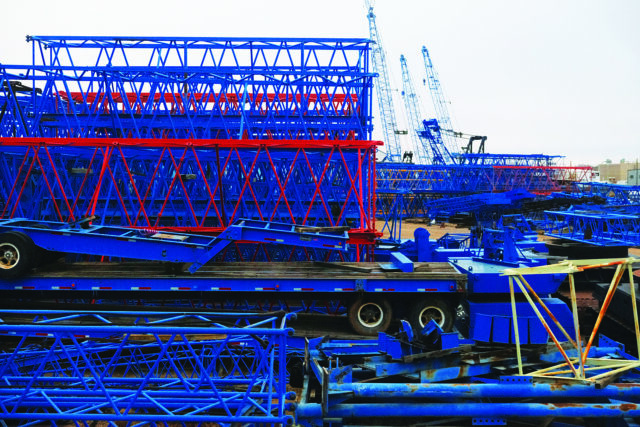
Crane components sit in a storage yard. Industry experts forecast significantly less multifamily construction activity in Greater Boston in 2026. iStock photo
Housing Development as Political Football
Boston mayoral challenger Josh Kraft made the Wu administration’s track record on housing production a central part of his unsuccessful campaign, vowing to roll back increases in affordability requirements that he blamed for making many approved projects financially unfeasible.
He was echoing criticisms from many in the real estate industry, who see affordable housing requirements as one of the few levers at a mayor’s disposal to meaningfully lower the cost of construction.
Mayor Michelle Wu resisted calls to change the formula, which requires 17 percent income-restricted units and 3 percent reserved for housing voucher holders.
Instead, the administration has sought to revamp the city’s 1960s zoning code on a neighborhood-by-neighborhood basis to make it easier for developers to build housing without time-consuming and costly zoning variances. The Streets + Squares initiative has resulted in rezoning of Roslindale Square, and approval of a similar plan in Mattapan allowed higher-density residential buildings along major thoroughfares.
The administration also approved and then extended a tax break program designed to help developers convert vacant offices into housing, which has attracted applications for over 1,500 units. It also implemented a new fast-track approval process for projects that include 100 percent affordable units, and offered city-owned parcels to developers planning multifamily projects.
Double-Digit Decreases in Housing Construction
Across Greater Boston, multifamily housing units under construction have declined from 17,348 in 2024 to 13,824 units, according to CoStar data, representing a 20 percent decrease.
Other high-cost metros, like New York and Philadelphia, also saw similar declines in total multifamily housing units under construction in 2025, according to CoStar. New York’s construction pipeline declined from 58,644 units in 2025 to 40,841, a 30 percent decrease, while Philadelphia’s dropped from 11,125 to 7,863, a 29 percent decrease.
At the same time, construction boomed in some Sunbelt metros, which have lower rates of union participation in construction and more affordable site acquisition costs.

Steve Adams
Four Texas cities, led by Austin, are expected to deliver nearly half of the 78,350 new apartments scheduled for completion this year in the nation’s 10 busiest markets for apartment construction, according to a RentCafe report using Yardi Matrix data. Brooklyn, New York was the only Northeast market to crack the top 10, with 7,189 units.
That volume of building is bringing down rents, which are down over 15 percent from their peak according to CoStar data analyzed by Bloomberg last week.
Single-family home builders are facing similar headwinds nationwide.
A survey by the National Association of Home Builders indicated that many builders delayed projects because of uncertainty about material costs following the Trump administration’s imposition of tariffs on imported raw materials including lumber.
Lumber mills cut production in turn, and lack of availability is a risk factor for developers in 2026, said Jesse Wade, NAHB’s director of tax and trade policy analysis.
The obstacles to new housing production point to higher apartment rents in 2026.
Real estate researcher Yardi Matrix forecasts that Greater Boston’s average apartment rent of $2,877 will rise 2.1 percent in 2026, tied with Washington, D.C. for the nation’s biggest increase.
New supply remains limited compared to historic levels, and a majority consists of higher-end projects targeted at “discretionary” renters, said Doug Ressler, Yardi Matrix manager of business intelligence.