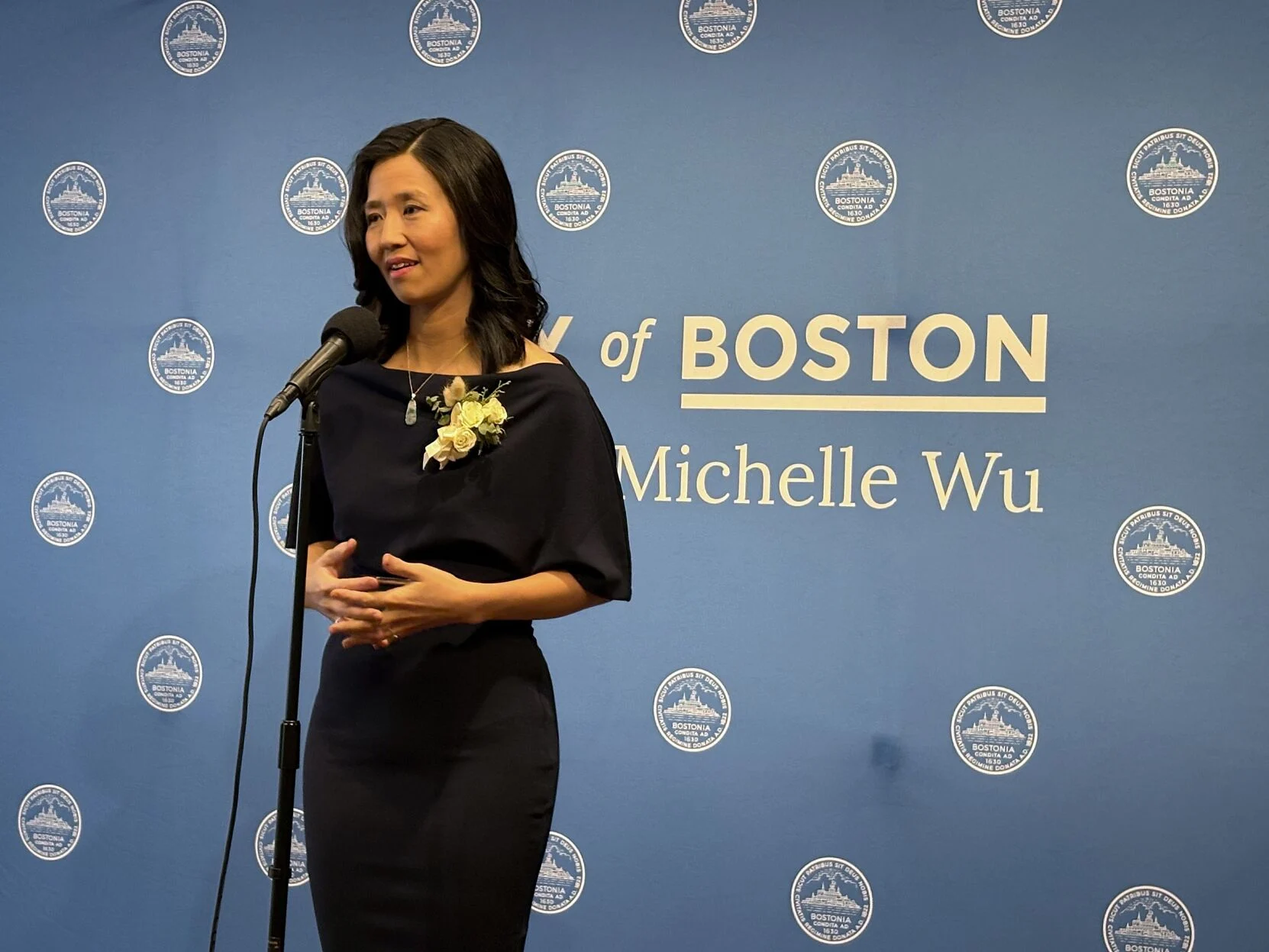
Boston Mayor Michelle Wu speaks to reporters after getting sworn in for her second term. Photo by Sam Drysdale | State House News Service
Boston Mayor Michelle Wu threw her support behind the November ballot question legalizing rent control in Massachusetts, while rejecting the possibility of Cambridge-style rezoning to legalize denser housing in single-family districts.
Wu split with Gov. Maura Healey, who has stated her opposition to the rent control question, in backing the measure sponsored by the Homes for All Massachusetts coalition. It would cap rent annual rent increases at 5 percent or the annual change in the Consumer Price Index, whichever is lower.
Wu has unsuccessfully attempted to win the state Legislature’s approval for a Boston rent control ordinance through a Home Rule petition.
Saying she would prefer a local option measure, Wu said she still would vote in favor of the current ballot question.
“I’m not going to let perfect be the enemy of the good in this case when there is so much urgency and pressure from housing costs on our residents,” Wu said during an appearance on WGBH News Boston Public Radio’s “Ask the Mayor” segment Tuesday.
She’s just the latest high-profile Progressive leader to fall in line with the proposal despite concerns it’s too harsh, or too easy for the real estate industry to pillory.
Opponents of the measure responded to Wu’s comments, saying rent control would shift the tax burden from rental properties to homeowners, or force communities to slash budgets.
“This ballot question is not about Boston. It is a statewide mandate that would impose the nation’s most restrictive rent control program on every single community in Massachusetts, whether they want it or not,” Conor Yunits, chair of Housing for Massachusetts, said in a statement.
The ballot question also faces a recently-filed legal challenge at the Supreme Judicial Court.
The ballot question exempts construction less than 10 years old and buildings with four or fewer units.
No One-Size-Fits-All Rezoning
Elsewhere in the interview, Wu rejected the notion of following the Cambridge City Council’s 2025 decision to eliminate single-family zoning, as a strategy to control housing costs.
The Cambridge rezoning is estimated to spur construction of thousands of new homes, and allows 4- to 6-story buildings on many lots previously zoned for single-family homes, with density bonuses for projects with more affordable housing.
By contrast, under Wu’s tenure, Boston has been pursuing rezoning plans on a neighborhood-by-neighborhood basis, a process expected to play out over multiple years. The Squares + Streets program focuses on allowing higher densities on major thoroughfares and near transit stops, and reducing the need for developers to obtain variances.
“We cannot be stuck just talking about heights and density and floor area ratio. Communities want to have a real planning conversation about all of the needs,” Wu said, adding that a citywide needs assessment is studying desire for specific uses such as types of retail or commercial space in various neighborhoods.
“We’re trying to move on that. We are a city of neighborhoods,” Wu said.
Only one neighborhood, Roslindale Square, has been rezoned thus far. Three other neighborhoods, Charlestown, Mattapan and East Boston, were rezoned under earlier planning studies.
Boston faces a collapsing housing construction pipeline, which some blame on tough financing conditions and others on the city’s zoning and affordable housing rules.
Defends Parcel P3 Change of Plans
Wu also defended the Boston Planning Department’s decision to drop its support for a planned life science and affordable housing development on Parcel P3 in Roxbury. The administration now is pursuing plans for a new Madison Park High School on the 8-acre site at Tremont and Whittier streets.
The designation for HYM Investment Group and My City at Peace as developer of the site expired at the end of January after a three-year span.
Some Roxbury residents have criticized the decision to abandon plans for the lab project, which developers had predicted could create 2,700 jobs and bolster the Roxbury economy.
“There was a designation made under a different set of economic conditions. It was a project pinned on lab and life sciences being the economic engine that would allow for every other community benefit to be paid for out of it,” Wu said. “The designation was extended again and again and again over three years.”
The Massachusetts School Building Authority’s support for partial state funding for the $700 million school project forced the decision, Wu said.
“We cannot legally be planning both on the same parcel of land at the same time,” Wu said.
Wu said the site eventually could include commercial development.
“It will be a slightly different set of boundaries,” she said.