Boston City Councilor Michelle Wu is pointing to Stop & Shop’s proposal for nearly 900 apartments and condominiums at its 11-acre Allston property as an example of the city’s myopic approach to civic planning.
“It is sound public policy for residents and city officials to insist that the developer provide more than the bare minimum of affordable housing required in order to receive city approvals,” Wu wrote in a comment letter to the Boston Planning and Development Agency.
The rumored potential mayoral candidate took to social media Monday night to expand on affordable housing goals, her critiques of the project and the city’s approach to reviewing development.
“Can we clear something up? I’m not a YIMBY. I’m also not a NIMBY. Framing development as a battle between simple Yes or No is short-sighted,” Wu tweeted. “Residents & developers don’t have to be at odds, but our process forces that [because] there’s no citywide planning.”
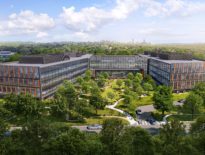
In a partnership with New England Development, Stop & Shop is proposing 895 apartments and condos, 375,000 square feet of office space and 117,000 square feet of retail including a new supermarket at 60 Everett St.
The original proposal called for 1,050 housing units. Banker & Tradesman first reported the major development plans for the property in 2016.
Boston’s inclusionary development policy requires a minimum of 13 percent affordable units.
Allston Yards developers revised the plans in June to provide for 17 percent affordable units overall, but only 13 percent in the first 200-unit phase. They also agreed to deed restrictions prohibiting units to be rented out on Airbnb or as short-term rentals, and a two-thirds requirement for owner occupancy.
Wu said the project should set aside at least 20 percent of its housing units as income-restricted. She also criticized the proposed height of buildings, which exceed the 150-foot limit in the BPDA’s Brighton Guest Street planning study. Revised plans submitted to the Boston Civic Design Commission in July call for four buildings ranging from 85 to 232 feet.
“But the larger problem is that we’re not engaging in thoughtful, long-term community conversations to shape our neighborhoods for a future that includes residents of every demographic & income level. Right now, displacement is treated as a necessary by-product of growth,” Wu tweeted.
In a response issued Tuesday, the BPDA cited its work on “an unprecedented number of planning studies under way across the city” and the 2017 completion of Boston 2030, the city’s first comprehensive master plan in a half-century.
“These studies work with each community to create a comprehensive vision for the area and guide future growth and investment that is equitable for all,” the BPDA stated. “Since the Allston Yards project was proposed in 2017 based on prior planning completed for the neighborhood, the project has evolved significantly in response to community and BPDA feedback to incorporate a higher number of income-restricted units, additional homeownership opportunities, open space, and an updated complete street network. The project is still going through a comprehensive public review process and we look forward to continued engagement with community members and all stakeholders.”
This report has been updated with a statement from the BPDA.