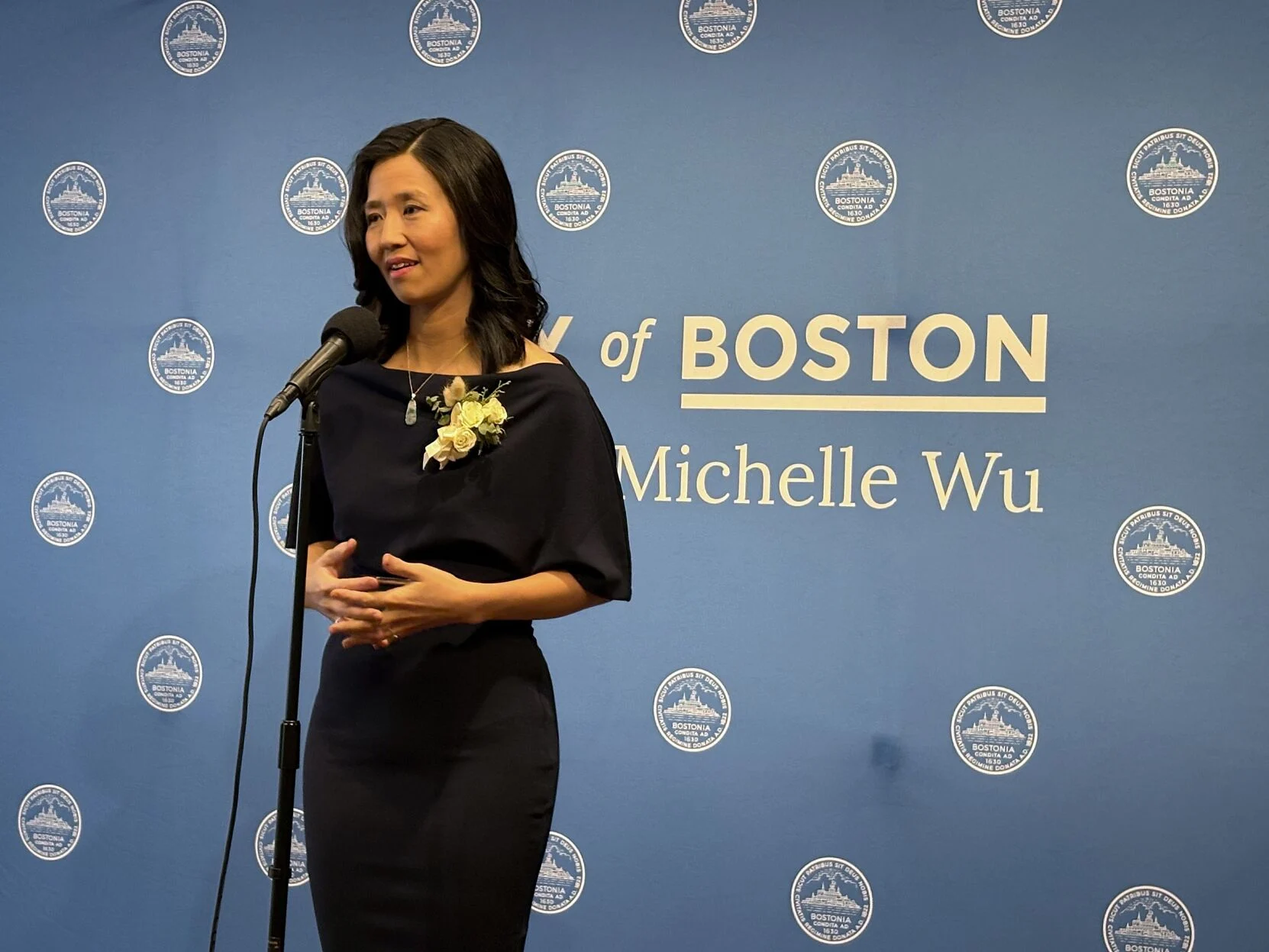
Boston Mayor Michelle Wu speaks to reporters after getting sworn in for her second term. Photo by Sam Drysdale | State House News Service
Boston Mayor Michelle Wu honed in on a message of “getting the basics right” as she took her oath for a second term leading the state’s largest city, while asserting that the Trump administration “has plundered our economy, ravaged our reputation, torched our institutions, and destroyed the lives of our people.”
Wu’s inauguration unfolded at Boston’s Symphony Hall on Monday following her landslide election win last fall.
The mayor pledged to streamline every city permitting process, invent new ways to boost housing production and emphasized a message of promoting parks, improving city schools and filling potholes.
“Making Boston the best city for families means getting the basics right, and delivering on our most fundamental, most important work every day — repaving streets and sidewalks, tending to our playgrounds and parks and ensuring that every block of our city is healthy and safe, beautiful and welcoming for every one of our residents,” she said.
Schools, Permitting Pledges
Starting this year, the mayor’s office will hold office hours in neighborhoods across Boston to connect directly with residents to “unstick any city service issues in real time,” Wu said.
She also set goals for Boston Public Schools, which have long been troubled by chronic transportation failures and long student commutes, inequitable student performance, absenteeism and aging school buildings.
“We refuse to accept that accessing high-quality education means crisscrossing our children all over the city, rather than ensuring that in every corner of Boston the best school is just down the block,” she said. “We will revisit school assignment to be simpler and more predictable, reduce time students spend on the bus and reinvest in advanced coursework, arts and athletics.”
Wu announced in October that she and the city were working with several community organizations to launch new before- and after-school programs at 20 “Community Hub Schools” which would be open to all students at those schools. She said Monday that programming would start by the 2027 school year. The district is engaged with the Massachusetts School Building Authority over plans to rebuild Boston’s vocational school, Madison Park.
The mayor added that the district is on track to offer early college classes to every high school student by the fall of 2028.
“I am a BPS parent, and I know how fast the days tick by and how quickly every single school year means our students and families are either stepping into their potential or missing out on that opportunity that was delayed,” Wu told reporters, when asked about the timeline of district progress. “Many of these long-term plans that were put in place three years ago, four years ago, are now at the point in time where this is the moment where we will be able to really see the results coming through.”
Housing Named a Priority
Wu also highlighted the housing affordability and availability crisis as a priority for the next four years, though she didn’t offer new concrete plans related to the issue.
“We are the city that created whole new neighborhoods out of swampland and invented the triple-decker to tackle the housing crises of our past,” she said. “We will not be defeated by the affordability crisis of the present.”
Her speech did not address falling commercial valuations as the city’s downtown has emptied, leading to significant budget challenges for city government and sharp property tax increases for homeowners.
Later, when asked about her long-term solution for the issue, Wu said it was to “revitalize our business sector and downtown, and ensure that we are reducing, getting rid of vacancies.”
She pointed to new businesses that have come to Boston under her first administration, such as Lego and Hasbro who moved their headquarters to the city. She said as “we enter an era of economic strain” that the city “will rely on these public, private partnerships.”
“Companies have been choosing Boston because this is where they can find the best talent, this is where their workforce wants to live. We’re also going to continue giving people a reason they can’t miss out on being in person in Boston — that means filling every storefront with exciting, welcoming small businesses,” she said. “Ultimately, every vacant space in a downtown building or in an office or in one of our commercial areas needs to be converted to active use.”
Critic Blasts ‘Fiscal Crisis’
Boston Policy Institute Executive Director Gregory Maynard said Wu’s speech did not include the words “office,” “downtown,” “tax,” or “budget.” Alleging that the city is in the midst of a “fiscal crisis,” Maynard said that the confluence of falling commercial property values and rising residential property taxes heighten the stakes for the city’s next school budget in February and the mayor’s fiscal 2027 budget proposal in April, Maynard said.
The mayor’s speech did not role out specific major new initiatives she plans to take in her new term. A reporter asked Wu why, and if it had to do with the challenging budgetary environment.
“We are doing new things every single day, and this is certainly a moment where we have to make some tough choices about what comes next, and be clear that Boston and every community is having to do more with less,” she said. “But we are going to keep doing more, and so we described and set the direction to give a vision for the next four years.”
Gov. Maura Healey attended Monday’s inauguration, as did U.S. Reps. Ayanna Pressley of Boston and Jake Auchincloss of Newton, and Reps. Aaron Michlewitz and Michael Moran, both of Boston.