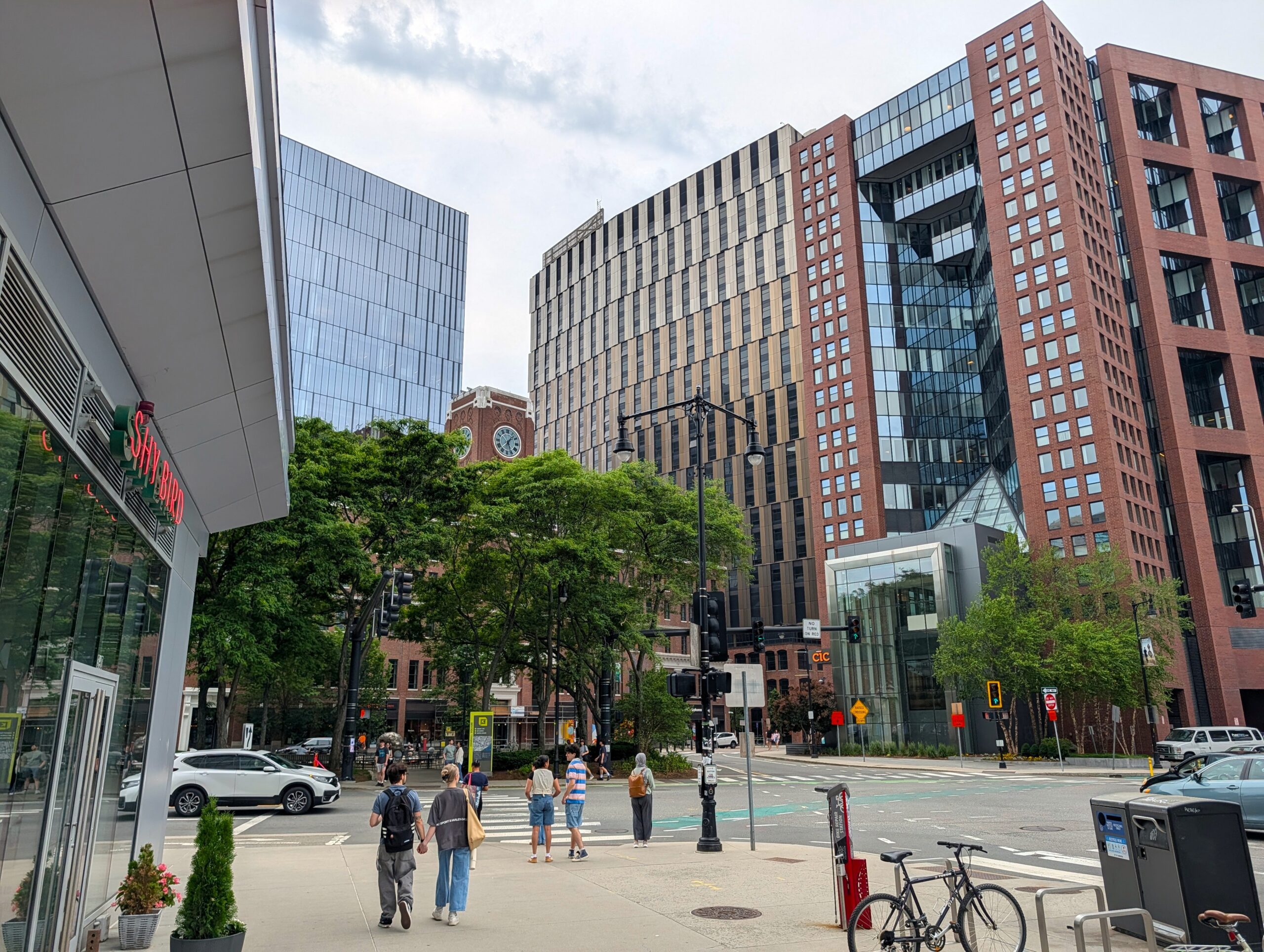
Several of Boston’s largest projects underway are substantially or fully committed, including 585 Kendall, 75 Broadway and 290 Binney St. in Cambridge. Photo by James Sanna | Banker & Tradesman Staff
Greater Boston’s life science real estate market is beginning to show clearer signs of an inflection point after several years of supply growth, declining rents and subdued tenant demand.
While the region continues to work through a historically large inventory of available lab space, improving leasing activity, stronger capital markets and a deepening tenant pipeline are providing some of the strongest evidence yet that the market may be entering the early stages of recovery.
Metro Boston was the standout U.S. life science leasing market during the first half of 2026, recording approximately 2.3 million square feet of lab and R&D leasing activity – its strongest six-month period since 2022.
More importantly, leasing volume exceeded Boston’s pre-pandemic 2015-2019 six-month average by approximately 37 percent. Boston was the only major U.S. life science market to surpass its pre-COVID benchmark, while national leasing remained 36 percent below historical levels.
Several large transactions helped drive that performance. Sanofi renewed approximately 900,000 square feet at Cambridge Crossing, while TransMedics Group committed to nearly 500,000 square feet at Assembly Innovation Park in Somerville. These commitments reinforce a broader trend toward established companies making large, long-term investments in the region even as smaller and earlier-stage tenants remain more cautious.
Digging Out of a Vacancy Glut
Leasing is recovering from a historically weak starting point.
Greater Boston still has approximately 18.3 million square feet of available lab space, including 14.8 million square feet of direct availability and 3.5 million square feet of sublease space. Overall availability stood near 31 percent at midyear, placing Boston among the most oversupplied major life science markets in the country.
That oversupply continues to put downward pressure on the economics of operating a lab building.
The average Boston triple-net lab asking rent declined from roughly $78.30 per square foot in the first half of 2023 to $71.65 in the first half of 2026, a decline of approximately 9 percent. Landlords are also competing aggressively for tenants through concessions and tenant improvement packages, particularly within newer developments and first-generation laboratory space.
Quality and capitalization have therefore become important differentiators for Boston.
Across the U.S., institutional and publicly traded/REIT owners’ control approximately 51 percent of lab inventory but have captured 86 percent of leasing activity since 2022. This trend is even more prevalent in Boston where the leasing imbalance is attributed partly to access to capital, newer product and the ability of sophisticated life science owners to offer substantial concession packages, with tenant improvement allowances in some instances exceeding $400 per square foot.
In other words, these well-capitalized owners can “buy” deals through heavy concessions which does not bode well for some of the more regional and local investors but allows Boston to remain more competitive with other U.S. lab markets.
No More Spec Construction
The development pipeline is also becoming more disciplined with effectively no speculative construction kicking off.
Several of Boston’s largest projects underway are substantially or fully committed, including 585 Kendall, 75 Broadway and 290 Binney St. in Cambridge.
This leaves vacant first-generation lab space in the Seaport, East Cambridge, Fenway, Alewife and 128 West on deck to absorb an influx of tenants in the market. Avison Young is tracking 15 lab requirements above 100,000 square feet. Until these requirements translate into leasing, speculative development is expected to remain on hold outside of Kendall Square for another 18 to 24 months.
Perhaps the most important leading indicator showing we are at an inflection point is capital.
Massachusetts-headquartered biopharma companies raised $3.45 billion in venture capital during the first half of 2026, a 25 percent year-over-year increase and the strongest first half since 2023, according to MassBio. Eight Massachusetts companies also went public during the first half – equal to the combined total from 2024 and 2025.
These funding rounds and capital injections through public offering have been the main contributor toward increased space requirements.

Tucker White
External Factors Drive Lingering Indecision
However, the question remains: Where will these space requirements land and, perhaps more importantly, when?
Some lab requirements have been in the market for over two years suggesting the indecision is a product of geopolitical factors, local headwinds and internal strategic considerations, not the availability of lab space, lease rates and the abundance of labor.
Boston’s underlying talent ecosystem remains the biggest advantage for these occupiers. According to Lightcast data, the region has the highest concentration of life science employment among the major lab markets and added more than 4,200 life science jobs between 2025 and 2026: the largest increase in the country.
Boston-area universities also produced approximately 8,300 life science bachelor’s, master’s and doctoral graduates in 2025, including 652 doctoral graduates, the highest total among any major MSA in the U.S.
Taken together, the data does not suggest that Boston’s supply imbalance has disappeared. Rather, the market appears to be transitioning from contraction toward stabilization.
The next phase of recovery will depend on whether improving funding conditions translate into sustained leasing from the emerging and mid-sized companies that historically formed the backbone of Boston’s multi-tenant lab market.
It is one thing to have Sanofi renew their lease well ahead of their current expiration. It is another to have 10 companies make up that same square footage and lease new first-generation lab space that has been sitting vacant. The latter needs to happen soon if the market is to begin a longer lasting and balanced road to recovery.
Tucker White is U.S. office and life sciences lead of market intelligence at Avison Young in Boston.