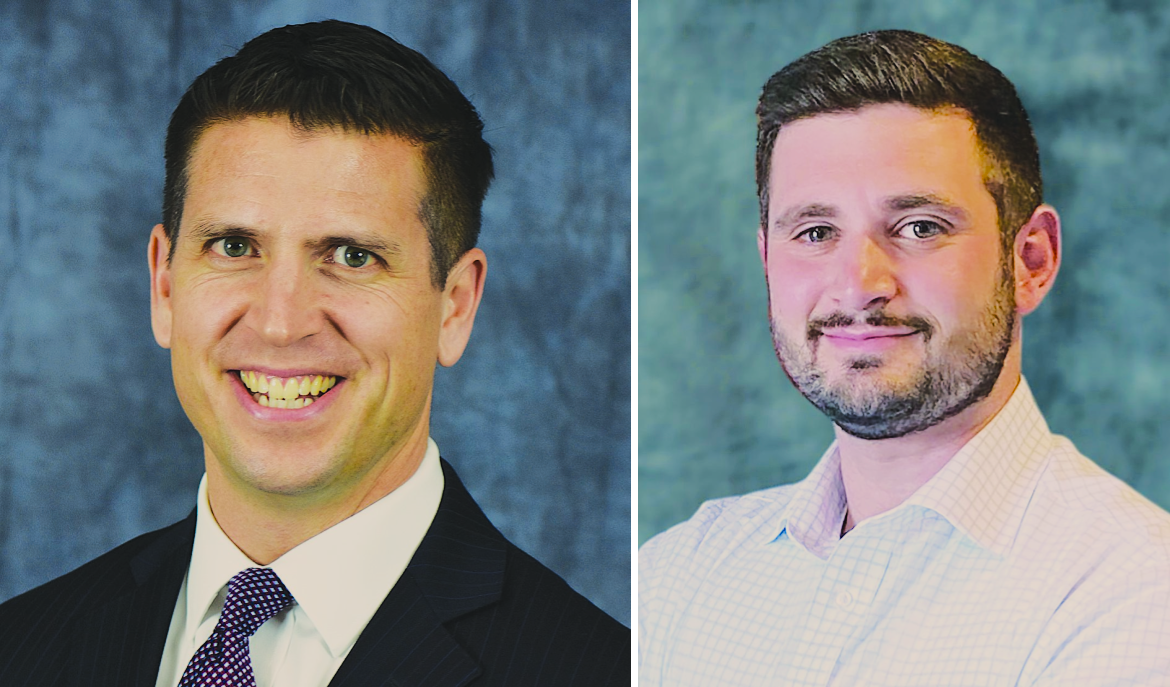
Photos courtesy of Cummings Properties
Eric Anderson
President, Cummings Properties
Age: 50
Industry experience: 27 years
John Halsey
Head of leasing, Cummings Properties
Age: 36
Industry experience: 10 years
When biotech startups are ready to graduate from incubators and lease their own dedicated space, a frequent destination is Cummings Properties’ 11 million square-foot portfolio in Boston’s northern suburbs. With an in-house construction team on call, the Woburn-based developer touts its project management capabilities as providing a speed-to-market advantage over competitors. Amid the lingering lab space surplus, it’s taking a similar approach in offering to convert industrial properties into the flex R&D layouts preferred by the growing clean energy and tough tech sectors.
Q: How does Cummings’ portfolio respond to the needs of today’s lab tenants and financial conditions?
Halsey: We have had to, as all landlords in Greater Boston, adapt over the years recently to try to satisfy what is a declining lab market. We’ve seen some very small signs of life this year, but it’s been a challenge over the past couple of years. What we do with our lab inventory and our inventory as a whole is try to maintain ultimate flexibility: not being tied to one size or style of lab. We are open to demising larger labs into smaller labs or decommissioning labs that may be highly specialized or archaic and create space that is more attractive to the current tenant in the market.
While we are seeing growth in lab clients, there is a bit of a hesitation to sign a long-term lease. In the peak of the lab boom, we were getting our preferred five-year term on nearly every new lab client coming in the door. Now we’re seeing requests for shorter term, just with the uncertainty and volatility: one to three years. We don’t particularly like to do a year or less, but we will if we feel like we have a space that we want to move. We’re being more flexible on term in general, and the hope is that the market will turn around and we’ll be able to keep these new tenants long-term.
During the peak when there wasn’t enough lab space available, we were able to excel in converting on a timeline far quicker than our competition. We’re not super enthusiastic about converting any of our flex and office space into new labs. We’ve done it, but it’s the exception, not the norm. What we have seen is an uptick in the cleantech type space, and we are more open to converting our flexible industrial space into a more technical use.
Anderson: We will build out depending upon the user’s needs. Our preference is to reuse and modify existing lab spaces. With our in-house capabilities, we are able to do that most of the time. If somebody has something unique, we absolutely will build to their specifications.
Halsey: We are seeing a demand for power, and that has been prevalent over the last couple of years. Fortunately, our portfolio has the type of space that has that power. Whereas we were doing more pharmaceutical biology labs, now we are doing more of the battery tech, the uses that require the infrastructure and the power. It really depends upon the tenant. If you have a 5,000 square foot industrial space, we are going to provide 200 amps of power for a normal shipping, receiving and logistics company. We have some buildings with up to 3,000 amps. That’s a pretty significant premium with respect to power and that lets a lot of these highly technical companies bring in that equipment that has that heavy draw.
Q: What’s the typical profile of your new tenants in the lab portfolio?
Halsey: We see a lot of new potential companies coming out of The Engine [in Cambridge] and Greentown Labs [in Somerville]. What’s tricky about that is a lot of them are coming out early before they are ready to scale up. They are wanting to see what the market has. I hope we get a look at most of those clients. We’re worked really hard at being a name associated with space for the types of uses coming out of Greentown.
Q: What is the size of your in-house incubator space and third-party providers?
Halsey: InnoVenture Labs in Beverly occupies 30,000 square feet and we have C2I Accelerator on Washington Street, here in Woburn, and Rilas Technologies – also here in Woburn – occupies 8,000 square feet. Tufts University leased about 20,000 square feet at 200 Boston Ave. in Medford. They are going to run and operate it and bring their own clients. That’s a nice example. We got back about 20,000 square feet of second-generation lab space. It’s not a great market right now, so we looked at Tufts and it was a great space for an incubator.
Anderson: We continue to offer a number of incubator spaces ourselves. It’s not a traditional incubator, but we provide them with small laboratory suites. Those are generally in the few hundred to 1,500 square feet. We’ve got a half-dozen of those clusters in Beverly, Woburn and Medford. Those typically have been in high demand and a great feeder. Once they grow and their science takes off, they would take space.
Q: Beyond your lab portfolio, what’s the latest progress filling up the 174 and 176 Middlesex Turnpike office campus in Bedford that you acquired last year?
Halsey: We have seven leases to date and 40,000 square feet. It’s a really diverse cross-section of companies: an audio tech company, some behavior health care, an energy drink company, a law firm and a software company. We were able to reuse the former kitchen and lease it to a group that is going to do a test kitchen and appliance showroom. There’s a lot of space there for us to lease, and we look at it as a new challenge. We had 330,000 square feet of vacant space. The previous owner had been trying for a handful of years to lease that to one or maybe two users, without any luck. When we acquired it, we said, “All right, we’ll give it a shot.” And we got bored after a couple of days and said, “This is not the market for this right now. Why don’t we do what we do well, and we’ll break it up.” We created spec suites from 2,400 to 10,000 square feet. We wanted to prove the concept and did that on spec and found a couple of clients pretty quickly. At the same time, we’re going to hold 176 Middlesex now. We’ll see. Maybe we’ll find a full building user, or a half-building user. If we don’t, we’ll run the same play.
Q: How capital intensive is to convert that type of a property into a multitenant building?
Haley: It is intensive. There is a reason a lot of other building owners don’t like to do it. It’s better to spend that and get the building full now, as opposed to waiting. There is a lot of rent that can be collected in a year’s time. Our philosophy is: Let’s just go. The philosophy being, let’s grab these companies when they are younger. You treat them very well. We can accommodate businesses’ growth over their lifetime.
Halsey’s Five Favorite Boston Sports Moments
- David Ortiz’s walk-off vs. Yankees (Game 4 of the 2004 ALCS)
- Malcom Butler’s interception (Super Bowl XLIX)
- Adam Vinatieri’s kick (Super Bowl XXXVI)
- David Ortiz’s grand slam (2013 ALCS)
- The Boston Bruins’ comeback vs. Toronto (Game 7 of the 2013 Stanley Cup quarterfinals)
Anderson’s Top Five CrossFit Hero Workouts of the Day
- Murph
- Glen
- Bert
- Hamilton
- Gaza