Alewife Park/Image courtesy of IQHQ
Life science companies gravitated to established industry clusters in Greater Boston and the San Francisco Bay area in a diminished leasing environment in 2025. The regions could stand to benefit as investment flows to the next generation of biotech startups.
Greater Boston led all U.S. metros during 2025 in leasing activity, including two of the largest five transactions in the nation, Avison Young researchers reported.
And in a key leading indicator of future activity, local companies received over $22 billion in venture capital funding, pointing toward a potential uptick in space demand.
“The current environment is creating a rare window where companies can secure premier lab space in Boston with more flexibility and better economics than we’ve seen in years,” Tucker White, Avison Young’s U.S. life science lead for market intelligence, said in a statement. “That dynamic is already translating into renewed leasing velocity.”
Amid a broad decline in life science investment and soaring lab vacancies, companies gravitated to established industry clusters during 2025. Boston and the San Francisco Bay area were the primary beneficiaries: combined, the two regions accounted for 70 percent of the nation’s leasing activity.
Greater Boston led the nation with approximately 3.2 million square feet of transactions.
Tenants’ preference for traditional industry hubs has been replicated locally, with Cambridge attracting the two largest leases of the year.
In October, Lila Sciences committed to 246,400 square feet at IQHQ’s 1 and 5 Alewife Park, in a relocation from 140 First St. in East Cambridge.
GlaxoSmithKline inked a 225,000 square-foot expansion at 200 Cambridgepark Drive.
Greater Boston and San Diego led the nation in venture capital funding during 2025, capturing nearly two-thirds of all investment.
“While the bulk of capital continued to target series A and B rounds – reflecting investor preference for more re-risked platforms – a notable rebound in seed and pre-funding activity also emerged,” the report noted.
The lab vacancy at year’s end was 28 percent nationwide and 28.5 percent in Greater Boston. San Diego and San Francisco Bay area have higher vacancy rates at 33.5 and 31.2 percent, respectively.
Responding to the glut of vacant space, developers have curtailed new construction. The Greater Boston pipeline peaked at 13 million square feet in 2022, but just 3.2 million square feet was under construction at the end of 2025.
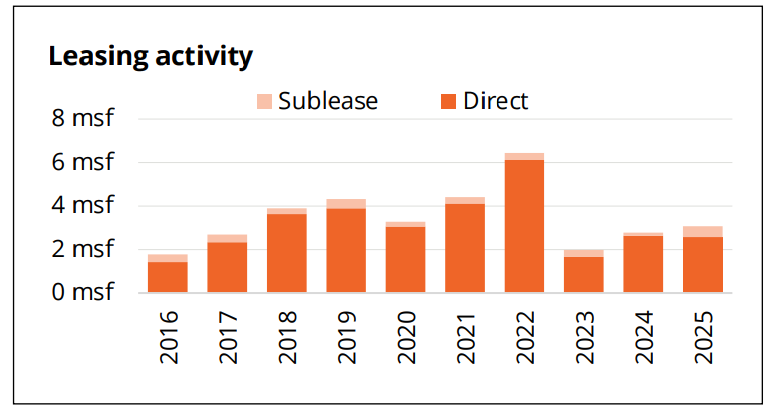
Greater Boston leasing activity. Image courtesy of Avison Young