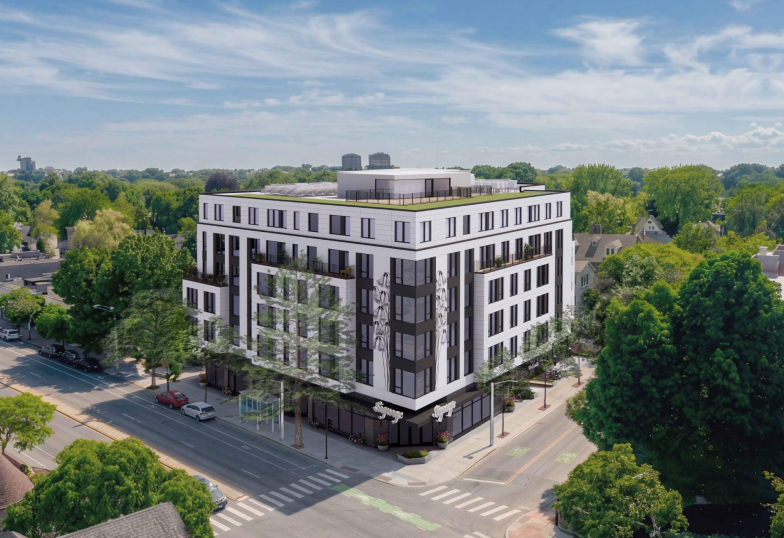
Image courtesy of Peter Quinn Architects
A developer seeking to replace a Walgreens pharmacy near Porter Square with a 71-unit residential building is challenging Cambridge’s requirement for affordable housing units in multifamily projects.
The case takes aim at Cambridge’s policy of requiring developers to execute covenants that permanently restrict rents on affordable units before a building permit is issued, rather than upon completion. The result is an impasse with the project’s lender, Cambridge Savings Bank.
Cambridge-based Old North Development Co. acquired the 1940 Massachusetts Ave. property in October for $8.5 million. Cambridge Savings Bank provided a $5.5 million bridge loan for acquisition and predevelopment.
The proposed 6-story, 61,300-square-foot building conforms to zoning as of right, meaning it does not require approval of any special permits. But under Cambridge’s ordinance, the developer is required to execute an affordable housing covenant for 14 units before a building permit is issued. In other Massachusetts communities, such agreements take effect upon completion, according to the complaint submitted by attorney Robert Stetson of Boston-based Bernkopf Goodman in Middlesex Superior Court on Aug. 27.
Cambridge Savings Bank declined to subordinate the mortgage, according to the complaint. The bank indicated doing so would impair the collateral value of the bridge loan.
Cambridge Savings Bank did not respond to a request for comment.
Developers are responsible for paying $23,600 a week in carrying costs and a potential $450,000 building permit fee, the lawsuit states.
It also characterizes the inclusionary housing ordinance as a violation of the Massachusetts Declaration of Rights by conditioning a permit on forfeiture of private property.
On Aug. 27, Superior Court Justice Sarah Ellis denied the plaintiffs’ request for an injunction ordering the city to issue a building permit, but allowed the lawsuit to proceed.
A message was left with the city of Cambridge seeking comment.
The lawsuit is the second to challenge Cambridge’s requirement that developments with 10 or more units must include a 20 percent income-restricted component.
In December, the Pioneer New England Legal Foundation filed a lawsuit on behalf of developer Patrick Barrett III, who seeks to build an 89,500-square-foot condominium building near Inman Square. The lawsuit argues a municipality must prove that a project will worsen a specific problem, such as a shortage of affordable housing, and that Cambridge’s policy discourages housing development by making projects more difficult to finance.
The lawsuit is in discovery phase in state Land Court.
Such policies also have been implemented in Boston and many suburban communities in recent decades as a way to generate income-restricted housing through private development.
But the financial equation has changed amid rising interest rates and construction costs in recent years, leading to a steep dip in overall housing construction. Real estate industry groups say many communities’ inclusionary development policies now inhibit housing production by making it difficult or impossible for many projects to complete financing.