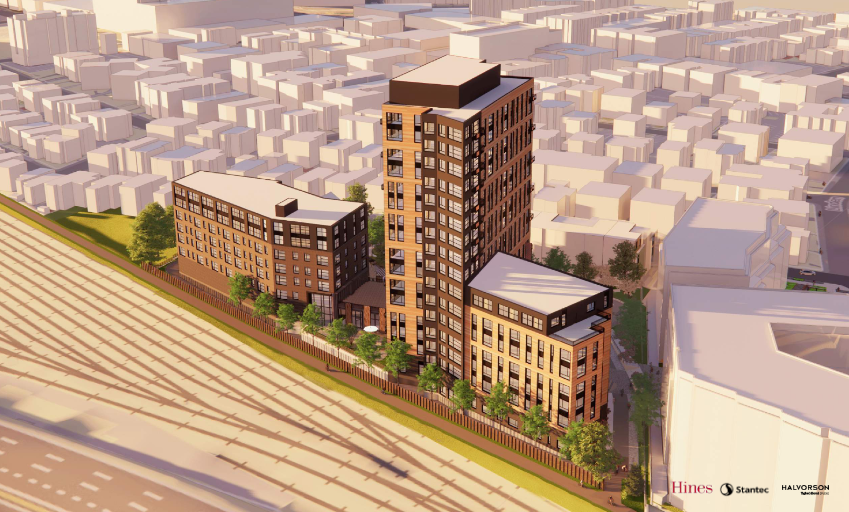
22-24 Pratt St. in Allston. Image courtesy of Stantec
Four stalled developments could receive tax abatements to help complete financing and break ground on a combined 1,400 housing units in Boston next year.
The targeted tax abatements are proposed by the Boston Planning Department as a way to reduce a backlog of approximately 30,000 housing units that have been approved, but not yet begun construction.
“The goal is getting them from right on the goal line to construction,” Boston Chief of Planning Kairos Shen said today.
The abatements total $31.5 million, but Mayor Michelle Wu has indicated she could support up to $100 million in similar agreements with other developers, Shen said, mirroring the city’s $100 million Housing Accelerator Fund. City officials are in talks with developers about approximately a dozen other projects, which could yield a total of approximately 4,000 newly-constructed units.
The largest of the four projects city officials named Monday is Fulcrum Global Investors’ 1 Mystic Ave. project in Charlestown, which is approved for 408 units in a 16-story tower.
The others are Hines’ 318-unit 22-24 Pratt St. in Allston, Nordblom Company’s 333-unit 83 Leo Birmingham Parkway in Brighton and the 341-unit building D at Allston Yards, an infill project at the Stop & Shop Supermarket-anchored retail property at 60 Everett St.
Two of the projects also are seeking to pay into a fund in lieu of locating income-restricted units on-site, Boston Chief of Housing Sheila Dillon said.
The One Mystic Ave. project is seeking approval of an in-lieu payment for its for-sale condominium component, which comprises approximately half of the total, and 22-24 Pratt St. is seeking to locate half of its 54 income-restricted units off-site.
Payments go to a fund that subsidizes construction of affordable units at other projects located in the same neighborhood.
“We have a really healthy pipeline of affordable housing developments” with deeper affordability than mostly market-rate projects can provide, Dillon said. “So we are very interested in getting resources for those projects.”

The current WEEI studios in Brighton would be demolished to make way for a 330-unit apartment complex in a project by Nordblom Co. Image courtesy of Stantec
City’s Pipeline: 10K Units in Stalled Big Projects
In a media briefing at City Hall Monday morning, Shen said the city has identified 47 approved housing projects with at least 100 units that haven’t begun construction, totaling approximately 10,000 unbuilt units.
“We have not talked to all 47 of these” development teams, he said. “We have been pretty open to all of those project proponents: ‘Hey, come and talk to us.’ That has been happening the last few months.”
The four projects named Monday were the closest to being able to break ground he said. The city, he said, has urged the “about a dozen” project teams it was still in discussions with to continue “sharpening their pencils” and find ways to lower their costs so that the city’s tax relief, which averages out to around $22,500 per unit, might enable them to break ground.
Under the proposed agreement, developers would have their property taxes frozen at the current pre-construction value until occupancy. Tax rates would then ramp up to full value on a five- or 10-year period, depending upon developer preference.
The proposal requires approval by the Boston Planning & Development Agency board to authorize negotiations between each developer and the Boston Assessing Department on a Chapter 121B agreement.
It stems from informal talks between City Hall staff and developers who have been unable to break ground in part because of higher interest rates and construction costs in recent years. Wu in 2024 floated, then rejected as too expensive, the idea of tax breaks to move market-rate housing projects into construction.
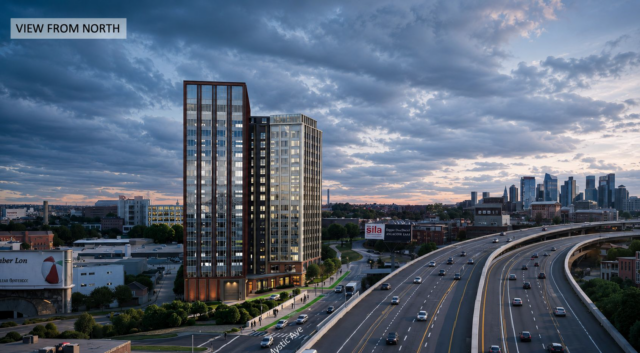
The One Mystic tower would add over 400 units in a 16-story tower in Charlestown’s Sullivan Square. Image courtesy of Stantec
The department focused on projects with at least 100 units that are close to finalizing development financing, Shen said.
The goal is for all four projects to break ground in 2027, but deadlines to break ground and keep the tax agreement in effect are still under negotiation, Shen said.
The parcels currently are paying a small fraction of the taxes that would result following construction. The 22-24 Pratt St. project, for example, currently pays under $92,000 a year but would owe $1.8 million annually with the tax agreement initially, ramping up to $2.1 million.
The next step, Shen and Dillon said Monday, was for the public to weigh in. The BPDA board will vote in mid-October to authorize negotiations that would lead to the first four Chapter 121B deals between the Boston Assessing Department and developers.
Between now and then, Shen said, the city wants public input on whether the projects selected by city staff “are worthy” of the tax abatements, and whether the idea of tax breaks to spur development is a good one.
“This project was approved back then,” he said. “Is it still a good project? Will it have the kind of impact we want? Will it be positively contributing to the neighborhood?”