Lowell is seeking a master developer to build up to 2 million square feet of commercial and residential projects on a 15-acre site on the southern edge of downtown.
Millions of square feet of abandoned mills have been resurrected as housing in post-industrial Lowell, but finding developers capable of completing new commercial and residential projects on vacant parcels in the city’s center has been a steeper challenge.
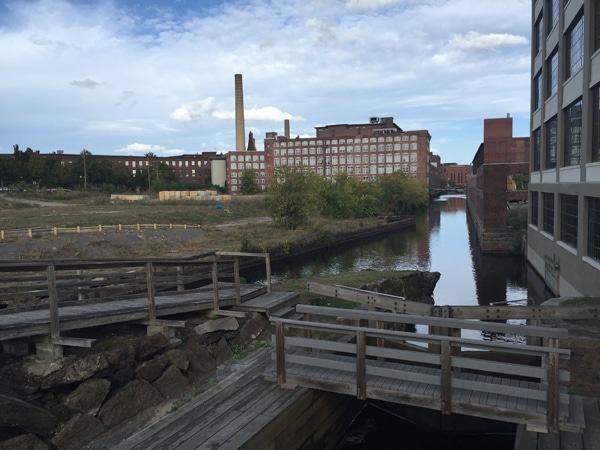
Now comes the latest attempt to raise steel in the Hamilton Canal district, two weed-covered peninsulas bordered by three industrial canals on the southern outskirts of downtown. City officials have asked developers to submit qualifications by Oct. 13 with the goal of spurring up to 2 million square feet of mixed-use development on the 15-acre municipally-owned site.
“We’re providing an opportunity that doesn’t exist in the relatively built-out Gateway Cities,” said Craig Thomas, Lowell’s urban renewal project manager.
The estimated $800 million project, economic development officials say, could effectively double the size of the downtown and create a model mixed-use district within a short walk of the MBTA commuter rail station and regional bus terminal. The city is dangling six fully-permitted sites as a carrot to developers, and is touting a flexible zoning code that encourages a variety of uses and designs.
But attracting ground-up commercial development could be the hardest part, given conditions in the Route 495 north submarket.
The 1.3-million-square-foot Cross Point Towers in Lowell, a former Wang Laboratories headquarters converted into a multitenant office building, has more than 550,000 square feet of space currently available. Ten miles south in Andover, more than 400,000 square feet are available in the Brickstone Square office park. Office rents in Lowell currently range from $16 to $18 per square foot, roughly half that for properties along Route 128. And the Route 495 north submarket has a vacancy rate just under 25 percent, according to brokerage Avison Young’s second-quarter office market report.
A Case Of Bad Timing
Textile mills and the Lowell Machine Shop complex occupied the Hamilton Canal District site through the 1940s and were succeeded by industrial buildings in the ensuing decades. The city acquired the then-vacant parcels in the early 2000s and selected Boston-based Trinity Financial as master developer.
The master plan and zoning for the district was finalized in 2008, while the residential real estate market was in freefall and shortly before the financial meltdown killed demand for commercial development.
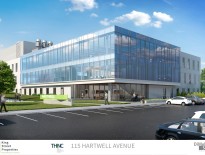
Trinity developed just one commercial building before bowing out last spring: the 55,000-square-foot 110 Canal St. office building that officially opens this week. That project was completed after UMass Lowell leased 22,000 square feet for its Innovation Hub incubator and the state kicked in $1 million to help complete the project.
Trinity also built the 130-unit Appleton Mills, a $64 million affordable and artist housing project that opened in 2011.
The city began the search for a replacement this summer and recently issued a request for qualifications, with more than a dozen representatives from real estate firms attending a recent informational meeting. A committee of city employees will review the submissions with the goal of selecting up to five finalists by the end of October and one or more developers by January.
Developers will be asked to develop a “signature site” including housing, vibrant retail, active first-floor uses and pedestrian-friendly public spaces along the canals. They’re not bound by the previous master plan, with the city encouraging them to submit other ideas for commercial development such as a hotel.
The developer would be required to start the first building within six months of signing a land disposition agreement with the city.
To prime the pump for development, the city is upgrading infrastructure in the surrounding area. It received $15 million toward redesign of the Lord Overpass and road improvements to the Thorndike Street and Dutton Street corridor. With the Lowell National Historical Park, it’s begun a study of expanding the existing trolley service onto the canal site.
And as a key element to attract commercial development, it’s planning to build a 900-space parking garage on the site with a target completion date of 2018.
“All of the brokers tell us the commercial space is not viable without significant structured parking nearby,” Thomas said.
Construction of a $200 million consolidated trial court building on a 3-acre site bordering the canal district is another potential catalyst, bringing hundreds of employees from five courthouses to the neighborhood. That project is dependent upon approval of state funding and is at least three years from completion.
The Economics Of Gateway Cities
Larry Curtis, president of Boston-based developer WinnCompanies, said his firm will seek to be named the new master developer. But Curtis cautioned that expectations should be tempered by the financial realities of development in Massachusetts Gateway Cities, the 26 communities that qualify for a variety of state incentives designed to revive their lagging economies.
Winn won’t propose a “fantasy project” for the sake of being named master developer, Curtis said.
“Some developers promise the world and you intuitively know they can’t deliver,” Curtis said. “It’s sometimes disappointing to a city. But we’ve done so many projects successfully in Lowell that we have an opportunity to be a guide.”
WinnCompanies in recent years has converted former Lowell mills into the 27 Loft, Counting House Lofts and Boott Mills Luxury Apartments and Lofts, and is gearing up for a similar conversion of the adjacent Adden Building in the former Hamilton Manufacturing complex into 75 residential units.
Because rents tend to be lower in Gateway Cities – entry-level lofts in Lowell start in the $1,250 range – developers need a variety of low-income tax credits and historic tax credits to offset their costs and turn a profit.
The Hamilton Canal project will require substantial government incentives, Curtis said, to justify financing for ground-up residential construction. He estimated the full build-out at five to 10 years.
“Anybody that promises quicker is not likely to attain success,” he said.