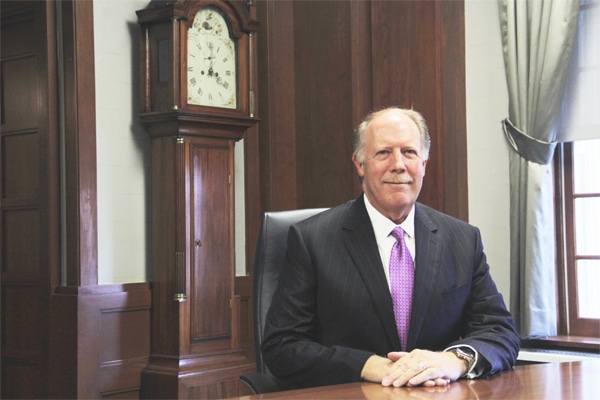
Douglas J. Faithfull
Title: Executive Vice President, Chief Lending Officer
Age: 62
Experience: 38 years
Doug Faithfull broke into the commercial real estate business with little more than plucky determination and an interest in real estate. He got his start as a real estate appraiser, but after a few years of that at Old Stone Bank, he started pushing for a chance at commercial lending. Faithfull cut his teeth on commercial real estate lending along the East Coast during its heyday in the 1980s. Now the head of commercial lending at Cambridge Savings Bank, he sat down with Banker & Tradesman to discuss talent development, the business cycle and growing the bank’s commercial portfolio.
Q: The dearth of up-and-coming talent in commercial lending is a perennial issue. What has your experience been with developing talent internally?
A: We’ve found that folks we’ve brought up through the ranks, whether it’s through credit or some other avenue, have turned out to be really top people. They know the bank, they understand the culture here, they get trained properly in the way that we think things should be done, and in fact we just brought a young fellow from the retail side of the bank over into our construction lending area.
We have a lot of our top folks in the commercial side who have come up through various different parts of the bank and are very successful. In our credit area, we’re bringing in more young folks out of college with just one or two years of experience. Over the last 10 or 15 years, banks got away from credit training and there’s a dearth of high quality credit analysts. The last couple we’ve hired, we’ve had to go Florida or Ohio because in the Boston area, you just can’t get ’em. Once people hire them, they hold onto them, but that’s a good feeder source for our commercial areas. Initially it’s a bit of an overhead expense, but we’d rather have this pipeline available to us.
Q: What are your thoughts on the commercial real estate scene in Boston right now?
A: We’ve been doing a lot of apartment construction. We think we’re seeing the crest here. We’re doing a couple of deals now, but we’re not sure that two years out we’re not sure we want to be starting any new construction.
We’ve done a lot of business with very strong players in very strong locations, but at some point, you’re going to see some saturation. The strong projects in the strong locations will do OK. It’s when you start to see stuff where people come in with deals in locations that are really maybe a tertiary location. It’s not accessible to transportation, there’s no shopping nearby, it’s like sticking something out in the middle of nowhere. It’s not something we’re interested in doing. The people who know what they’re doing know that. A lot of times it’s out-of-town people coming in who hear that Boston’s a great place to invest. And it is, for the right place and the right product, but usually it’s folks who are well established that know where that is.
Q: You mentioned growing your corporate lending and C&I lending as one of the major goals of your new strategic plan. Have you guys developed any specialties under that umbrella?
A: A couple of years ago, we had an industrious lender, Michael Kuhn, who took an interest in the alternative energy segment and three, four, five years ago, not many people were doing that from the financing side, but there were a lot of government grants and subsidies supporting the growth of that industry. He did his homework and he wound up understanding it really well and we started doing some business on solar and wind projects.
The economics of the deals were strong. There was a lot of money behind the debt that we were putting into it. Some folks became pretty proficient and wound up creating these arrangements with communities for power purchase agreements – [they] go out and look at the particular community and they have some kind of a credit rating so they’ll sign a power purchase agreement for 20 years. … We structure the loan so that it pays off in 10 [years], so it’s a pretty good business and we’ve developed a niche in the market for that.
We’ve also done a lot of professional services, architecture and engineering firms, CPA firms, law firms, a lot of business in the food industry, distribution and manufacturing. We’re always looking for other opportunities and niches.
But if you’re going into another area – particularly one that other banks are good at – you’ve got to steal market share from them, you’ve got to ramp up the in-house expertise that knows that business, so it’s a big financial commitment to go into a market you may or may not create a presence in. We like to do it organically. We start out small and if we get a presence in it, if we can ramp it up, then we may make the additional investment, but that strategy’s worked pretty well.
Faithfull’s Five Favorite Movies:
- “The Godfather”
- “The Shawshank Redemption”
- “Casablanca”
- “Witness for the Prosecution”
- “The Hunt for Red October”