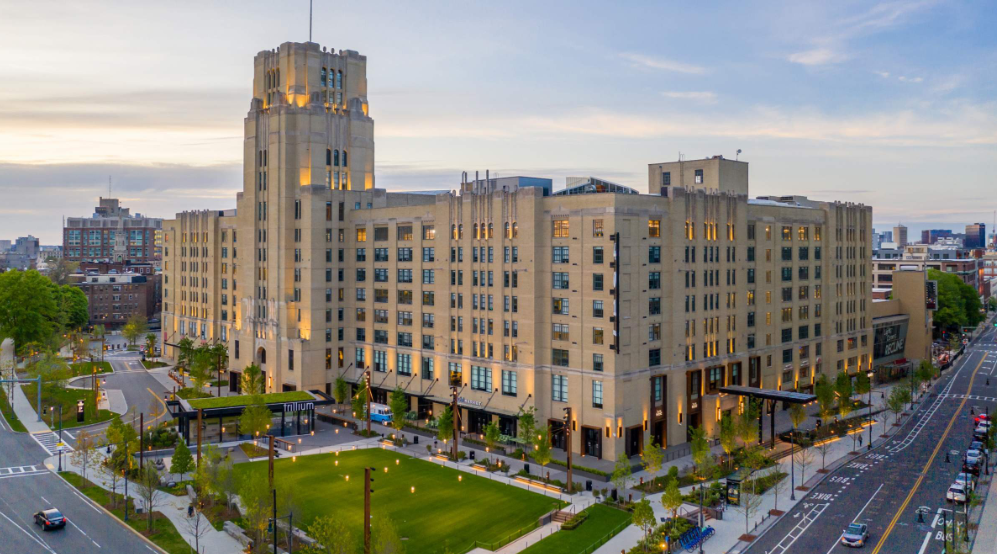
Image courtesy of Boston Planning Department
Alexandria Real Estate Equities announced plans to divest another $2.9 billion worth of properties in response to the lingering life science leasing slump.
One property it won’t be putting on the market is 401 Park Drive in Boston, which has been in the headlines because of the change of management at its Time Out Market food hall.
The nation’s largest life science landlord will market the rest of the building to office tenants rather than convert it to labs as previously planned, executives said during a conference call Tuesday to discuss fourth-quarter financial results.
“We have seen an increase in demand for office space,” CEO Peter Moglia said. “And given the availability we have elsewhere in the Fenway for lab, it made more sense to just go ahead and follow a business plan to lease [401 Park] as office and not create any more lab space in the near future.”
Alexandria continues to develop a lab tower at 421 Park Drive that has 392,000 square feet available.
Previously known as the Landmark Center, 401 Park is a former Sears warehouse built in 1928 that has operated as office space in recent decades. Currently, it has long-term leases with Longwood Medical Area institutions, Alexandria Founder Joel Marcus said. One major tenant, restaurant software vendor Toast, relocated to Fort Point in 2024.
Marcus acknowledged the Trump administration’s cuts to National Institutes for Health funding may reduce research hospitals’ real estate requirements.
“That may start to move institutions in a different direction,” Marcus said. “But at some point, institutions still need to get space, and both Fenway and the LMA are the best locations for that. So it actually is a pretty easy decision.”
Alexandria’s 1.6 million square-foot Fenway portfolio also includes the 201 Brookline Ave. lab tower.
Alexandria reported a net loss of $1.1 billion for the quarter, despite selling 26 properties for a combined $1.5 billion.
The dispositions included Watertown’s Arsenal Mall, which Alexandria had planned to partially redevelop as a life science project complementing its 1.1 million square-foot Arsenal on the Charles campus.