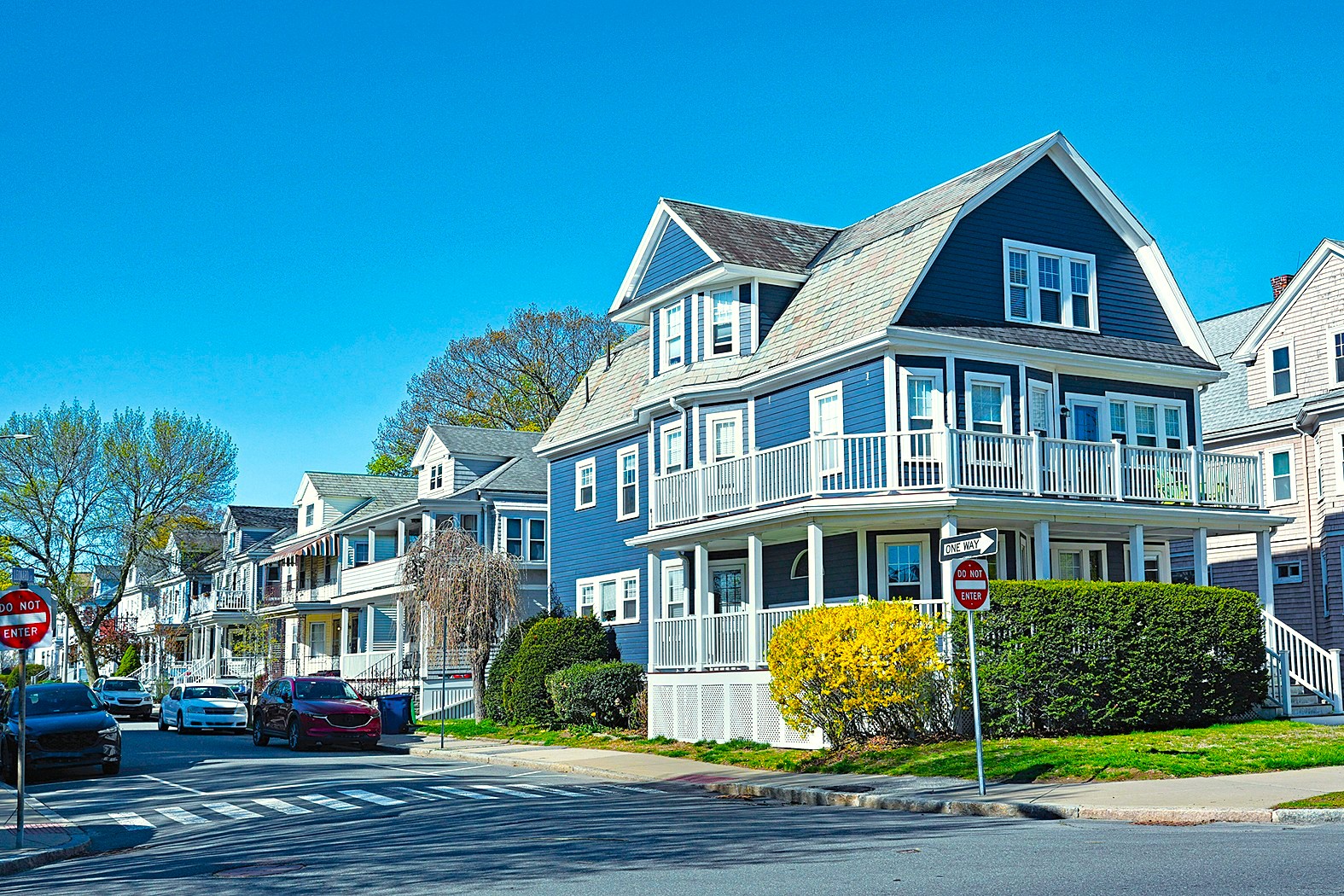
Two-family homes in Boston. Data shows the area’s buyers trail the nation in their power over sellers. iStock illustration
Homebuyers in Massachusetts are missing out on something the rest of their peers in America have this year: the power to make sellers cut their prices.
But a rift is starting to emerge between the non-luxury and luxury markets that’s letting better-off buyers be a lot pickier.
The Boston metro has the lowest rate of seller concessions in the country according to data from the brokerage and listings portal Redfin.
Only 26.7 percent of Boston-area homebuyers got things like money toward repairs, closing costs or mortgage rate buydowns from a home seller in May 2026. The national average is 46 percent.
When it comes to actual cuts to a home’s sticker price – long an elusive prize for many Greater Boston buyers – a mere 15.1 percent of homes on the market in July had a price cut in the Boston area, according to listings portal Realtor.com. This is down three percentage points year-over-year.
Compare that to 20 percent nation-wide, or over 28 percent in the Phoenix or Austin, Texas markets and nearly 31 percent in the Denver area.
The five counties that make up Greater Boston (Norfolk, Suffolk, Essex, Middlesex, and Plymouth) saw the prevalence of price changes drop from 10.47 percent in June 2025 to 9.93 percent in June 2026 according to data from MLS PIN, the real estate listings service for much of Massachusetts. Norfolk County saw the greatest decline (from 11.6 percent to 6.34 percent) over the same period.
Buyers continue to outnumber sellers in Boston according to Redfin economists’ estimates, adding to demand that can sustain sellers’ ability to secure their desired sales price. Redfin estimates that there were 13,000 buyers in the market in June compared to 12,000 sellers. After collapsing over the course of 2024, 2025 and early 2026, that gap has begun to widen again in recent months.
Not Enough Homes to Buy
All these data points reflect the shortage of homes for sale which has long been an issue in Massachusetts, said Jonathan Miller, the noted real estate commentator and president of appraisal firm Miller Samuels.
“While inventory’s up slightly, it’s still really low,” he said.
The distinction is heightened by comparing this year to the years before the COVID-19 pandemic. Greater Boston inventory increased by 8.8 percent year-over-year to 3,493 active listings in June 2026, according to MLS PIN. That’s down from 4,319 in June 2019 – itself a 19.1 percent drop over the same month in 2018.
This is an issue that has not and is not going away according to Miller. The market is still saddled with many potential home sellers who feel locked into their homes by their low-interest-rate mortgages, today’s high interest rates and high home prices.
“The real problem is the lock-in effect for existing inventory, which traditionally has been around 90 percent of total inventory,” Miller said. “It’s less than that now because rising rates are keeping people from listing their properties, especially if they bought in the last five or six years at a mortgage rate at 4 percent or below. We’re still stuck, and I think this is a long-term problem.”
An aspiring homebuyer in the Boston metro needed to make $216,995 to afford the median-priced home in Greater Boston in June, according to a recent report from Redfin. Only 11.6 percent of single-family home and condominium listings in the area were deemed affordable to the median earner by Redfin, meaning their monthly mortgage payments would cost no more than 30 percent of their income.
Correct Pricing ‘Critical’ Despite Tightness
While inventory has increased from where Greater Boston was in 2025, a lack of supply is continuing to make buying in Massachusetts difficult.
“I’m finding that there’s a tremendous amount of talk about in the U.S. that there’s so much more inventory but really, the Northeast and the Midwest are still devoid of adequate supply,” Miller said. “Even the Sun Belt, which has a lot more supply coming in, that’s actually tightening up a bit too.”
While the supply and demand dynamics are still in sellers’ favor, the economy and mortgage rates are straining both buyers and sellers.
“We’re in this K-shaped economy,” Redfin Chief Economist Darryl Fairweather noted. “If you have your money in the stock market, you’re probably richer now than you were a year ago. If you can use the money from the stock market to buy your home, you’re less impacted by high mortgage rates.”
Still, the median number of days a home spent on market has begun to tick upwards in the Boston metro according to Realtor.com. The market saw a seven-day increase on a year-over-year basis in June, the listing portal’s economists said, giving at least some hope to today’s buyers.
“Pricing in reasonable proximity to what value is, is probably much more critical now than it was a year or two ago,” Miller said. There just isn’t free reign to pick a price, and then the buyer will pay.”
While the luxury market tends to be immune to impact from concerns in the economy or high mortgage interest rates, that isn’t necessarily the case anymore.
Luxury Sellers’ Power Lagging
Overall, the non-luxury real estate market in Greater Boston is allowing sellers to stand their ground on pricing, but the luxury market is seeing an increased number of concessions and price changes.
For Greater Boston homes sold between $1.5 million and $2 million, the share with price changes rose from 9.6 percent in 2025 to 11.4 percent in 2026, according to MLS PIN.
Real estate professionals said that today’s buyer is looking for more polished homes than prior generations. Whether it is a beach house on Cape Cod or a starter condo in Greater Boston, the condition of a home can have drastic impacts on a buyer’s perception of the property.
“In terms of avoiding price cuts or concessions for a seller, the condition is really important to people,” said Paul Grover, principal and cofounder of Berkshire Hathaway HomeServices Robert Paul Properties. “The real premium can be the houses that not only are neat and clean, but that are mint [condition] or brand-new.”
Non-luxury homes in the Boston metro are selling for 102 percent of their list price while luxury homes are selling for 99 percent of their list price, according to Redfin. The company defines a luxury home as existing in the top 5 percent of a market by price.
Like the entire real estate market in Massachusetts, the luxury market had a slow start to the year as poor weather had buyers hold off their home search while sellers delayed putting their home on the market. The availability and relative softness of luxury rents has helped keep first-time luxury buyers on the sidelines, too, Banker & Tradesman reported last month.
“It looks like the second half is catching up,” Grover said. “In terms of demand, I would say demand is strong but buyers, they are taking their time and really evaluating properties and prices. If something’s not selling, it could very well be that it’s overpriced, and so you could definitely see price reductions.”
While luxury prices in Boston are up 2 percent year-over-year, according to Redfin, there are fewer active luxury active listings and more non-luxury active listings. The company defines “non-luxury” as homes in the 35th–65th percentile of any market, by price.
This data shows luxury sellers holding on to their homes, said Fairweather, the Redfin chief economist.
There were 1,425 active luxury listings in Greater Boston in June, Redfin’s data shows, a 4.1 percent decline year-over-year.

Greater Boston buyers hunting for a luxury home, like a unit in a Back Bay townhouse, have much more power than their less well-heeled peers, data shows. iStock illustration
Even Luxury Buyers Face High Costs
Even in the luxury market, rising prices can impact the ability to sell a home even if a seller isn’t feeling the lock-in effect thanks to buying with cash, having a larger down payment or simply having more financial freedom.
Occasionally high-end homeowners will get unsolicited offers for their homes, Grover said, but the cost of buying a new property can outweigh the benefits of selling.
“It’s not unusual for them to say, ‘Well, that’s great to know our house is worth $15 million, and we paid $7.5 million for it 10 years ago, but where do we go once we sell it for the $15 million?’ They are not going to get anything else here,” he said. “Even if they were buying a fix-up or a teardown, in no time they would be at $15 million or above to try to replace [their current home].”

Sam Lattof
While economic factors such as mortgage interest rates don’t have as strong of an effect on a luxury buyer compared to the average homebuyer, they want to avoid overpaying for a new home just like anyone else.
“The buyers – no matter how strong a position they are in financially – they are savvy buyers,” Grover said. “They, for the most part, do not want to overpay. They’re almost as discerning or savvy as ever in terms of what things are selling for and the days on market, and trying to determine price per square foot.”
If a property sits on the market, it can have lasting ramifications for how it is perceived by potential buyers. Even if a home seller decides to lower the price, buyers will still be wary of purchasing the home. This kind of cloud can lead to a seller taking their property off the market and straining inventory further.
“The challenge with those properties is that, if they’re priced too high and they sit on the market, sometimes even when the price has come down and they haven’t gone yet, sometimes people are waiting for them to come down again,” he said. “Buyers, sometimes, can miss good opportunities, and they just think there’s something wrong with it, other than price, because the days on market is high.”