Jade, a 325-unit apartment complex developed by Greystar at 202 Mill Road in Everett, began resident move-ins in early summer/ Image courtesy of @flauntboston
Apartment rents are trending downward in a handful of communities near Boston, including a 3.6 percent annual decrease in multifamily development hotspot Everett.
ApartmentList reported that median rents in Boston and Cambridge rose 1.1 percent in the past year and 3.3 percent in Somerville.
But rents dropped 3.6 percent in Everett, which attracted approximately 3,000 apartments in its “Commercial Triangle” district south of Revere Beach Parkway following its rezoning from industrial to residential. Rents also declined on an annual basis in Norwood, Peabody and Waltham by 4.9, 5.4 and 1.3 percent, ApartmentList reported.
Large multifamily developers have experienced softer-than-expected demand for apartments nationwide and in Greater Boston.
Equity Residential, which owns nearly 6,900 apartments in Greater Boston, reported its local properties have been underperforming this year.
“What we’ve seen right now is just a little bit more softening than you otherwise would have expected,” Chief Operating Officer Michael Manelis commented during a conference call in October to discuss the company’s third-quarter financial report. “When we started this year, we thought this urban core of Boston was going to do better than the suburban. It’s absolutely playing out that way where the urban portfolio is outperforming the suburban, but it’s just not as robust as what we would have thought.
For the first nine months of 2025, Equity Residential’s Greater Boston portfolio had a 96.3 percent occupancy rate with average rents of $3,703. Executives said they expect its performance to weaken further in the fourth quarter.
“I think right now what we’re seeing is a confirmation that a weaker biotech sector, pullback in university and research funding, immigration challenges are all just chipping away at overall demand levels in the market,” Manelis said.
AvalonBay Communities attributed the slump to reduced job growth, macroeconomic uncertainty, lower consumer confidence and a reduction in government hiring and funding.
November is historically the slowest month for apartment leasing, according to ApartmentList. Nationwide, rents fell 1 percent in November and 1.1 percent on a year-over-year basis, reflecting “shaky housing demand,” according to ApartmentList researchers.
A recent report by brokerage Colliers also reported that apartment rents have plateaued across Greater Boston as a recent construction wave crested. A stagnant job market and a decline in international college students have limited demand in some neighborhoods.
New deliveries have pushed vacancy rates up from 5.6 to 6.3 percent in the past year, according to the report. Allston-Brighton, which has seen nearly 1,000 apartments completed in the past year, now has a nearly 11 percent vacancy rate.
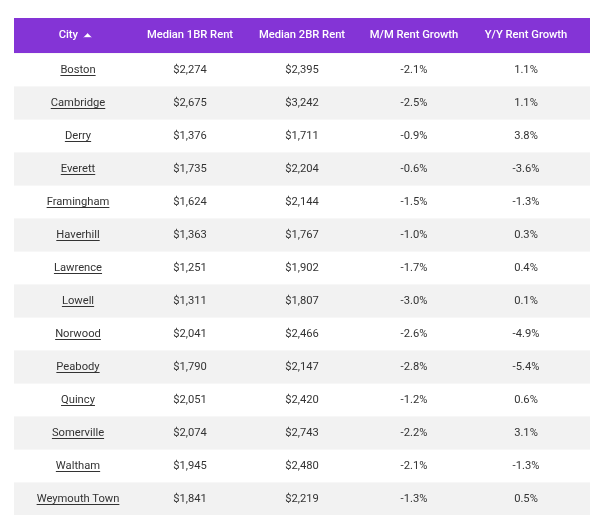
Image courtesy of ApartmentList