Rep. Barney Frank, D-Mass., presides over a House Financial Services Committee hearing on Capitol Hill in Washington, D.C. on Feb. 11, 2009. Photo by Haraz N. Ghanbari | Associated Press / File
The late Rep. Barney Frank left a complicated legacy in the Massachusetts banking industry: at once caring deeply for the health of local financial institutions, yet co-authoring one of the biggest drivers of bank consolidation today.
“He cared about banks, he greatly cared about the local banks,” said Dan Forte, Frank’s close friend and the former president and CEO of statewide trade group Mass Bankers. “His intention was always, is this going to hurt our banks’ ability to lend, and therefore [cause a] loss of credit to the local communities and local consumers. That was always his aim. That’s what he hung his hat on throughout his career.”
Frank died May 19 at the age of 86. The piece of legislation that bears his name, the Dodd-Frank Act, will likely be remembered as his hallmark achievement in 32 years representing Massachusetts in Congress and 10 years as the leading Democrat on the House Financial Services Committee.
This sweeping legislation tried to prevent another near-collapse of the American economy, as happened in 2008. It also created the Consumer Financial Protection Bureau, the Financial Stability Oversight Council to monitor systemic risk, and the Orderly Liquidation Authority that sought to wind down large failing financial institutions without taxpayer bailouts.
The act also created new standards for mortgage lending and added extra compliance burdens that many blame for forcing small, local banks to the edges of the American financial system.
“The Dodd-Frank Act was a really difficult piece of legislation that you were really trying to protect America from Wall Street, but it also had consequences for Main Street,” said Hanscom Federal Credit Union CEO Peter Rice. “While the act was extremely important in establishing credit unions’ independence, it did put new regulatory burdens on financial institutions, the same ones whether you were Wall Street or a local neighborhood institution.”
Helped Protect Mutual Banks During Crisis
Two years before co-authoring Dodd-Frank, as the American financial sector looked ready to sink amid the 2008 financial crisis, Frank played a central role in making sure mutual banks in Massachusetts and across the country got access to the same lifejackets the federal government was handing out to megabanks.
Interbank lending had ground to a halt as institutions feared loans wouldn’t be repaid by peers holding failing subprime mortgages and exotic financial instruments tied to them. Soon, there were concerns that the entire United States financial system would collapse.
To stop the runaway financial crisis, Congress created the $700 billion Troubled Asset Relief Program (TARP). The program allowed the federal government to purchase so-called “toxic” mortgage-backed securities and other assets from drowning banks, taking equity positions in exchange that stabilized these lenders.
But mutual banks were initially left out. And as the stock market and financial system continued to wobble, it was unclear if these bedrock community banks would be vulnerable to going under without access to TARP’s lifelines. Frank, then the chair of the House Financial Services Committee and one of the most powerful politicians in the country, moved into action.
“There was one night where I got a call from Barney’s chief of staff that said, ‘Barney needs you to talk to the Secretary of the Treasury tomorrow morning, and explain to him what a mutual bank is, and why they should be allowed to be involved in the TARP program,’” Mass Bankers’ Forte said. “He recognized that with any type of legislation, particularly crisis legislation, there will always be unintended consequences.”
TARP helped stop the American banking sector from collapsing, said Steven Antonakes, then Massachusetts’ top state banking regulator.
“That injection of capital really strengthened the industry during a time of incredible stress and allowed banks to continue to lend during that period of time as well,” said Antonekes, who’s now Eastern Bank’s chief risk officer.
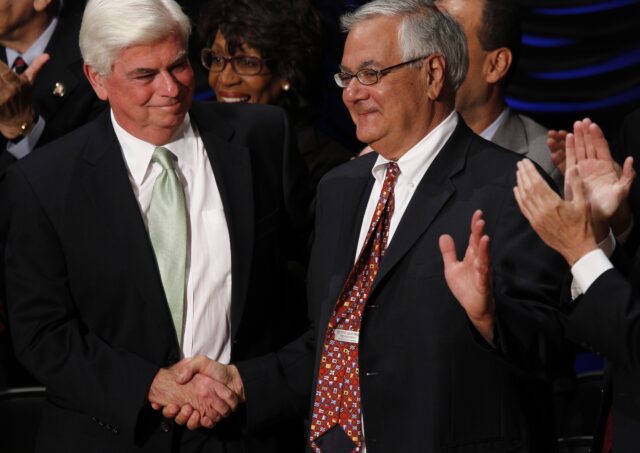
Sen. Chris Dodd, D-Conn., left, and Rep. Barney Frank shake hands at the signing ceremony for the Dodd-Frank Wall Street Reform and Consumer Protection financial overhaul bill in Washington, D.C. on July 21, 2010. Photo by Charles Dharapak | Associated Press / File
Dodd-Frank’s Mixed Legacy
While in Congress, Frank always considered how a piece of legislation such as would affect Massachusetts in particular. He exhibited genuine care for the disenfranchised whether it be his constituents or financial institutions, Forte said.
But the new lending standards Frank co-authored in the Dodd Frank Act, intended to stop banks and mortgage companies from repeating the 2008 crisis by lending to borrowers who couldn’t repay, caused some smaller institutions to roll back their mortgage lending – as shown in a study conducted for the Mercatus Center at George Mason University – and overall hurt their ability to lend. The increased regulatory requirements forced some smaller institutions to hire more compliance staff and the mortgage lending process increased in length.
A study from Harvard University found that community banks’ share of U.S. banking assets and lending market fell from over 40 percent in 1994 to around 20 percent in 2015. Conference of State Bank Supervisors President and CEO Brandon Milhorn noted in a May 2025 speech that community banks now hold about 11 percent of banking assets in the United States.
“The unfortunatecy of that act is that a lot of smaller institutions did get caught up in collateral damage in Congress’ attempt to limit the potential damage in the future,” Hanscom FCU’s Rice said. “It put the same regulatory burden on smaller institutions.”
Frank’s biggest legislative achievement came in for criticism at the time from the American Bankers Association and other industry and right-leaning groups as being too harsh, and from some left-leaning voices as not doing enough.
“If no one’s particularly happy with what you did, you probably did the right thing because you’re not going to please everybody at all times,” said Antonakes, who went on to become a senior leader at the Consumer Financial Protection Bureau during the Obama administration. “A lot of people were involved at the time, whether it be the banking industry, the administration [and] consumer advocacy groups, as well. So, I think he was balanced. [Frank] had a healthy respect for capitalism but also believed that these markets had to be appropriately regulated.”
Fixing Unintended Consequences
The law had another consequence that’s kept open the door to one of today’s most popular survival strategies among mutual banks: the mutual holding company.
There was a push during the writing of the Dodd-Frank Act to prohibit mutual banks from creating mutual holding companies, Forte said, but ultimately it did not succeed. Today, numerous local mutual banks have combined their holding companies to share services while remaining their mutuality, or issued shares to raise capital while still remaining a mutual bank.
“At the end of the day, [Frank] wanted to get to the right place,” Antonakes said. “He didn’t assume he knew everything. He had genuine curiosity.”
Additionally, when unintended consequences arose from legislation, Frank wasn’t afraid to try and rectify his mistakes, executives said.

Sam Lattof
When Fannie Mae and Freddie Mac were potentially about to become insolvent during the 2008 crisis, Frank and then-Treasury Secretary Hank Paulson decided that the preferred stock at the two lenders, then quasi-private corporations, would default and would not be bailed out, Forte said. Frank came to find out that the information he and Paulsen were relying on, which stated that few banks owned the stock, was not up to date.
“I’m in the office early on Monday getting prepared to be able to talk to Barney and explain some of the consequences, and he called me to say, ‘Hey, Dan, this happened, this is not good. We understand it, but we had to make a decision,’” Forte said. “‘The [defaulting] bonds would have had a cascading effect on other countries because they were owned by corporations and other foreign entities. The preferred stock was owned by individuals in banks. Now we realize how many banks this is going to impact.’”
With Forte’s help, mid-crisis, Frank secured a change to the type of loss that the default would cause for banks, from a capital loss to an ordinary loss. This change saved banks millions of dollars at a time when every part of the financial system was desperate for liquidity, according to Forte.
Additionally, as the Dodd-Frank Act was being drafted, the Senate version included a strict limit on the loans that could be made to one borrower. Forte noted how he informed Frank of the potential impact on Massachusetts banks, which led to changes being made.
“We brought this to Barney’s attention, that we had a lot of small cooperative banks that took advantage of the more generous loan-to-one-borrower limits,” Forte said. “Barney got an exemption in the Dodd-Frank bill, so that Massachusetts banks that had those type of abilities could continue to do that. He was always cognizant of the nuances of the legislation, its impact on banks and therefore its impact on consumers specifically.”