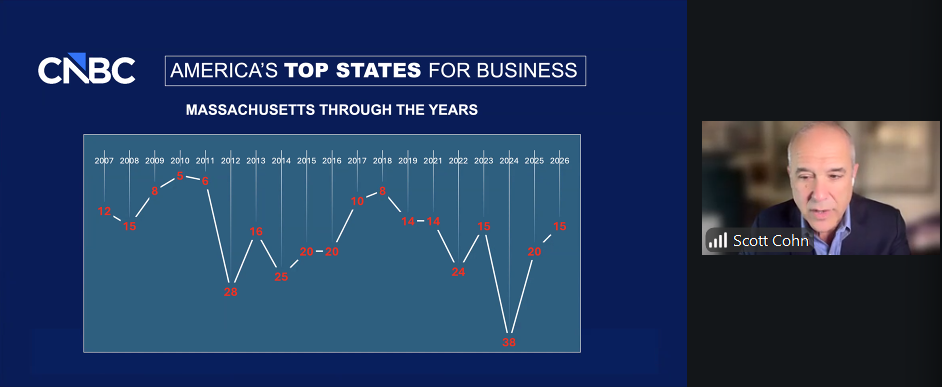
CNBC Journalist Scott Cohn speaks at a briefing on July 29, 2026, showing where Massachusetts has been ranked in the outlet's Top States For Business rankings over the years. CNBC screenshot | via State House News Service
Massachusetts rose to 15th overall in CNBC’s top states for business ranking in 2026, though it still faces challenges due to how much it costs to do business here.
Massachusetts’ overall ranking is up five places from 2025. The 2026 study ranked the Bays State first in education, sixth in access to capital, and eighth in technology and innovation. The state was, for the second year in a row, ranked 49th for cost of doing business. It ranked 27th for business friendliness – up from 42nd in 2025 – and 26th for workforce, a decline of three places from the prior year.
While Massachusetts has strengths in education, quality of life, innovation, access to capital, and permitting speed and efficiency, study creator and CNBC journalist Scott Cohn said Wednesday, its weaknesses stem from high wages, taxes and rent, housing unaffordability, and issues with physical infrastructure like roads and bridges.
‘Ease of Permitting’ Added to Rankings
CNBC scored all 50 states on 138 metrics across 10 categories of competitiveness. Infrastructure was the top-weighted category for rankings in 2026, marking the first time CNBC factored “ease of permitting” into its rankings, it said. Infrastructure includes not just roads, bridges and ports, but electricity and water, broadband, and shovel-ready sites, Cohn said, “something that companies are talking about more and more.”
Massachusetts’ infrastructure ranking rose from 35th in 2025 to 24th in 2026. Cohn said during a briefing hosted by the Massachusetts High Technology Council that Massachusetts is strong with regard to permitting timelines, but that it still struggles in other areas.
“We look closely at electricity, and while Massachusetts does OK, not great, on cost, as you might imagine for utilities, we also started to look at just overall generating capacity, and you’re kind of down on that,” Cohn said. “And site readiness, the shovel-ready sites that I talked about, Massachusetts still has not really done anything with that to the extent that site selectors want.”
Economy was weighted second-highest in the rankings, followed by workforce weighted third, encompassing metrics such as worker attraction, career education and availability of workers. Massachusetts “did a little better for job growth than in the past” due in part to its educated workforce, Cohn said, “but people are not staying in Massachusetts. They’re not moving to Massachusetts. We’ve talked about this in the past. That is a problem for the state.”
Lack of Workforce Training Dings Mass.
Cohn said Massachusetts’ middle-of-the-pack workforce ranking is also in part because the state “doesn’t put a lot of emphasis on career education, community colleges, worker training programs [and] vocational education,” which he said companies are looking at more as they’re deciding where to locate. The state’s healthcare and reproductive rights strengthened its quality-of-life rankings, which were strained by the cost of childcare and air quality, he noted. High wages, rents and taxes “hurt you with cost of doing business,” he added.
The concept of competitiveness has boiled over in Massachusetts, as concerns about the state’s standings inspired initiative petitions this cycle and lawmakers have been pushing for policies they say will boost the state’s economic competitiveness in various categories.
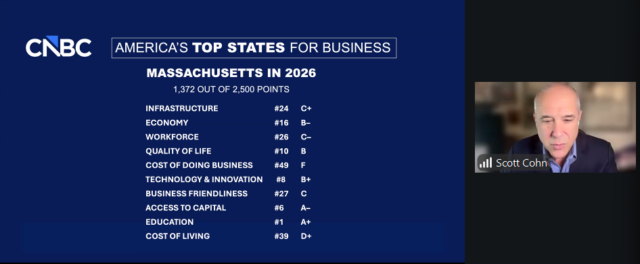
CNBC Journalist Scott Cohn speaks at a briefing on July 29, 2026, showing where Massachusetts stands in various metrics in the outlet’s Top States For Business rankings. CNBC screenshot | via State House News Service
The High Tech Council is backing a measure that will go before voters in November that would change the state tax revenue limit. It also backed a question that would have decreased the state’s income tax rate from 5% to 4%, which was thrown off of the ballot by the Supreme Judicial Court. Senators also recently moved to reinstate local happy hour policies in their economic development package, claiming it would improve the state’s competitiveness among young people.
‘Your Challenge Is Reducing Costs’
Business groups for years have been warning about high levels of outmigration of young people, families and businesses from Massachusetts, and on the Senate floor last week, Minority Leader Bruce Tarr cited research from the Pioneer Institute that put the state’s economy in the category of “in recession or at high risk,” and suggested the state “cannot spend our way out of the economic posture that we’re in.”
“Your challenge is, in Massachusetts reducing costs, that’s nothing new. Get the people back or get them to stay. Work on the infrastructure. Career education, maybe that’s a policy issue, but again, it’s something that companies and site selectors are looking for, that pipeline of people who can do advanced manufacturing,” Cohn told the High Tech Council and others at the Wednesday briefing.
The state’s competitive advantages “should not be taken for granted,” the Council wrote July 9 when the CNBC rankings came out. “Massachusetts continues to experience one of the highest rates of domestic outmigration, losing 182,000 residents to other states since 2020, with many relocating to states offering a lower cost of living and doing business. Sustaining the Commonwealth’s leadership will require addressing the affordability pressures that increasingly influence where people choose to live, work, and invest.”
Ohio, North Carolina and Virginia were ranked America’s top three states for business, Ohio coming in first in both infrastructure and cost of doing business, North Carolina first in economy, and Virginia second in infrastructure. Texas came in fourth overall, ranking first in workforce.