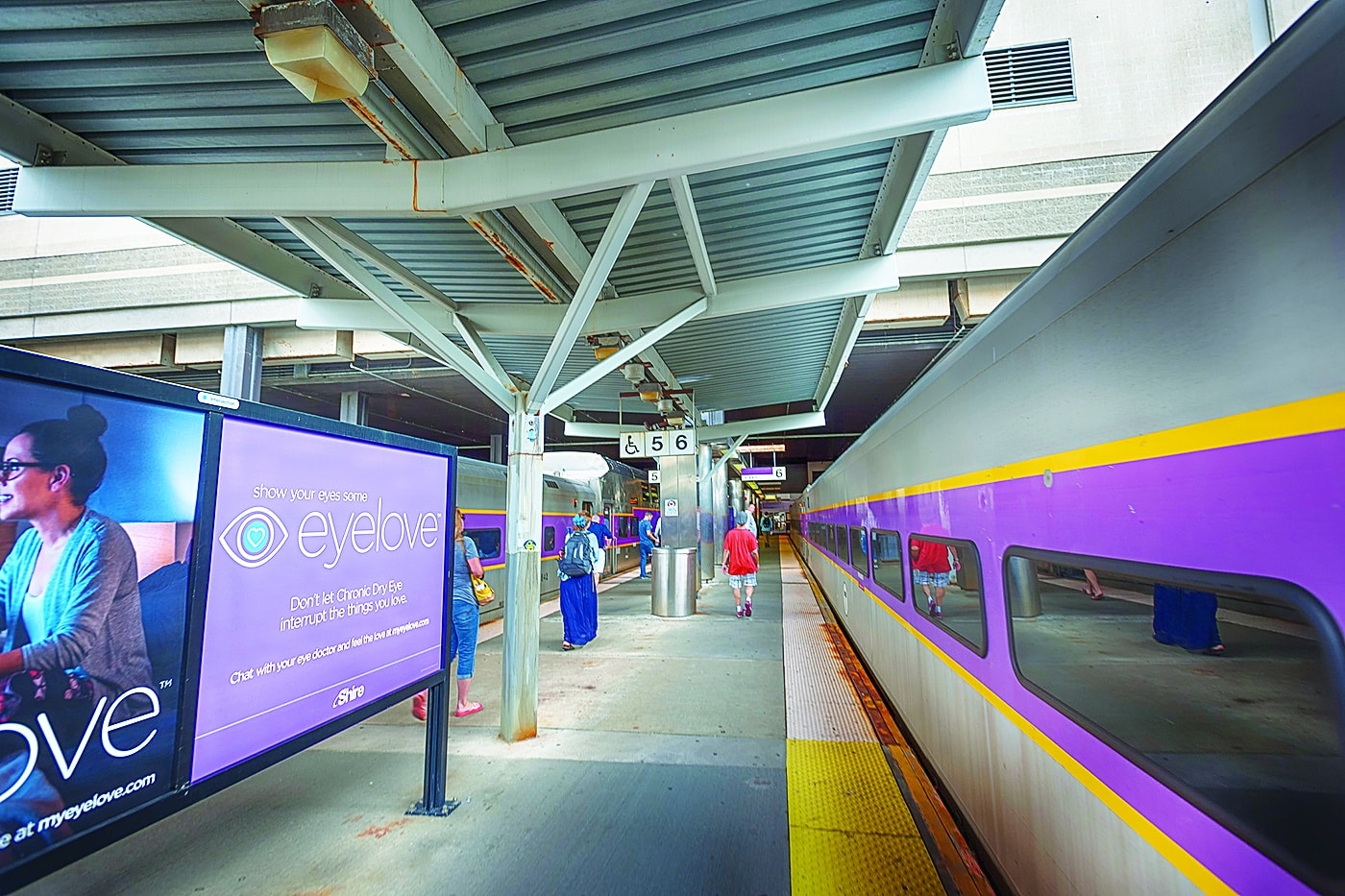
Passengers leave an MBTA commuter rail at Boston’s North Station. iStock photo
Business leaders in Massachusetts and around the country are starting to call attention to the impending expiration of federal transportation funding, and pressing Congress for a strong and steady investment in urban transportation.
With sign-on from a former head of economic development in Massachusetts, a coalition of nine business-backed groups from metro regions they say account for 30 percent of national GDP last week unveiled its priorities for the next iteration of surface transportation funding. The group, the Metropolitan Civic Leadership Alliance, said the current authorization is set to expire Sept. 30.
“Massachusetts competes globally on talent and innovation – and transportation is the connective tissue that makes it all possible,” Jay Ash, a Baker administration economic development secretary who is now president and CEO of the Massachusetts Competitive Partnership, said. “Reauthorizing federal transportation funding is essential if we want to support job growth, connect workers to opportunity and keep the American economy strong. Congress needs to act with urgency.”
The last federal surface transportation authorization came in 2021’s Infrastructure Investment and Jobs Act. That law was projected to provide $4.2 billion in federal funds for highway and bridge investments in Massachusetts over its five-year term, a 29 percent increase over the previous authorization, according to the national transportation research nonprofit TRIP. But Trump administration figures have indicated a hostility to funding for some public transit projects, raising questions about future federal funding.
Greater Boston Chamber of Commerce CEO Jim Rooney also indicated transportation funding is one of his group’s top priorities this year.
“While we have turned a corner on transportation in some ways, we are not where we need to be,” he said in a recording of his annual outlook speech posted to the chamber’s YouTube account. “We must stay focused on improving reliability and convenience in our public transit systems throughout the state.”
Boston Chamber Chief Calls on Legislature
Under Rooney, the chamber has been a frequent advocate for more transit investments as a way to reduce the Boston area’s congestion and cost-of-living issues by unlocking housing at transit nodes.
The T’s financing typically depends on transfers from state coffers for its operating budget, as its portion of the state sales tax has significantly unperformed predictions over the last 20 or so years and ridership remains below pre-pandemic levels thanks to the increased prevalence of working from home.
The T’s capital budget – used to buy new trains, repair infrastructure and build facilities needed to expand service – is covered by federal money and proceeds from the state Fair Share Amendment, also known as the Millionaires Tax.
With revenue from the latter far exceeding predictions, state legislators tapped the funds to close a $700 million gap in the T’s budget for its current fiscal year. But the transit agency still faces a $560 million budget deficit for its next fiscal year, which begins in June. The agency has been chipping away at its $20 billion-plus repair backlog, but still has years of repairs ahead of it to make up for decades of underinvestment, agency officials say.
The ballot question that created the Fair Share surtax on incomes over $1 million originally promised the money would be split evenly between transportation and higher education projects, but the Legislature has not adhered to that in recent years.
That practice should change, Rooney said.
“We still have work to do. This is why we are calling on the Legislature to continue to prioritize mobility across the state. The income surtax was designed to invest in our future. It is time to split those funds 50/50 between education and transportation,” he said.
Advocates: More Money Needed
Statewide advocacy group Transportation for Massachusetts, also known as T4MA, and the progressive Massachusetts Budget and Policy Center think-tank released a report Wednesday arguing that uncertainty around federal funding and the MBTA’s own unstable financing structure means Massachusetts needs to find new sources of revenue for transit.
“Fair Share has been a major success story for transportation, but as we write our next chapters, we need more resources to fully repair and improve our systems,” Reggie Ramos, executive director of T4MA, said in a statement. “We’re turning the corner on decades of underinvestment, and we can build on the strong foundation Fair Share provides to finally bring to life the system our residents deserve.”
The state’s Fair Share revenue hit $3.38 billion last budget cycle, but is likely to plateau in the coming years, the T4MA report predicted, and won’t be enough to cover operations, repairs and improvements at the MBTA, regional transit agencies that serve communities outside Boston, and for the state’s roads and bridges all at once.
The report suggests investigating highway tolls, congestion pricing, local-option taxes and higher fees on ride-hailing and food-delivery apps.
The conservative Massachusetts Fiscal Alliance blasted the T4MA report, issuing a statement from Executive Director Paul Craney claiming that ““Beacon Hill activists keep insisting that the answer to every problem is more money, even as residents and businesses continue to leave Massachusetts. The income surtax was sold as a solution, yet we’re still hearing the same demands for new taxes while affordability worsens and economic growth stalls.”
State House News Service staff writer Colin A. Young contributed to this report.