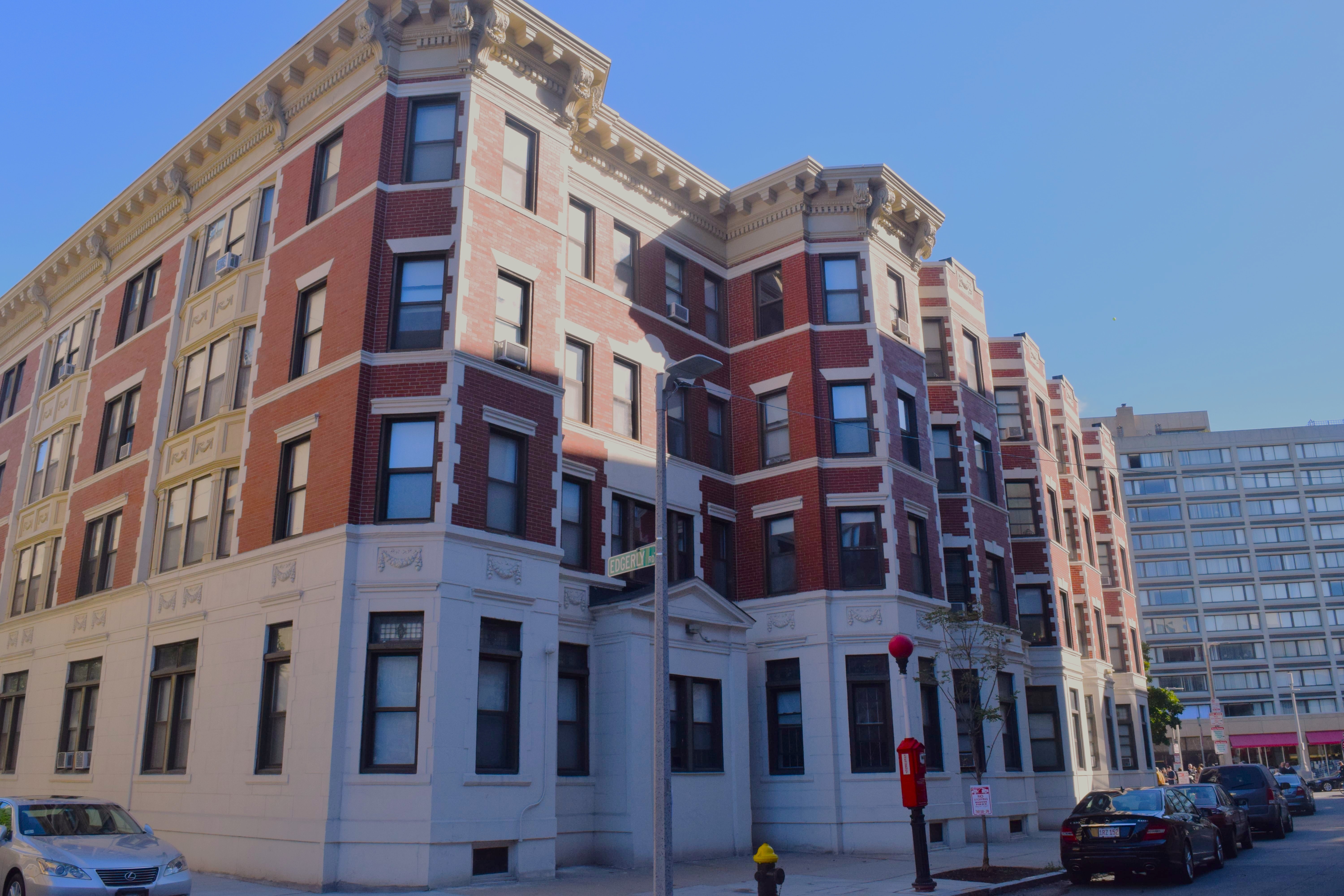
A grant from Boston’s Equitable Emissions Investment Fund will help Fenway Forward replace gas-fired boilers at its Burbank Gardens property, complying with the BERDO ordinance. Photo courtesy of Fenway Forward
Gas-fired boilers at the Burbank Gardens apartments in Boston’s Fenway need replacement, presenting a looming costly capital improvements bill for owner Fenway Forward.
Boston’s Equitable Emissions Investment Fund (EEIF) provided a partial solution for the nonprofit affordable housing developer. A $245,250 grant will offset the cost of electrifying the 52-unit building’s hot water system.
“The system was nearing the end of its useful life, so it was good timing to do this rather than replacing our gas-fired system,” said Ari Sugarmen, a project manager at Fenway Forward.
The entire cost of the project is yet to be determined, but Fenway Forward also is tapping into a Climate Ready Housing grant from the state Executive Office of Housing and Livable Communities, Sugarman said. It’s also in talks with MassDevelopment about potential funding programs for deep energy building retrofits. The organization has begun long-term planning for BERDO compliance across its entire real estate portfolio, comprising 11 buildings owned and under management.
Expected to begin in late summer, the Burbank Gardens project illustrates the complex decisions that both nonprofit and commercial developers face to comply with Boston’s building decarbonization mandates.
Big Demand for Emissions Aid
Boston’s Building Emissions Reduction and Disclosure [BERDO] ordinance covers approximately 5,500 buildings representing 5 percent of the city’s total building stock, but generating approximately 40 percent of emissions.
Owners not in compliance with the requirements, which took effect last summer for the largest buildings, soon will begin subsidizing other projects through the Equitable Emissions Investment Fund as payments start rolling in.
Properties in environmental justice communities, as defined by certain income, minority population and non-English speaking population thresholds, are eligible for the EEIF grants, along with neighborhoods with poor air quality.
Demand for the EEIF grants exceeds supply thus far. In 2024 and 2025, the BERDO Review Board awarded $1.5 million from the fund to seven projects, from a field of 41 applicants seeking over $11 million.
Because the alternative compliance payment requirement only kicked in last July, the city seeded the fund upfront with $3.5 million from its operating budget.
The seven projects receiving funding ranged from solar arrays at Dorchester Bay Economic Development Corp.’s Wilder and Glendale apartments to HVAC replacement at a Boys & Girls Club of Dorchester clubhouse.
It’s unclear how much income from alternative compliance payments will become available this year, according to a statement from Oliver Sellers-Garcia, Boston’s environment commissioner and Green New Deal director. The BERDO Review Board has approved up to $600,000 in EEIF grants for 2026. Close to 85 percent of the buildings subject to BERDO are in compliance with the current targets, the department estimates.
The department will open the next round of grant applications on March 30.
Calculating the Long-Term Cost-Benefit
Building owners can comply with BERDO through building retrofits, purchases of renewable energy credits or alternative compliance payments to the EEIF.
For some building owners, alternative compliance payments are a Band-Aid solution, said Jesse Stanley, a partner who oversees green building tax incentives at consultants KBKG. But as a recurring annual cost, they make less financial sense than a strategic investment that garners return on investment through reduced energy costs.
“When it becomes something you’re paying every year indefinitely, instead of a strategic investment with a return on investment in reduced energy costs, it becomes an endless and increasing penalty with no payback, so it should be avoided as much as possible,” Stanley said in an email.
Renewable energy credits also have drawbacks in Boston and other cold climate cities, because they only apply to electricity usage and not on-site combustion such as natural gas boilers.
Finally, building upgrades should be planned to comply with the stepped up emissions reduction targets in coming decades, Stanley said.
Councilors Question Net Zero Zoning Effects
Clean energy requirements for new construction in Boston also are adding a new cost variable for developers, prompting the City Council to debate changes to Article 37 of the zoning code, also known as the Green Buildings and Net Zero Carbon zoning.
It applies to projects with at least 15 housing units of 20,000 square feet of new construction, requiring most buildings to attain net-zero standards by 2030 through on-site renewable energy, purchases of renewable energy credits or alternative compliance payments.
Affordable housing developers including WinnCompanies and some Zoning Commission members opposed the new requirements when they was enacted last year, predicting it would make projects harder to finance.

Steve Adams
This month, District 4 Councilor Brian Worrell proposed amending the code so that developers don’t have to pay for costs such as renewable energy certificates until after all other approvals except the issuance of a building permit.
“Review costs pile up fast and become prohibitive. For many developers of affordable housing, these costs can add up without a guarantee of a subsidy,” Worrell said. “It creates a real barrier to creation of the affordable housing stock we need.”
The amendment is under review by the council’s planning, development and transportation committee.