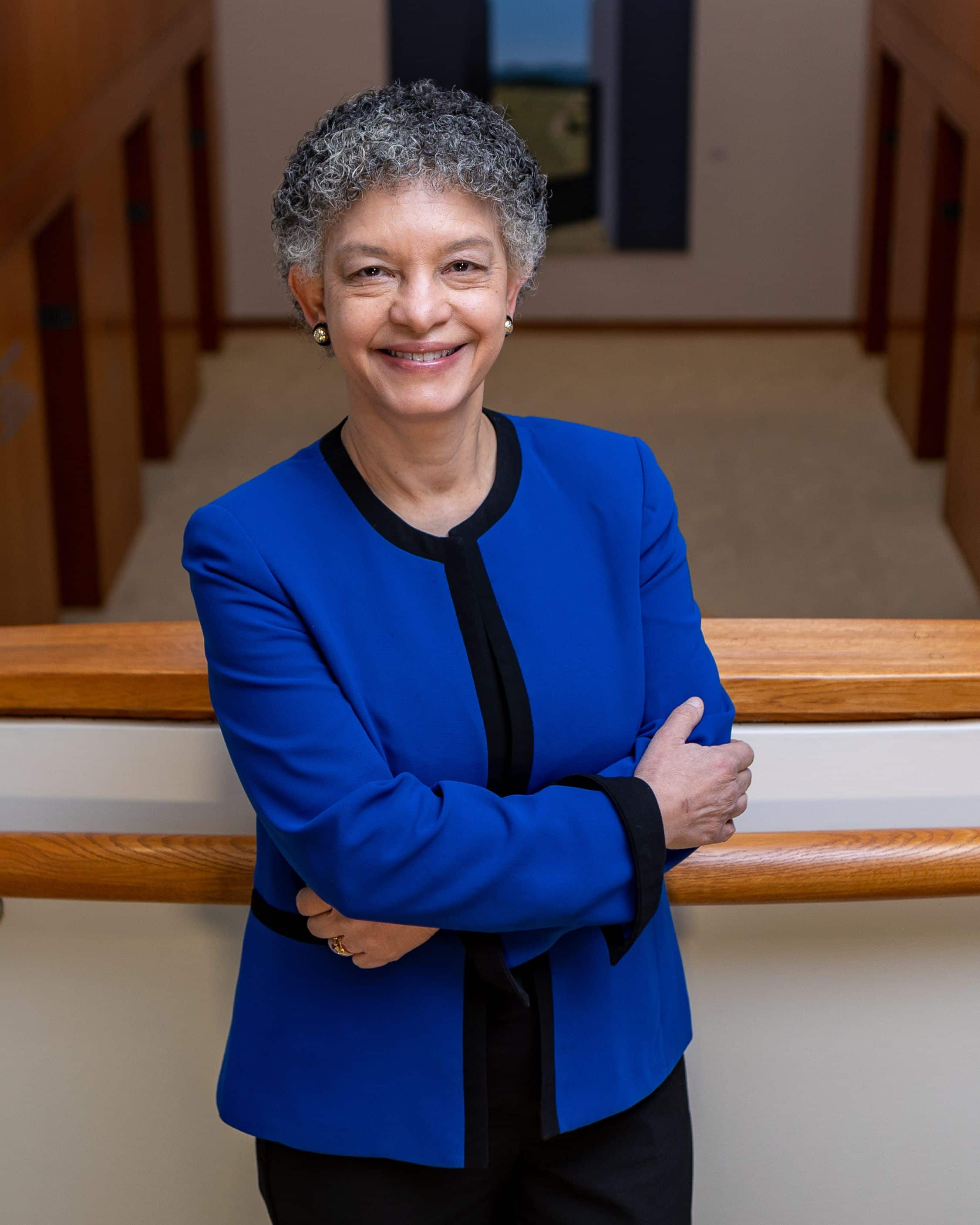
Susan M. Collins. Photo courtesy of the Federal Reserve Bank of Boston.
The president of the Federal Reserve Bank of Boston thinks interest rates will have to rise by more than half a percent this year and stay high to make sure inflation is kept under control.
Demand for goods – and their prices, in some cases – is receding, Susan M. Collins told a conference the bank hosted at its headquarters Thursday morning. And energy prices are coming down along with rent growth, she added, but wages are still growing faster than 2 percent per year and both job vacancies and the rate at which people quit jobs are both still high – signs, she said, that demand for labor remains too strong.
“While it is promising to see the effects of higher rates starting to spread from the most interest-sensitive sectors to the broader economy, more is required to ensure a steady path toward our inflation target. As monetary policymakers, restoring price stability remains our imperative. Thus, I anticipate the need for further rate increases, likely to just above 5 percent, and then holding rates at that level for some time,” Collins said.
After the last meeting of Federal Open Market Committee, the Federal Reserve issued guidance predicting that its benchmark short-term rate will reach a range of 5 percent to 5.25 percent by the end of 2023.
But Collins also cautioned that it’s time the FOMC, on which Collins sits, slows the pace of interest rate increases. Over the last year, the Fed has raised its benchmark interest rate precipitously, from between 0 percent and 0.25 percent in early March 2022 to between 4.25 percent and 4.5 percent in mid-December.
“More measured rate adjustments in the current phase will better enable us to address the competing risks monetary policy now faces – the risk that our actions may be insufficient to restore price stability, versus the risk that our actions may cause unnecessary losses in real activity and employment,” she said. “I am well aware that, as with inflation, the costs of higher unemployment are disproportionately borne by people of color and economically vulnerable groups.”
The FOMC finishes its next meeting Feb. 1.
High interest rates are being partly blamed for the downturn in commercial real estate sales and development activity that began in the second half of 2022. Some in the industry are anxious to see rates drop in the coming year.
“Maybe rates will go down in the fourth quarter, I think we’re in for some really hard times,” Catalyst Ventures Development founder Daryl Settles told an audience at a commercial real estate industry forum hosted by trade group NAIOP-MA in Boston’s Seaport District Wednesday morning.
Still, two of Settles’ fellow panelists at the NAIOP event said, the local and national economies will be healthier in the long run for rates not to drop too far.
“I could see a world where rates come down pretty quickly” in a 2023 recession, Bain Capital Principal Jacquelin Salon said. “I kind of hope the fed doesn’t go back to zero interest rates. it’s obviously helpful, being in real estate, for cap rates but it’s not healthy over the long term for smart and prudent capital allocation”
“I think rates need to stay high. We’ve been at a 5 percent fed funds rate before and real estate markets managed fine through those periods so in the long term it’s healthy for rates to be a little higher,” TA Realty Vice President of Research Lisa Strope said.