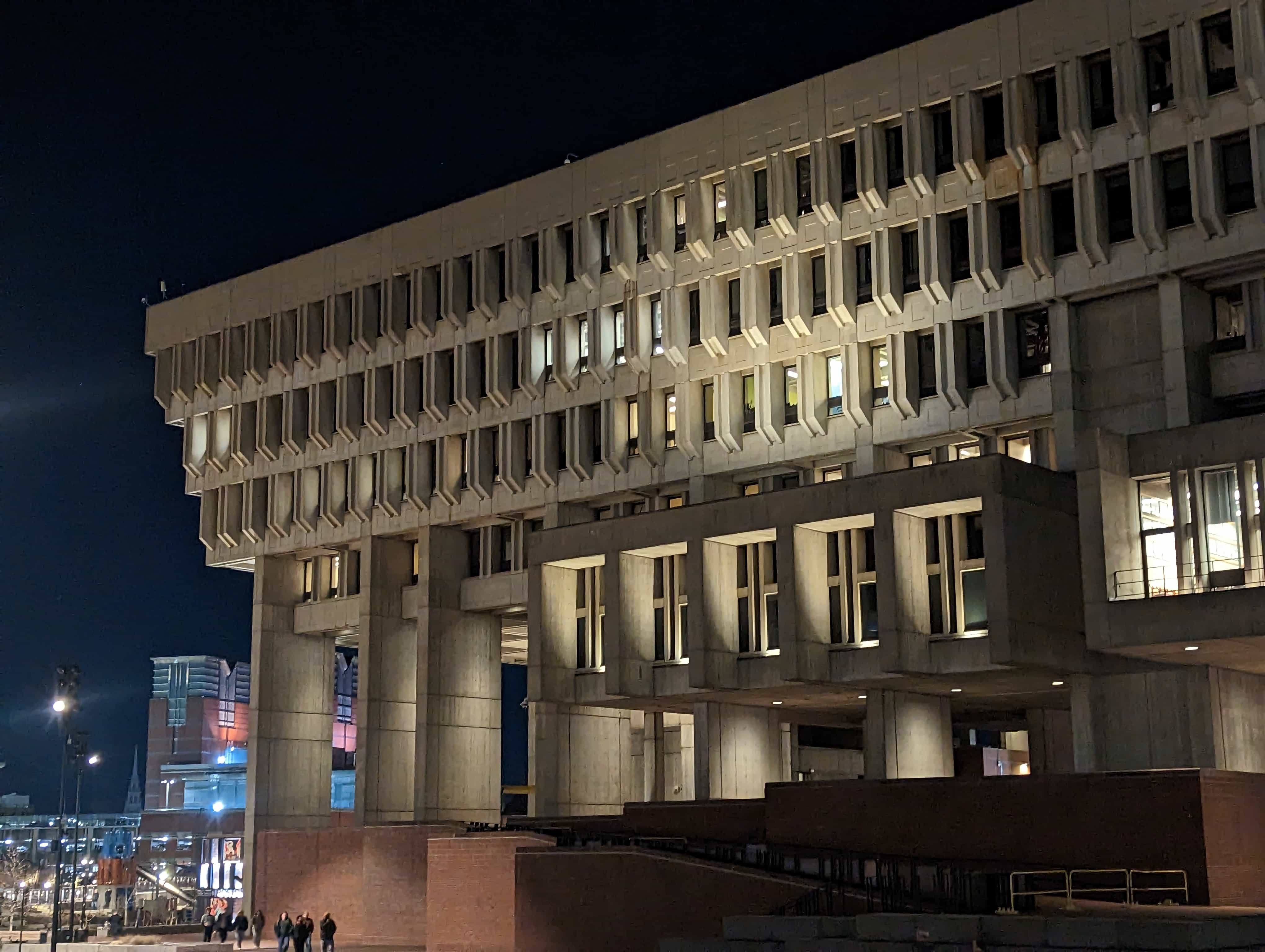
Boston City Hall. Photo by James Sanna | Banker & Tradesman Staff
The city of Boston increased assessments on at least 150 commercial landlords that appealed their valuations, according to a legal group that claims a widespread practice of retaliation by the Assessing Department from 2023 to 2025.
The city voluntarily provided data on all commercial properties valued at $6 million or more to the Pioneer New England Legal Foundation, which is suing the city in Suffolk Superior Court.
The list includes 150 properties and 182 instances in which property taxes increased after an appeal to the state Appellate Tax Board [ATB], said Frank Bailey, president of the legal foundation. The disputed payments from such properties are approximately $19 million.
The foundation also released a map of the properties in question.
The findings are prompting the foundation to redouble its demand that the state Department of Revenue conduct an investigation of Boston’s assessing practices. This week, it sent its fourth request to DOR Commissioner Geoffrey Snyder asking him to investigate whether Boston’s valuation process is retaliatory.
A DOR spokesperson did not respond to a request for comment.
In May, Superior Court Judge Peter Krupp rejected the city’s motion to dismiss the case.
In his ruling, Krupp said the city’s alleged practice “plausibly chills all commercial property owners from exercising their right to seek an abatement.” The affected parties, then estimated at 60 property owners, are seeking financial damages and alleging violations of First Amendment rights.
City officials have responded to the allegations by stating that the city “stabilized” the assessed values of properties with open ATB appeals by raising them to previous years’ levels.
The practice appears to have been designed to minimize the drain on municipal tax revenues from declining commercial assessments, Bailey said.
“What happens here is the city is borrowing these additional dollars from the commercial sector,” he said during a media briefing Tuesday.
Boston Mayor Michelle Wu has unsuccessfully sought to shift a larger share of property tax collections onto the commercial sector than the maximum allowed under state law, in an attempt to minimize residential property tax increases.
The lawsuit previously estimated 60 commercial properties were affected by the alleged scheme. It represents the owners of 148 State St., a Financial District office building that was acquired in 2017 for $41 million.