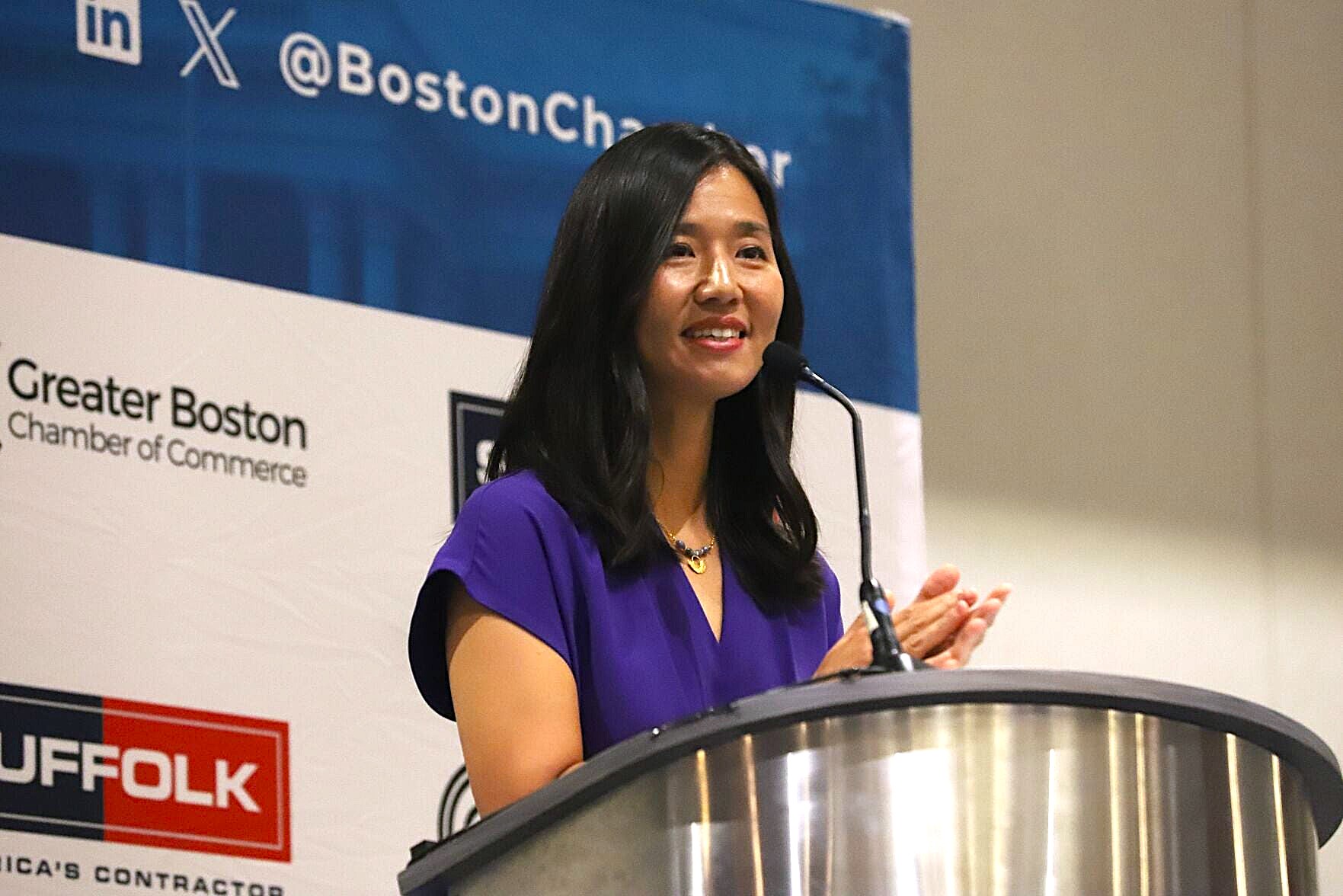
Boston Mayor Michelle Wu speaks at the Greater Boston Chamber of Commerce on Wednesday, Sept. 16, 2026. Photo by Sam Drysdale | State House News Service
The World Cup gave Boston a test case for an argument Boston Mayor Michelle Wu and other municipal officials have made for years: Cities need more freedom to respond to their own economic circumstances.
Speaking Wednesday at a Greater Boston Chamber of Commerce event, Wu pointed to the economic activity generated by the World Cup as evidence that giving cities more flexibility can benefit local businesses. She also used the appearance to lay out a broader agenda for changes she wants from Beacon Hill in 2027.
At the center of her pitch was the complaint about the statutory limits Massachusetts places on municipal governments – from property taxes to liquor licenses – and the mismatch, she said, between those limits and the economic pressures cities now face.
“There are very clear ways to partner,” Wu said of state and local government. But, she added, “it is when the economic headwinds push us beyond what was anticipated in state legislation sometimes decades ago that we get to a structural challenge.”
Wu, Beacon Hill at Odds
The comments add texture to the tension over state versus local control that has put Wu at odds with Beacon Hill.
Opponents of proposals allowing greater local control over policymaking have argued the result could be a patchwork of confusing rules for residents and businesses to follow and send mixed messages about the strength of state laws.
Wu pointed to Proposition 2½, a voter law that limits annual increases in property tax revenue, as one example. The law allows local voters to agree to larger increases through override votes. But Wu said that when inflation and other costs rise faster than the 2 1/2 cap, cities too often need to cut services simply to keep pace.
“There is a reason why there have been an important and unprecedented number of Proposition 2½ ballot overrides suggested and gone after by different communities, because when we have a state tax and municipal revenue and financing system that… caps you to two and a half percent increase, and is the largest revenue source, it prevents any city from generating additional revenue without going to the entire state. That means it’s okay under low or even normal sort of inflationary times, but anytime inflation is more than two and a half percent, that means cities are having to then find ways to cut just to stay even,” Wu said.
She said municipalities need resources to address priorities including housing, climate resilience, schools and transportation.
“We don’t expect – I mean, I’ll ask for it – but I don’t expect the state’s going to suddenly hand over the reins to cities to say, ‘Okay, you set your own taxes, you make your own decisions, you decide how many liquor licenses, you decide when businesses can open and close.’ All decisions that many other cities get to make on their own because it affects within their boundaries,” she said.
Transfer Taxes a Key Sticking Point
Instead, she called for more flexibility when economic conditions change and dedicated funding for areas including housing “through a transfer fee,” the arts, climate infrastructure, transportation and school construction.
Wu has repeatedly pushed for a transfer fee on high-value real estate sales, a proposal that would require approval from the Legislature. Her latest home rule petition, approved by the Boston City Council in April, would allow the city to charge up to 2 percent on real estate transactions over $2 million, with revenue directed toward affordable housing. Similar proposals from other communities have failed to win final approval on Beacon Hill.
“Even outside the room here, I was speaking with a couple of my fellow mayors about just the scale of the challenges that some of our cities are under,” she said.
Cambridge City Manager Yi-An Huang, Somerville Mayor Jake Wilson, Medford Mayor Breanna Lungo-Koehn, Melrose Mayor Jennifer Grigoraitis, Newton Mayor Marc Laredo, Everett Mayor Robert Van Campen, Revere Mayor Patrick Keefe and Malden Mayor Gary Christenson were all in attendance.
Chamber CEO Jim Rooney also thanked Boston city councilors (seven of the 13 on the council) for being at the event. It did not appear that Wu’s speech drew much in-person interest from state lawmakers.
Another area of friction: The Senate in January rejected Wu’s proposal to temporarily shift a greater share of Boston’s property tax burden onto commercial property owners. The Senate voted 33-5 against the proposal, which had cleared the House.
Wu backed primary challengers to two senators who opposed her tax plan. Sen. Nick Collins defeated Latoya Gayle by 11 percentage points, while Sen. William Brownsberger defeated former Wu aide Daniel Lander by 35 votes after a recount.
Mayor Pushes for Nightlife Rules Change
While the World Cup coming to Massachusetts was bound to lead to an economic surge, Wu said nightlife rules allowed by the state in connection with the global event provided her with an example of the type of local flexibility she wants.
Lawmakers approved a temporary program this summer allowing participating cities and towns to extend alcohol service by one hour, up to 3 a.m., and create designated outdoor drinking areas. The measures required local governments to opt in. Wu said the results in Boston showed that businesses could benefit when municipalities have the authority to respond to unusual circumstances.
“In the last two weeks of June alone, World Cup visitors spent an estimated $83 million just within the city of Boston,” Wu said. She said bars citywide reported a 27 percent increase in sales over the previous year, while downtown bar spending nearly tripled on a day when several World Cup teams played.
She argued that the changes benefited businesses beyond the areas where the largest crowds gathered.
“That’s what we’ve heard from our small businesses: If you give them the ability to do what they need to do, and create the slightest excuse for people to come together, they’ll make it happen,” Wu said.
The temporary rules also demonstrated, she said, that local governments could tailor the changes to their own communities. Businesses that did not want to extend their hours did not have to do so, while restaurants that closed earlier could still benefit from customers remaining in the area and moving between establishments.
Wu said the state should consider making the rules permanent, empowering cities and towns to make key decisions.
After the forum, Wu told reporters her administration has continued discussing the issue with House lawmakers before, during and after the World Cup. The Senate and Healey administration have supported making some of the changes permanent, while the House has been more cautious.
“We saw proof of what a difference it makes when businesses can make their own decision about how to operate,” Wu said.