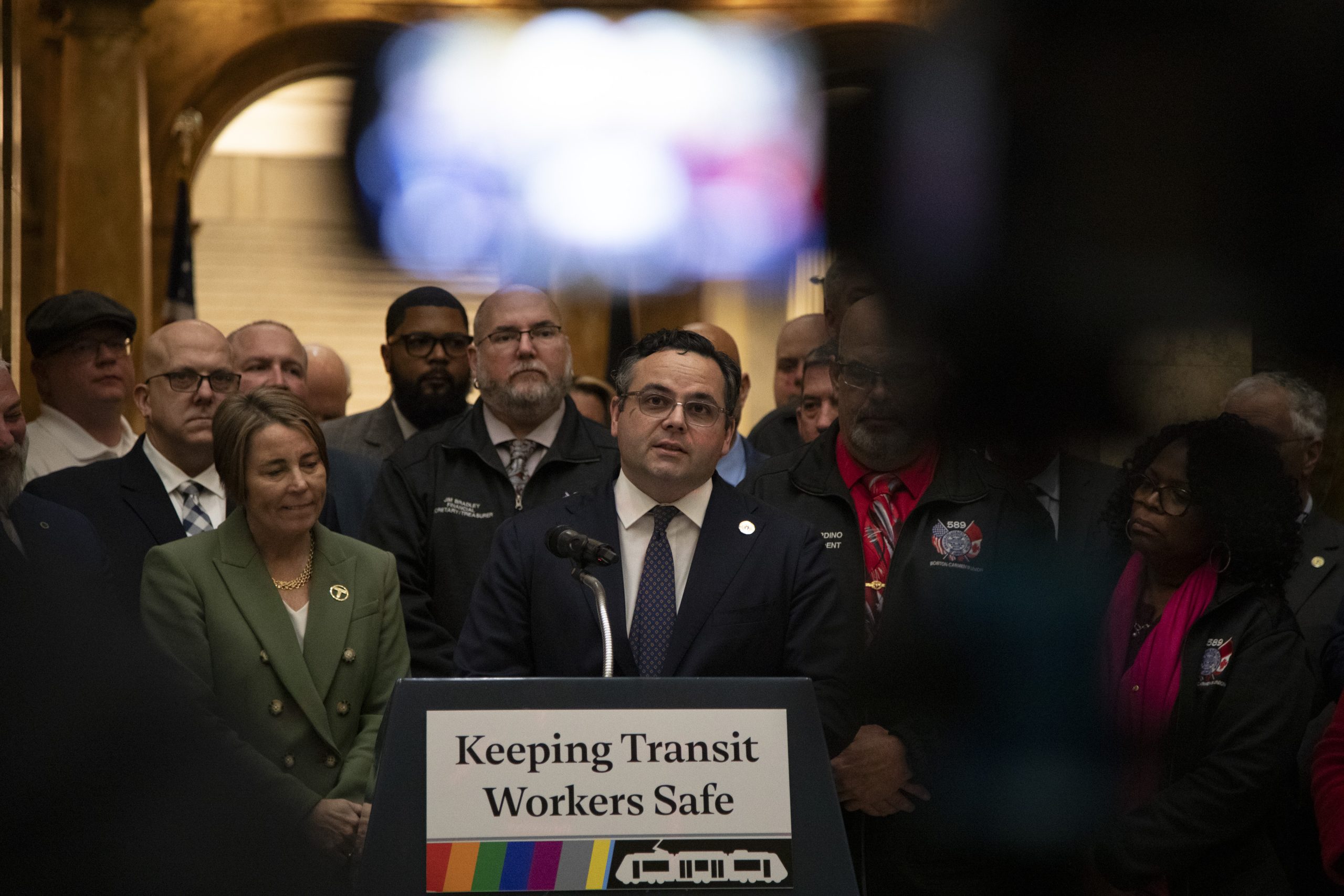
Sen. Nick Collins of Boston speaks at a bill-signing event on Dec. 3, 2025. Photo by Chris Lisinski |CommonWealth Beacon / CC BY-4.0
After turning up their collective noses at Mayor Michelle Wu’s latest attempt to rebalance Boston’s property tax bills, Senate leaders are ready to forge ahead with their own relief plans – and to wrench open the financial curtains on a record-setting ballot question field.
A key Senate committee on Thursday advanced four bills that would give communities more leeway to soften the blow of sudden tax increases. Two of the bills are authored by senators representing Boston who have drawn Wu’s ire for not backing her approach.
The bills are set for a vote on Thursday, Jan. 15, according to a Senate official, as is another measure that would require ballot question committees to more frequently disclose their fundraising and spending.
The sudden movement of the tax bills sets the stage for another round of finger-pointing and political elbowing about the growing burden of residential property taxes in the state’s capital.
As homeowners faced a series of steep increases, Wu tried on several occasions to secure permission from Beacon Hill to temporarily shift some of the burden to businesses. Her plan had buy-in from the House, but it never gained traction in the Senate and then became a vector for renewed cross-branch tension.
After Wu made her latest ill-fated pitch in December, Senate leaders instead began to move a pair of bills from Sen. Nick Collins of South Boston and Sen. Will Brownsberger of Belmont, whose district also includes part of Boston, taking aim at local property-tax issues.
Bills Create ‘Tax Shock Credit’
One of those bills that earned the Senate Ways and Means Committee’s approval Thursday would allow communities to create a “tax shock credit,” designed to ease the impact when a residential property tax levy is set to increase more than 10 percent in a single year. Officials say the relief would be targeted to “the most vulnerable taxpayers,” including taxpayers who have a child 6 years old or younger residing at the home in question, people 65 years or older who own and occupy their homes, and households where a member is enrolled in MassHealth.
The other bill would launch an opt-in rebate program providing an added credit to taxpayers who received the residential tax exemption in the prior year for an owner-occupied property.
Senate President Karen Spilka said the slate ready for action, which also includes two others bills that deal with senior property tax deferrals and exemptions, “puts more tools into the toolboxes of municipalities across the state to give a break to the taxpayers most in need.”
Fueled in large part by a post-pandemic shift to remote work, commercial property values in Boston have plummeted in recent years. That in turn has forced more of the city’s property tax burden onto homeowners, who are already staring down major increases to tax bills that arrive in January.
House Speaker Skeptical
Even with a Senate vote set for next week, it’s unclear when or even whether the new relief measures will become law. House leaders remain frustrated with the approach the Senate took to Wu’s plan, and they appear skeptical about the Brownsberger-Collins alternatives.
Asked last month if the House had any interest in taking up those Senate’s bills, House Speaker Ron Mariano – who at the time was perched near a third-floor ledge in the State House – quipped, “This may cause me to jump.”
The Senate was “critical of the mayor not giving out enough notice” ahead of her latest tax-shift proposal, Mariano said, according to State House News Service. “These guys pulled these bills right out of their back pocket. So I think that we need to understand what their bills do.”
The dust-up is still producing political fallout. Wu last month called out Collins for not supporting her prior version of the tax-shift plan. Meanwhile, Daniel Lander, a senior policy adviser to Wu, in December launched a Democratic primary challenge against Brownsberger.
While Wu has not weighed in on the race, Lander cited Brownsberger’s opposition to the mayor’s tax plan as a reason he decided to run, according to the Dorchester Reporter.
Ballot Question Funding Disclosures
The 2026 elections are also a key theme in the other major bill the Senate teed up for a vote next week.
That proposal, originally filed by Sen. Sal DiDomenico of Everett, would require campaigns pushing statewide ballot questions to submit reports at least once per month, with a bit more frequency closer to the election.
Current law is notoriously lax when it comes to financial disclosures for ballot questions, whose backers and opponents regularly spend millions or tens of millions of dollars trying to sway voters on impactful policy changes.
In 2026, ballot question campaigns do not need to file their next reports until September, allowing influential and well-funded groups to obscure how much money they are pumping into their efforts – and who their backers are – until just a couple of months before the election.
Lawmakers are growing increasingly skeptical of the ballot question process, which is often used by advocates as political leverage on issues that the Legislature does not want to touch.
As many as 12 statewide questions remain in the running to appear before voters this fall, which would smash the previous record of nine questions in a single election. They cover a wide range of thorny topics, such as whether to cut the state’s income tax rate, impose a strict cap on rents across Massachusetts, and repeal the decade-old voter authorization for recreational marijuana.
This article first appeared on CommonWealth Beacon and is republished here under a Creative Commons Attribution-NoDerivatives 4.0 International License.