Claremont Companies is seeking approval for 150 apartments in a 12-story building at 654 Brookline Ave. Brookline officials are looking at development sites such as parking lots for additional housing production. Image courtesy of The Architectural Team
Political gains by Brookline’s YIMBY forces are prompting officials to study the most aggressive strategies in recent history to encourage housing production.
Meanwhile in Cambridge, there’s been recent pushback about the effects of 2025’s historic citywide rezoning which eliminated single-family districts. Councilors have reviewed changes that would add new parking requirements and require new buildings to be built farther from neighbors.
Ground rules for development continue to dominate local politics in both cities, reflecting a volatile mixture of progressive politics, preservationist sentiment and eye-watering real estate values.
Brookline YIMBY Group Gains Ground
In contrast to neighboring Newton, where several pro-housing development incumbents were ousted in the 2023 election, YIMBY groups in Brookline recently strengthened their voice in local politics.
The Brookline for Everyone housing advocacy group endorsed two candidates who won seats on the Select Board: Amanda Zimmerman in 2026, and Michael Rubenstein in 2025.
This spring, the group endorsed 67 candidates for the 255-member Brookline Town Meeting, which has final say over zoning changes. Voters elected 64.
“The big thing we started with was changing the conversation about how housing affects people, introducing more of the people who are engaging in how government works, and voting more regularly,” said Jeff Wachter, a Housing for Everyone board member who is married to Zimmerman.
Brookline’s 2023 MBTA Communities rezoning plan focused on commercial corridors dominated by smaller retail and commercial buildings. Thus far, only one project has broken ground: a daycare center at 264 Washington St. that includes three residential units on the upper floors.
One major development is under review in Brookline Village, where Claremont Companies has proposed 150 apartments in a 12-story building at 654 Brookline Ave.
Brookline for Everyone is prioritizing a faster approval process for multifamily projects and supporting efforts to identify overlooked development parcels.
Last month, Director of Planning and Community Development Kara Brewton presented the Select Board with a list of opportunities for housing priority on town-owned sites, including the town-owned Centre Street parking lot in Coolidge Corner and the 23 Webster St. lot in Brookline Village.
A Little Less Conversation?
Brookline’s largest development in recent history, City Realty Group’s Meridian Chestnut Hill, cleared a major hurdle in May when Town Meeting rezoned a section of Route 9 for higher-density and mixed-use projects.
City Realty Group will seek approval for a project including 266 apartments and condominiums and a 200-room hotel.
Some officials and YIMBY advocates say the process leading to the vote was needlessly prolonged, and shouldn’t be used as a template for future planning. A citizen advisory committee formed to study the Chestnut Hill commercial corridor met 38 times in 2024 and 2025 before the rezoning went to a final vote.
“They need a more explicit time limitation, and the planning department can take a stronger hand in actually moving the process forward, versus just relying on volunteers,” Wachter said. “The neighbors are often figuring out the way to not make a project move forward.”
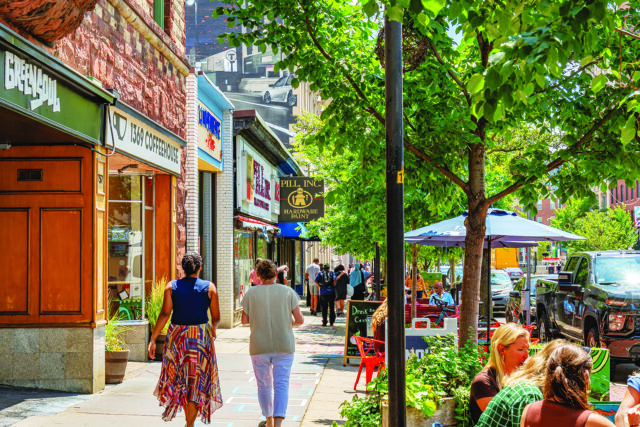
Pedestrians and cafe-goers in Cambridge’s Central Square in July 2025. Cambridge officials are reviewing potential changes to the historic citywide rezoning that eliminated single-family districts in 2025, such as larger setbacks from property lines. iStock photo
Cambridge Debates Rollback of Rezoning
After eliminating single-family districts in February 2025, Cambridge officials have been assessing the results amid an ensuing uptick of developer acquisitions.
Supporters say the rezoning has been working as advertised, catalyzing mid-sized apartment projects. Opponents say it’s living up to warnings about allowing projects that are too large, too close to neighbors and clash with the surrounding neighborhood.
The changes could add approximately 3,600 housing units by 2040, according to a 2025 study by Cambridge’s Community Development Department, including hundreds of income-restricted affordable housing units.
Councilor Kathy Zusy spotlighted the 9 Wyman Road project off Huron Avenue, where Burlington-based DND Homes acquired a single-family home on a 7,089-square-foot lot in July 2025 for $2.9 million. In December, DND sought a staff consultation on a proposed 6-story, 56-unit apartment building.
“The beautiful trees will be torn down, and every square inch of the lot will be turned into housing,” Zusy commented in a post on her Instagram page. “There is a practical place to build a building with 56 studio and 1-bedroom apartments in Cambridge, but it is not here.”
Councilor Tim Flaherty argues that the changes have driven up land prices as developers acquire single-family properties, and will build luxury market-rate housing to recoup their investment.

Steve Adams
In an opinion column for The Cambridge Day news site, Flaherty said the council should consider higher affordability requirements and incentives for family-sized units.
The 2025 vote legalized 4-story residential buildings across the city, or 6-story buildings with a 20 percent income-restricted component. Projects still need to conform with dimensional requirements such as setbacks.
In June, the CDD presented an update to councilors estimating that the rezoning will increase development in residential neighborhoods by over 10 times by 2030 compared with the previous zoning.
Staff also submitted data requested by councilors on increasing building setbacks from lot lines, new requirements to exclude green roofs and balconies from open space calculations, and requirements for one vehicle parking space for each additional unit above four units in new construction.
Justin Saif, co-chair of the A Better Cambridge housing advocacy group, said the rezoning has been largely successful and the increases in setbacks are unnecessary.
“We think the setback amendment is too soon and will throw everyone’s projects off that are already in the [permitting],” Saif said. “I don’t think they are really considering the full impact that would have, and how that would affect lending institutions, builders, and the folks who are paying closer attention to whether the zoning is stable. Our job will be advocating to everyone to make that clear.”