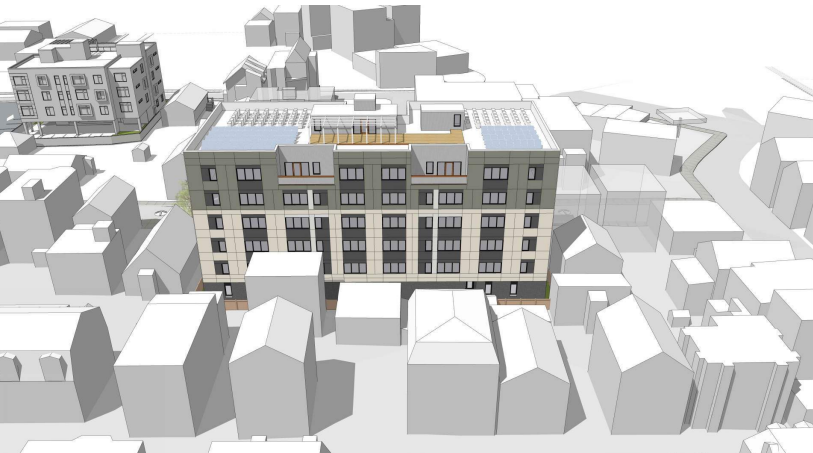
A proposed design for a multifamily building at 16-28 Porter St. is among many unlocked by Cambridge's citywide upzoning. Image courtesy of Peter Quinn Architects
Cambridge officials took a step towards rolling back the city’s historic 2024 citywide rezoning, which has prompted a backlash from some residents about the scale of recent multifamily development.
The City Council voted unanimously Monday to ask city staff to revise the multifamily zoning ordinance. The potential changes include an increase in setbacks from lot lines, in response to complaints from opponents about the size and appearance of projects.
During public comments, residents objected to “condo boxes” rising on “postage stamp lots” across the city.
Opponents said the ordinance largely has failed to achieve the objective of controlling housing prices, while displacing renters as properties are acquired for redevelopment.
The ability to replace single-family homes with apartment and condo buildings appears to have bid up land prices across the city, as developers pursue teardowns.
“These teardowns displace the middle class to line the pockets of wealthy developers,” resident Bernard Lupien said during public comments.
Approved in 2024, the ordinance abolished Cambridge’s remaining single-family zoning districts. It allows 4-story buildings across the city, and 6-story buildings if they include a 20 percent income-restricted component.
The new ordinance was expected to encourage construction of approximately 3,600 housing units by 2040, according to a 2025 study by Cambridge’s Community Development Department, including hundreds of income-restricted units.
According to a database compiled by Councilor Catherine Zusy, more than 1,150 housing units now are in the pipeline, including 172 income-restricted units.
Opponents have asked for increases in minimum setbacks from lot lines. They also object to developers’ ability to count green roofs and balconies toward the minimum open space requirement.
“I would want greater setbacks. I would want green roofs and balconies not to qualify as open space, because they’re not really open space,” Zusy said at Monday’s meeting.
Councilor Tim Flaherty pointed to developer Healthpeak’s plans to build up to 2,300 housing units in the Quadrangle neighborhood, and suggested a sunset provision for the citywide multifamily zoning.
The council instructed Community Development Department staff to report on potential changes to the ordinance, as well as the effects on housing production of various options. The process will take approximately eight weeks, Assistant City Manager for Community Development Melissa Peters said.
A Better Cambridge, a housing advocacy group that supported the 2024 rezoning, said potential changes would reduce housing development and negatively affect production of affordable and permanent income-restricted housing.
“They exacerbate rather than ameliorate the stated concerns of residents around redevelopment,” the group said in a statement following Monday’s vote.
The proposed changes, when available, will head back to the council’s Ordinance Committee for further discussion before a potential vote by the full council.
At a previous meeting, Cambridge Community Development Department staff stood by their previous estimates that the current zoning will result in construction of 250 to 300 new units per year in residential neighborhoods.
Cambridge has separately rezoned some sections of Massachusetts Avenue for residential buildings up to 18 stories.
But no projects have been proposed for those areas, which Vice Mayor Burhan Azeem blamed on higher interest rates and building costs.
“My concern is we are not going to get any of these larger developments in places where people wish they would happen,” Azeem said, adding that changes to the inclusionary zoning ordinance could be part of a compromise on neighborhood zoning.