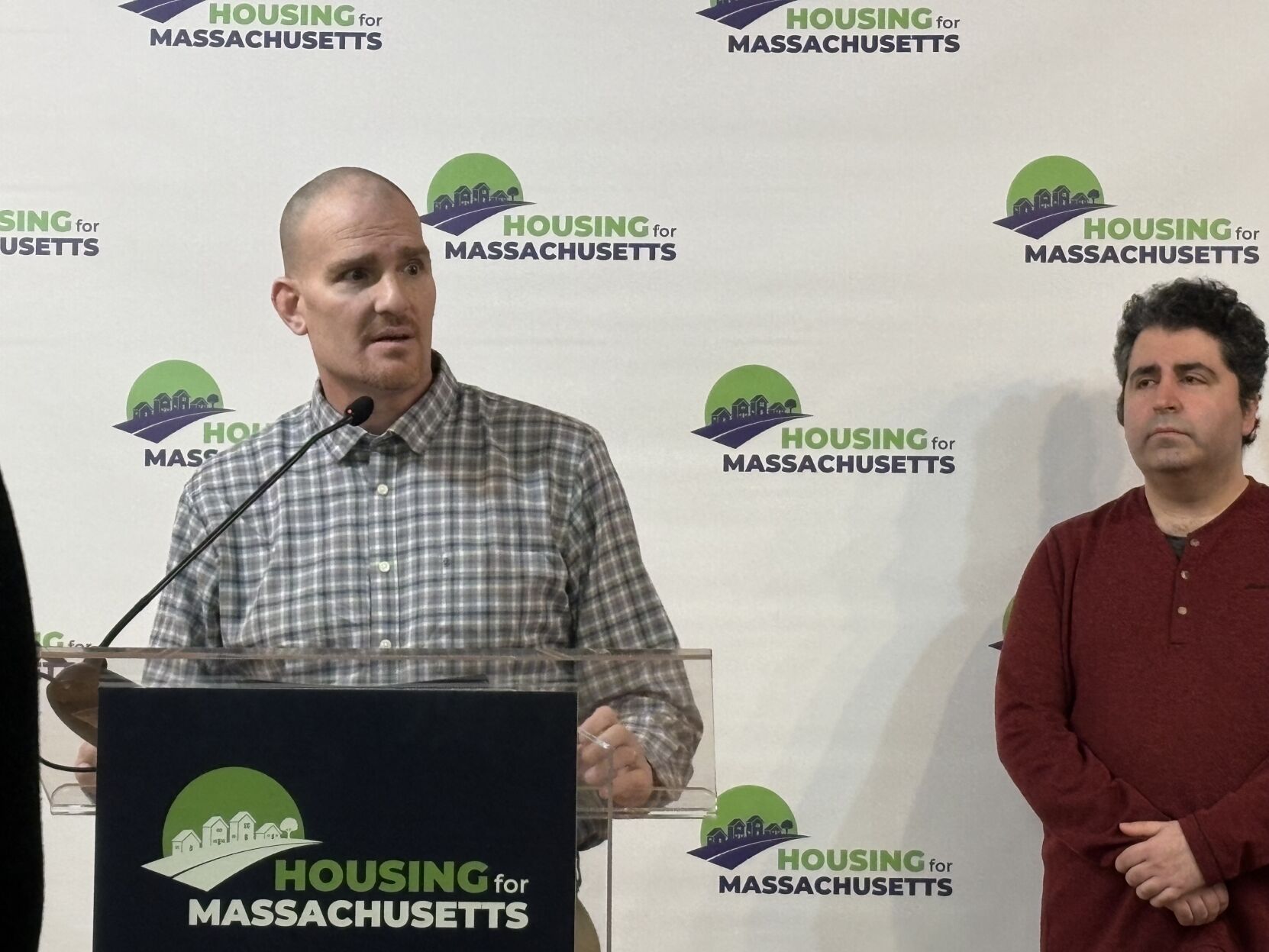
Revere City Councilor-at-Large Marc Silvestri speaks at a the launch of anti-rent control ballot question committee Housing for Massachusetts. To his right is Amir Shahsavari, president of the Small Property Owners Association. Photo by Sam Drysdale | State House News Service
People are angry about high rents, and can you blame them?
Zillow’s rent index pegs the cost of a Boston-area apartment at $3,000, up by an astonishing 50 percent over the last five years.
Homes for All Massachusetts, the committee of local left-wingers pushing the statewide rent control ballot question, has proposed capping rent increases at no more than 5 percent a year in every city and town across the state.
That would make it the most draconian rent control law in the country, should it survive many remaining legal challenges and get the blessing of voters in next fall’s state and federal elections.
It would also be a much tougher version than what Massachusetts jettisoned decades ago, when it only covered Cambridge and one or two other cities.
By this time next year, rent control may very well have returned to Massachusetts after a decades-long hiatus, if activists have their way.
However, the biggest swing factor will be the media coverage of the debate over the ballot question.
Media Has Familiar Template
If we get lots of cookie-cutter coverage that plays up stories of down-on-their-luck tenants and greedy landlords, while failing to scratch the surface of a highly complex issue, it will be hard for the message of the anti-rent-control campaign to break through to voters.
Unfortunately, there is already a template of sorts in the mainstream media for coverage of rent control.
To illustrate our point, let’s have some fun here with a mock story on a rent control proposal in the fictional city of Suncrest Bay from WXYZ Action TV News.
“We’re here today in Suncrest Bay, where residents watched helplessly as rents have risen for years now, even as they have fought hard to block plans for expensive new apartment buildings,” the reporter intones.
“Long-time Suncrest Bay residents blame the neighborhood’s rising rents on pricey new projects with fancy names like The Sterling and The Mint,” the reporter adds before a jump-cut to an interview with a local homeowner.
“‘I don’t know how people afford these $5,000 apartments with all the fixings,’” Norah Noodlehead tells the WXYX Action News reporter
“The only thing my blessed little Mary Jane, a teacher at teaching at Baycrest Elementary, could find with an affordable rent was out in Slagtown. Luckily, no one’s putting up none of those fancy new apartments there, so at least she won’t have to worry about rent increase,” her mother says.
Determined to fight back, Mrs. Noodlehead has teamed up with other Suncrest Bay residents to launch a grassroots effort to subject all rent increases, for whatever reason, to a citizens’ board for review.
“We’ve got to stop all these developers coming in here with their fancy pants plans and driving up the rents with all these expensive new apartment buildings,” Mrs. Noodlehead tells the WXYZ reporter.
Two Things Voters Must See
So what’s the point of this satire?
To win, Massachusetts business and real estate industry leaders battling the rent control ballot question must convince skeptical voters of two things.
One, that putting a cap on rents would shut down new apartment construction, even with the 10-year exemption for new units.
And two, that building more apartments will bring down rents in reasonably short order without some of the well-documented problems with rent control, such as units sliding into disrepair or being taken off the market altogether.
But these are tough arguments to get across to the average Massachusetts voter, who is neither an economist nor a developer and who sees luxury apartment buildings opening at the same time have gone through the roof.
It may be correct that we need to break ground on even more apartment buildings of all types after decades of underbuilding – and that bringing down rents, ultimately, is a factor of supply and demand.
It’s an argument, though, that is counter to what many people are actually seeing with their own eyes and likely take as simple common sense: as luxury apartments get built, rents rise.

Scott Van Voorhis
Not an Auspicious Launch
Not surprisingly, a majority of Massachusetts residents – 62 percent – say they would vote for a proposed statewide law that would cap rents at 5 percent or less in cities and towns across the state, per a recent Suffolk University/Boston Globe poll.
All of which is to say that rent control opponents certainly have their work cut out for them.
Last week, Housing for Massachusetts made its debut at a press conference near the State House that drew only a handful of reporters.
The newly formed alliance of business and real estate groups has teamed up to defeat the proposed rent control law, set to go before Bay State voters in November.
The good news? The election is not for another nine months, so the coalition has some time to work with.
“Rent control has failed wherever it’s been implemented,” Amir Shahsavari, president of the Small Property Owners Association, said during the event. “We are small, mom-and-pop businesses who provide 65 percent of the housing throughout Massachusetts, and we take great pride in providing well-maintained places to live. When policies come about that threaten our businesses, they not only hurt us, but the renters who depend on us.”
Scott Van Voorhis is Banker & Tradesman’s columnist and publisher of the Contrarian Boston newsletter; opinions expressed are his own. He may be reached at sbvanvoorhis@hotmail.com.