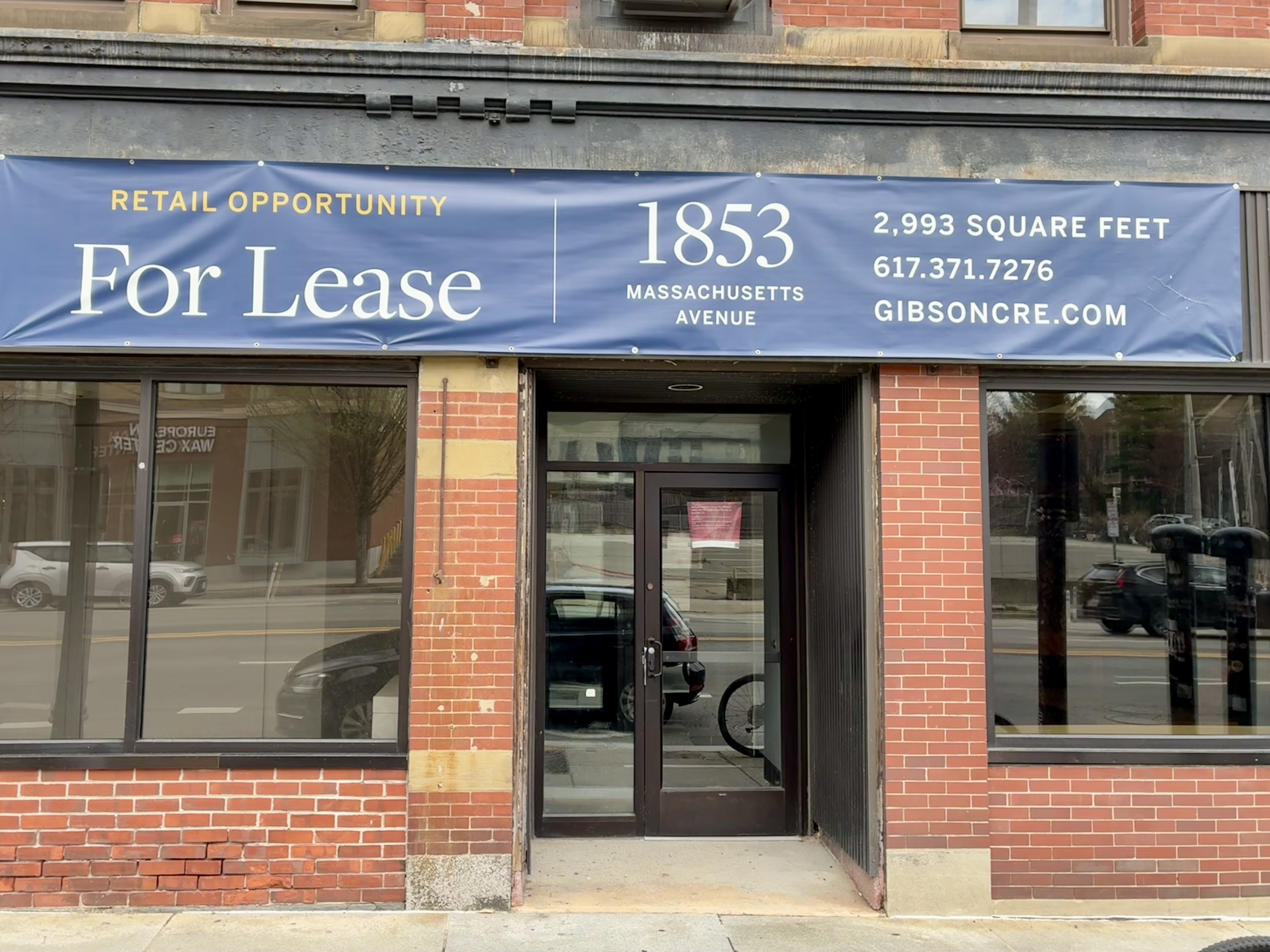
Owners of properties with vacant storefronts in Cambridge are required to post leasing contacts under a 2025 update to the city’s vacant storefront ordinance. Photo by Steve Adams | Banker & Tradesman Staff
Boston District 6 City Councilor Ben Weber has watched storefronts sit vacant for years despite their potentially lucrative locations in neighborhoods such as Jamaica Plain.
After Weber raised the possibility of creating a municipal vacancy tax, the city’s Office of Economic Opportunity and Inclusion is in the process of creating Boston’s first public retail vacancy database. The data could point toward new policies imitating those in Cambridge and other communities that have been tackling the stubborn problem of post-pandemic retail vacancies.
Arlington, Brookline and Lowell also track down landlords of properties with long-term vacant storefronts, through registration requirements. In 2023, Lowell enacted one of the most rigorous ordinances in Greater Boston, with potential annual fines of $5,000.
Many of the problem properties are under longtime family ownership, rather than investors seeking to maximize returns through aggressive leasing efforts, said Ali Carter, Lowell’s director of economic development.
“A lot of times they own it, but it’s not a priority for them,” Carter said. “And it’s the community that suffers.”
Owners of ground floor storefronts vacant for more than 90 days are required to sign up for the city’s vacant storefront database, which requires a $5,000 annual payment. Four landlords have been assessed so far, while others have sold properties, converted retail space into housing or signed new tenants.
“It’s meant to be a prod,” Carter said.
‘Bad Public Policy’ Deters Leasing
Although some communities like Arlington and Cambridge have kept track of retail vacancies since before the pandemic, COVID added new challenges for Main Street tenants.
Hybrid work habits cut into walk-in business from office workers.
High commercial property taxes and new policies enacted by local governments in recent years, such as elimination of some on-street parking in favor of bicycle lanes, added to merchants’ woes, said Jon Hurst, CEO of the Retailers Association of Massachusetts.
“These politicians need to look in the mirror and figure out what is creating these dark storefronts,” Hurst said. “A lot of it is based upon bad public policy.”
The city of Cambridge doesn’t fine landlords for vacancies, but city staff tracks unoccupied storefronts on a biannual basis and posts them to a public database. A new requirement was added in June 2025 requiring landlords of storefronts that sit vacant at least 180 days to post leasing contact information in the front window, and post signs notifying passersby of imminent new tenants.
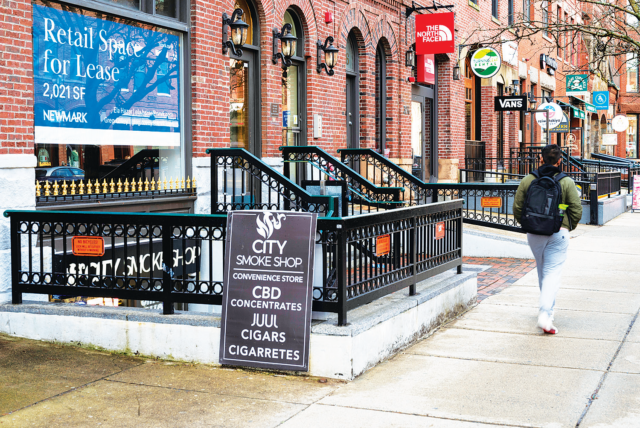
A vacant Newbury Street retail space in 2024. Boston leaders are examining ways to get retail landlords in outlying neighborhoods to fill long-empty storefronts. iStock photo
Somerville’s own six-year-old vacant-storefront registry program was deemed ineffective in a report released last year by then-mayor Katjana Ballantyne, who called for tougher penalties for landlords that didn’t register.
A 2025 report by two consultants hired by the city of Cambridge – Cambridge Econometrics and Agency Landscape + Planning – found a small but persistent subset of retail vacancies in the city post-COVID.
The citywide vacancy rate was just 2 percent at the end of 2024.
Pardis Saffari, Cambridge’s director of economic opportunity, said the updated Cambridge policy has attained widespread compliance despite the lack of a threat of fines.
“We are trying to find ways to make better connections with the property owners, and make sure the potential tenants know we are here,” Saffari said.
Cambridge is among the cities seeking to participate in this year’s version of an existing statewide vacant storefront program, which grants tax credits to tenants that lease spaces that have sat vacant at least six months. The Healey administration is changing the application process to become part of its Community One Stop for Growth portal, but has not yet opened up applications for the next fiscal year.

Steve Adams
Arlington’s Registry a Matchmaking Tool
Arlington initially created a vacant commercial property database in 2017 but updated the ordinance in 2024. The changes narrowed scope to retail storefronts and the Arlington Heights, Arlington Center and East Arlington commercial districts.
The ordinance sets an annual fee of $400 for storefronts that are empty for at least three months. The registry currently lists a dozen properties.
“The policy is the best tool to create a point of intervention with the property owners,” Arlington Economic Development Coordinator Katie Luczai said. “They get a letter, and I get a call and use that as an opportunity to say, ‘I’ve got some people interested in looking into Arlington: can we make a match?’”
Weber, the Boston city councilor, said in an email that the creation of the citywide vacancy database is the first step in potential policy discussions. In 2024, Weber sponsored a hearing on a potential vacancy tax, which drew opposition from business groups including the Greater Boston Chamber of Commerce and Greater Boston Real Estate Board.
Weber said the public database is expected to go live this summer.
“Before we can make informed decisions about how to decrease the number of vacant storefronts and reduce the length of time these spaces are left vacant, we need good data,” Weber said in an email.
Editor’s note: This report has been updated to reflect that Cambridge’s vacancy database is compiled by city employees, not through a registration requirement of landlords, and that the vacancy rate was 2 percent at the end of 2024.