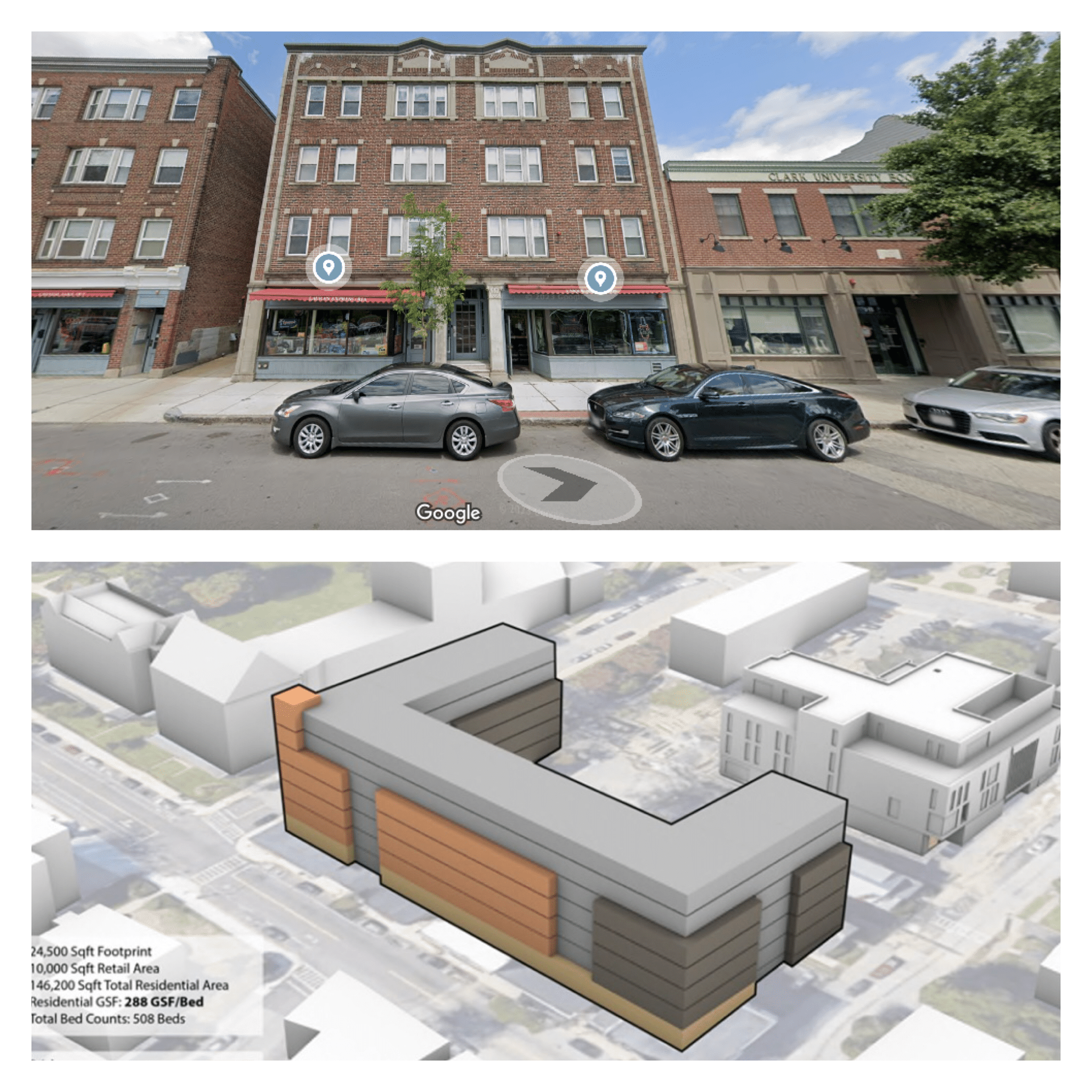
Images courtesy of Google Maps and Worcester Historical Commission
Clark University is seeking to address a shortage of on-campus housing by proposing with a proposed $77 million project on Worcester’s Main Street.
The school is proposing to demolish a trio of century-old buildings to add student housing after enrollment increased 13 percent in the current academic year, placing the school’s on-campus housing at 103 percent of capacity.
The school lacks the financial ability to build the $77 million project on its own, and plans to partner with a private developer. Renovations were estimated at $400 to $500 per square foot, compared with $315 to $385 per square foot for new construction, according to application documents submitted to the Worcester Historical Commission.
“Renovations of these buildings would be cost prohibitive, and would needlessly direct funds toward the renovation of undesired structures,” the application states.
The new 7-story residence hall would span 156,000 square feet and contain 508 beds.
Clark University owns the three properties at 918-924, 926-928 and 932-934 Main St., totaling 66,000 square feet and containing 117 beds. Originally completed in 1914 and 1925, they have long been occupied by ground-floor retail with apartments on the upper floors.
All three buildings are subject to review by the commission because they are designated historic buildings. Clark University has asked the commission to waive a 12-month demolition delay protecting the properties.
One of the properties, the Albert Chavoor building at 926-928 Main St., was considered innovative when it was completed in 1925 because it contained such features as switched ceiling lights and telephone hookups, according to Massachusetts Historical Commission documents.
Clark’s project isn’t the only high-profile redevelopment proposal seeking to demolish older buildings in Worcester’s core neighborhoods. Developer The Menkiti Group had, in response to a city RFP, proposed to level the former Denholm department store building across from Worcester City Hall in favor of a 10-story, 233-unit apartment building. A final vote on the proposal by the Worcester Redevelopment Authority in July was postponed following wage-theft allegations a WRA board member leveled at The Menkiti Group’s preferred general contractor, the Worcester Business Journal reported.