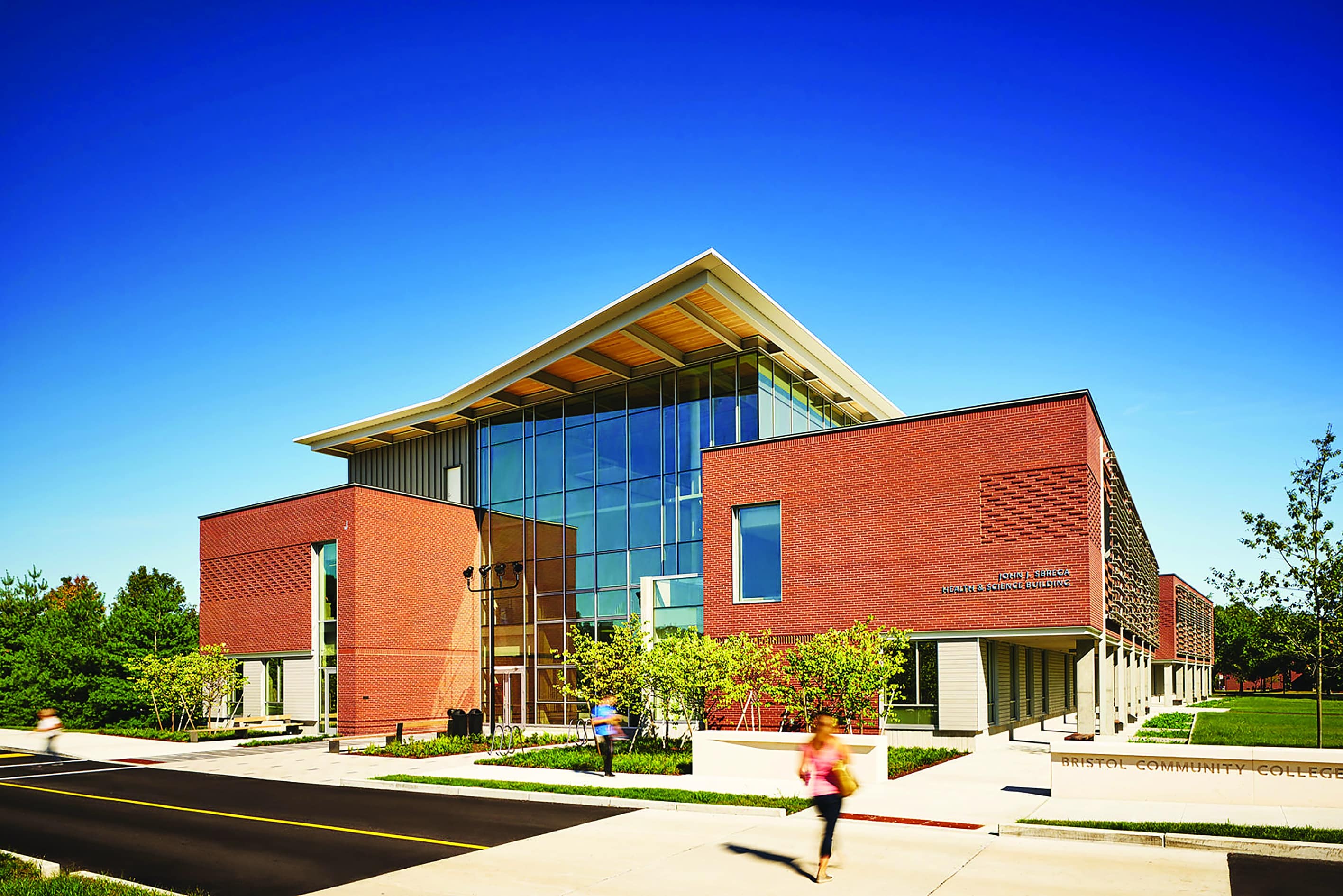
Academic institutions have pioneered clean energy designs, paving the way for commercial developers to adopt best practices from the first generation of projects. Pictured is Bristol Community College’s John J. Sbrega Health and Science Building, which Sasaki designed to attain net-zero energy performance. Photo courtesy of Sasaki
The race is on to decarbonize real estate developments across Greater Boston, especially as local communities seek to meet the state’s goal of achieving net zero emissions by 2050.
Buildings account for nearly 70 percent of greenhouse gas emissions in Boston, according to Boston’s Building Emissions Reduction and Disclosure Ordinance. And while the 2050 decarbonization goal is still decades away, private developers are preparing to pay for projects to meet decarbonization targets through tax incentives and public grants.
The push has design ramifications for projects in development as well as existing buildings in need of a retrofit. But it doesn’t mean developers need to be fearful of crushing costs, experts say.
“It’s almost like the science came first, all the academic projects came second, and now these incentives are in place for developers to take advantage of these lessons learned and implement them in their projects in order to comply in a cost-effective way,” said Tamar Warburg, an associate principal and director of sustainability and resilience at architecture, planning and design firm Sasaki.
There are an increasing number of financial sources to turn to when it comes time to retrofit a building – and early development examples of how to succeed.
Bill Comes Due for Fossil-Free Retrofits
Commercial landlords in the U.S. face a collective $3 trillion price tag for retrofitting buildings off fossil fuels, according to JLL research. In Greater Boston alone, the sum is nearly $33 billion, according to a 2020 report by The Cadmus Group on retrofitting commercial and multifamily projects.
There are several tools and financial incentive levers developers can pull, however – and retrofitting doesn’t necessarily mean going out and recladding a skyscraper and replacing all the mechanical equipment tomorrow.
“With our clients, we have short-term energy retrofits and deep energy retrofits, and the client tells us which one is possible,” Warburg said.
It’s possible to swap out a piece of mechanical equipment in a matter of weeks or rework the structure of a building, targeting embodied carbon within building materials, for a longer-term solution.
“There is a lot we can do as designers to make our structures more efficient, right-size the building for programs and evaluate how we can reuse buildings,” said Alison Nash, an architecture and interiors sustainability coordinator at Sasaki. “We have developed tools for this analysis in the planning stages of design … to help teams understand the sequestration opportunities in landscape and the impacts of structural choices.”
Incentives like utility rebates offered by programs like Mass Save help assist in quicker retrofits like replacing gas boilers with all-electric systems.
Gov. Maura Healey’s campaign platform included a plan to create a statewide Green Bank, to be run by the quasi-public Massachusetts Clean Energy Center, which would act as a clearinghouse for financial incentive programs.
There are also funding initiatives like the $2.9 million WinnDevelopment received from the Merrimack Valley Renewal Fund and the Massachusetts Department of Energy Resources, which helped the developer turn the nearly 177-year-old Stone Mill in Lawrence into a mixed-income housing development that is entirely fossil fuel-free.
“I’m really optimistic and excited to see the level of support to decarbonize from all levels – city, state and federal governments – because we have kind of a watershed opportunity to reduce emissions and improve housing here,” said Christina McPike, the director of energy and sustainability at WinnCompanies.
Federal Laws Offer Funding
McPike pointed to other potential revenue streams like funds Massachusetts received from the $1.9 trillion American Rescue Plan of economic stimulus passed early last year as well as the more recent Inflation Reduction Act, which included tax credits aimed at lowering emissions.
While developers can’t tap into ARPA funds directly today, McPike highlighted the proposed Zero Carbon Renovation Fund legislation – a $300 million piece of legislation co-sponsored by Massachusetts state Sen. Adam Gomez, D-Springfield, and Rep. Andy Vargas, D-Haverhill, to fund building efficiency upgrades and retrofits. The legislation calls for using a portion of the ARPA funds Massachusetts received to fund the policy.
The Healey-Driscoll administration also announced a $50 million grant program earlier this month aimed at decarbonizing existing low- and middle-income housing developments across Massachusetts. The news of that came months after a Massachusetts Commission on Clean Heat report that existing Mass Save programs weren’t enough to meet the financial scope of decarbonizing and retrofitting existing buildings across the state.
“Is there enough capital available to us today? No,” McPike said. “Do I think we’re going to get there? Yes, and I think we’re seeing that play out right now.”
The first five Zero Net Energy buildings Sasaki worked on were all academic buildings, including the John J. Sbrega Health and Science Building at Bristol Community College in Fall River.
The early academic push isn’t a coincidence, Warburg said.
“That often happens where universities are kind of a laboratory and then they demonstrate the possibility,” she added. “Then the private development world can benefit from that experimentation and that experience and apply the lessons learned to private development as well.”