
WeWork is the dominant coworking player in Boston, comprising 3.2 percent of tenancy across the 72 million-square-foot office market. Image courtesy of WeWork
WeWork’s stock market fiasco has yet to reverberate much for its more than 600,000 tenants, spread across a global empire of gracefully designed co-working offices. But beneath the work-and-play cheer, there’s unease as WeWork embarks on a painful restructuring that will include thousands of layoffs as early as this week.
The kombucha and beer on tap flow freely. The milk-and-cookie happy hours, yoga sessions and waffle Mondays continue as usual. But WeWork is slashing the lavish spending that fueled the office-sharing company’s breakneck growth and contributed to unsustainable losses that ultimately turned off Wall Street investors, forcing it to shelve its initial public offering.
Emptier than other WeWorks just blocks away, the space Lanny Grossman rents for his public relations firm EM50 Communications in Manhattan is sometimes dark because too few people show up to trigger enough automatic lighting sensors, he said. At some point, the grab-and-go market disappeared. Recently, Grossman has noticed a slowdown in cleaning, with dirty coffee mugs still there the next day.
WeWork said there has been no change to cleaning schedules at that location, but Grossman said the issues have deepened his skepticism about the future of his landlord.
“It’s weird. I come in and have my computer and my office and wonder if it’s going to be there the next day,” Grossman said.
WeWork is the dominant coworking player in Boston, comprising 3.2 percent of tenancy across the 72 million-square-foot office market, and it maintained its aggressive growth strategy during the third quarter. It inked an 87,000-square-foot lease at Manulife’s 200 Berkeley St. in Back Bay, another 106,000 square feet at 75 Arlington St. and 117,000 square feet at 100 Summer St, a tower which was acquired recently by Rockpoint Group for $806 million.
Local real estate researchers predict a WeWork departure coupled with a broader economic downturn could have a dramatic, negative effect on the downtown office market, as Banker & Tradesman reported last month.
Rent Payments Could Balloon Soon
Japanese tech conglomerate Softbank, which took an 80 percent stake in the company, has sent one of its executives, Marcelo Claure, to oversee WeWork’s restructuring. Claure told employees in an email Monday that layoffs would start this week, summoning employees to an all-company meeting Friday to discuss the changes.
WeWork has said that the layoffs will not include the small “community teams” that work inside the shared offices spaces, and that many job cuts will come from sides businesses the company is selling.
Meanwhile, cleaning, pantry and facilities maintenance employees in the U.S. and Canada are being offered jobs at JLL, a real estate services company that will then contract those workers back to WeWork. Arik Benzino, WeWork’s managing director for U.S. and Canada, told the affected employees in an email last week that their pay would remain the same and their shift assignments “will not change for the time being.”
The road to profitability remains a herculean challenge for a company that was posting up nearly $2 billion in losses a year. A $9.5 billion bailout from Softbank saved WeWork from possible bankruptcy, but the company now needs to reduce its reliance on venture capital and acquisitions that accounted for most of its explosive revenue growth.
WeWork is saddled with $47.2 billion in future lease obligations, and the cost of building out newly acquired spaces. The company is locked into mostly 15-year leases that are difficult to renegotiate, with rates expected to rise over time. Adding to that, WeWork is temporarily not paying rent on many locations under deals the company has negotiated with landlords. Those rent-free periods are set to expire in the coming months, meaning WeWork will have to start paying that rent.
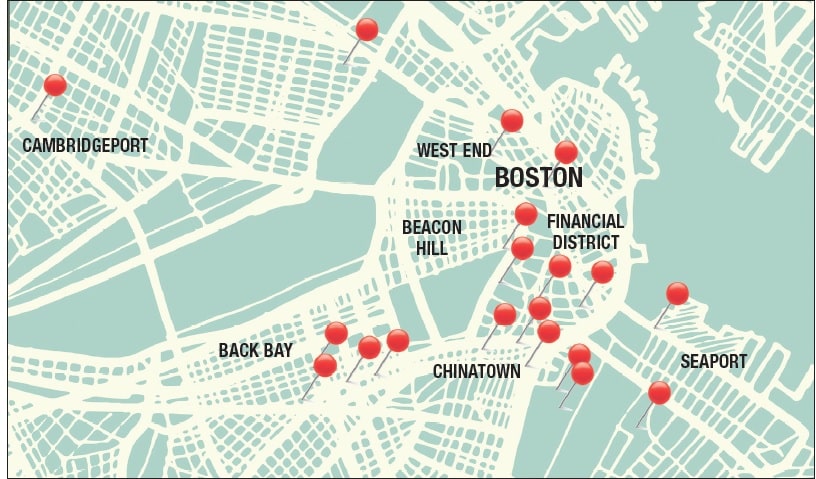
WeWork operates 19 locations in Boston and Cambridge, including 10 downtown.
‘This is Going to Be Draconian’
Experts and people in the industry are skeptical that WeWork can achieve meaningful cost reductions without somehow squeezing tenants.
“They have been living in Never-Never Land, an unsustainable paradise that is now going to get ratcheted back,” said Allen Adamson, an adjunct professor at New York University’s Leonard N. Stern School of Business. “They are not going to be able offer fewer cups of coffee to close the gap. It’s too big a gap. This is going to draconian in term of what has to be done.”
WeWork says it intends to move away from traditional lease agreements in favor of partnerships, in which landlords shoulder some renovation costs. The company is also shifting its focus from freelancers and start-ups to companies with more than 500 employees that sign longer leases and provide more stable revenue.
The trouble is WeWork faces growing competition from rival flexible office space providers pursuing those same strategies. Some traditional real estate companies, meanwhile, have launched their own flexible office space offerings, trying to tap into a market that WeWork helped jumpstart.
Bill Baldwin, managing principle of the global real estate advisory firm Cresa, said that for the moment, he prefers not to direct clients to WeWork, saying he is not convinced the company can avoid defaulting on leases.
“That’s a pretty scary situation to put a client of ours in,” said Baldwin, whose firm represents occupiers in real estate transactions.