The former Yankee Pedlar Inn restaurant in Holyoke was recently relocated and converted into a two-unit duplex by OneHolyoke CDC. Photo courtesy of OneHolyoke
For generations, duplexes were a mainstay of housing development in urban and some suburban neighborhoods across Massachusetts.
But for various reasons – including the rising cost of land and restrictive local zoning rules – duplexes in recent decades fell out of favor among many builders.
Today, old-style duplexes, both “stacked” and side-by-side types, account for only 3 percent of newly built housing units across the state, according to some industry estimates.
But newly constructed two-unit duplexes – and, to a smaller extent, their triple-decker housing cousins – remain popular in some Gateway Cities, thanks mostly to nonprofit Community Development Corporations.
And few CDCs are as enthusiastic about building and selling off new duplexes as OneHolyoke CDC in western Massachusetts.
Infill Lots Building Wealth
Over the past 50 years, OneHolyoke has developed about 70 duplexes, or 140 housing units, often on vacant infill lots in the gritty city of 38,000 people just north of Springfield.
OneHolyoke just recently built and sold off three more duplexes to qualified residents – and is actively pursuing other opportunities to build two-unit duplexes in Holyoke, according Executive Director Michael Moriarty.
Why the enthusiasm for duplexes? They provide two units of desperately new housing on relatively small lots of land, promote homeownership and allow qualified duplex buyers to build wealth by charging rents for their second units.
“We’ve kind of made it our calling card,” Moriarty said of OneHolyoke’s duplex-focused development strategy. “I’m sold on the duplex model. I’m preaching its gospel wherever I go. You’re building new housing – and building wealth for people,” Moriarty’s CDC also separately owns and manages approximately 250 apartment units in 25 buildings in Holyoke.
Private Developers Face Obstacles
OneHolyoke’s duplex development model most definitely won’t fit the requirements of for-profit private developers.
First off, OneHolyoke’s duplexes are heavily subsidized by federal and state housing programs.
In the case of its three recently developed duplexes, each two-unit building costs nearly $500,000 to construct.
Two were ground-up modular buildings, while the third was a relocation and conversion project involving the former Yankee Pedlar House Inn in Holyoke.
But as a result of the government subsidies, OneHolyoke was able to sell the duplexes for $250,000 each to qualified buyers making 80 percent of the average median income of people living in Greater Springfield.
Needless to say, no for-profit developer is going to build a duplex on its own, without subsidies, if it means losing money.
In addition to the federal and state subsidies, the qualified buyers of OneHolyoke-built duplexes are restricted to renting only to qualified lower-income tenants – with rents capped at non-market rates set by federal regulations.
Due to all the government regulations, the entire duplex development and sale process involves a lot of paperwork – and patience, Moriarty said.
“But we manage to pull it off all the time,” he said.

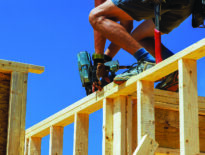
A new duplex under construction. Because they are built like and look like single-family homes, developers say they are relatively affordable to build and often inoffensive to neighbors. iStock photo illustration
Model Fits Neighborhood Scale
Elise Rapoza, senior research associate at the MassINC Policy Center, a public-policy think tank, said CDCs in other Gateway Cities are also pulling off financially complex duplex projects.
Such projects are popular among nonprofit CDCs because they address two issues at once, she said.
First, they provide desperately needed affordable housing on small plots of land.
Second, duplexes help qualified buyers to build wealth and financial security via their ability to charge rents to qualified tenants.
Another attraction of duplexes: Their smaller size and single-family looks make them more architecturally palatable to neighbors who might otherwise oppose new multifamily housing in their midst.
“Duplexes can live side by side with single-family homes without too much trouble,” she said.
There have been past efforts by state officials to promote construction of new duplexes across the state – and not just by CDCs and other mission-driven groups, Rapoza said. But most of those efforts never took off.
Most recently, Gov. Maura Healey’s Unlocking Housing Production Commission recommended that developers be allowed to build two-family and four-family housing by right on all residential zoned areas where there are existing water and sewer connections.
But the by-right proposal – as well as other recommendations from the commission – requires sponsorship and support by Beacon Hill lawmakers.
Market-Rate Duplexes Not Easy
Guy Manganiello, managing partner of Genesis Construction and Development Inc. in Middletown, said his firm has privately developed many non-subsidized, market-rate duplexes over the years.
But he said it hasn’t always been easy.
He noted that the high cost of land in many cities and towns makes it financially prohibitive to build duplexes if other more lucrative housing options are available.
In addition, many towns, through zoning ordinances, make it hard, if not impossible, to build any type of multifamily housing, big or small, at scale.
But if land prices are right and if communities are amenable to small-scale multifamily housing projects, then building duplexes make a lot of sense, he said.
Because developers are basically building two nearly identical housing units –one on top of the other or one next to the other – on the same plot of land, construction costs go down due to efficiencies, he said.
In many instances, the cost to construct each duplex unit can run 20 to 30 percent less than what it costs to build a lone single-family home, depending on the designs, he said.
“Every building is different, but duplexes are generally more efficient to build,” said Manganiello. “It’s a rinse-and-repeat operation. It really hits that missing-middle market everyone’s talking about.”
He added Gateway Cities are a natural for duplex projects, due to their lower costs of land and their generally more welcoming attitude toward new small-scale multifamily housing projects.
“It’s a great way to build additional housing,” Manganiello said of duplexes. “It’s also a great way to promote homeownership.”