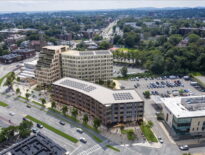
Last month, Boston-based Foxfield sold 50 Broadway in Beverly for $11.12 million to an affiliate of Quincy-based Grossman Companies. Photo courtesy of Foxfield
As we approach 2026, transaction volume in the Greater Boston multifamily market has rebounded, with 2025 sales volume projected to total approximately $5 billion. This is notably higher than the typical $4 billion annually seen in previous years and represents more than a 50 percent increase from 2024’s transactional volume of $3.3 billion.
We believe Boston will continue to see transactional volume remain at or slightly above the historical average during 2026.
Investors remain bullish about the region, attracted to its cycle-resistant demand drivers and favorable supply-demand fundamentals.
The muted supply pipeline post-2025 suggests continued strong apartment fundamentals, keeping Greater Boston at the top of institutional capital’s target markets and resulting in a busy 2026 for sales activity. Broker Opinion of Value (BOV) activity has increased heading into the fall, with many assets anticipated to launch around the National Multifamily Housing Council meeting and in spring 2026.
Boston continues to trade at lower cap rates compared to other markets nationwide, with class A deals in premier locations pricing in the 4.50 percent to 5.0 percent range. While urban areas remain attractive, capital is increasingly orienting towards suburban deals due to their lower basis and reduced regulatory exposure. Suburban value-add properties, particularly those built before 2000, present significant opportunities, trading at a 25-50 percent discount compared to new construction, depending on location.
New Deliveries Set to Decline
Since 2000, the Boston metro has seen an average of 5,200 new apartment units delivered annually; however, since 2020, that average has increased to 7,300.
In 2025, approximately 8,500 new units will be delivered, the highest total in the last 19 years, but in 2026, deliveries will drop by 40 percent to a projected 5,600.
Despite the historically high number of new apartments delivered, demand has outpaced the supply leading to high occupancy levels and steadily increasing rents. With the expected drop in new deliveries over the next few years, this supply/demand imbalance will continue.
Government regulation, affordability requirements, cost of materials and labor and the cost of capital have made new development a challenge in Greater Boston. While the challenges are most acutely felt in the urban markets, developers are finding limited success in the outer urban and suburban areas where cost-effective lower-density development is more feasible.
Rent Control Proposal Introduces Uncertainty
A significant regulatory proposal that is keeping investors attentive to Massachusetts lawmaking is the potential introduction of rent control on the ballot in November 2026.
The “Keep Massachusetts Home” initiative in its current iteration would limit rent increases across all 351 municipalities in the commonwealth to the lesser of CPI or 5 percent annually.
The region continues to be undersupplied with housing, which has resulted in rents that are among the highest in the nation. With new deliveries projected to materially decrease over the next few years, this initiative would introduce unwelcome additional hurdles to new construction.
The current form of the proposal would mark the most strict and punitive rent control measure in the country and negatively impact the development of new housing.
Institutional as well as local and regional investors and developers will be keeping an eye on the rent control proposal throughout the next year as they consider investment into the Greater Boston region.

Chris Phaneuf
An Uptick in Institutional Investors
Local and regional private investors remain the most active sources of capital in the market; however, 2025 saw a significant increase in mandates from both foreign and domestic institutional investors, attracted by Greater Boston’s positive fundamentals.
Low-yield institutional capital has ample funds to deploy and is selectively re-entering the market, with a preference for stable assets that demonstrate proven operational success.
The competitive landscape is intensifying, with deeper bid lists and heightened competition as 2025 is proving to be a massive improvement for sale volumes compared to 2023 and 2024.
Greater Boston remains a top investment target from capital across the nation and globe, with its robust fundamentals and strategic opportunities across urban and suburban markets.
Chris Phaneuf is senior managing director at Berkadia in Boston.