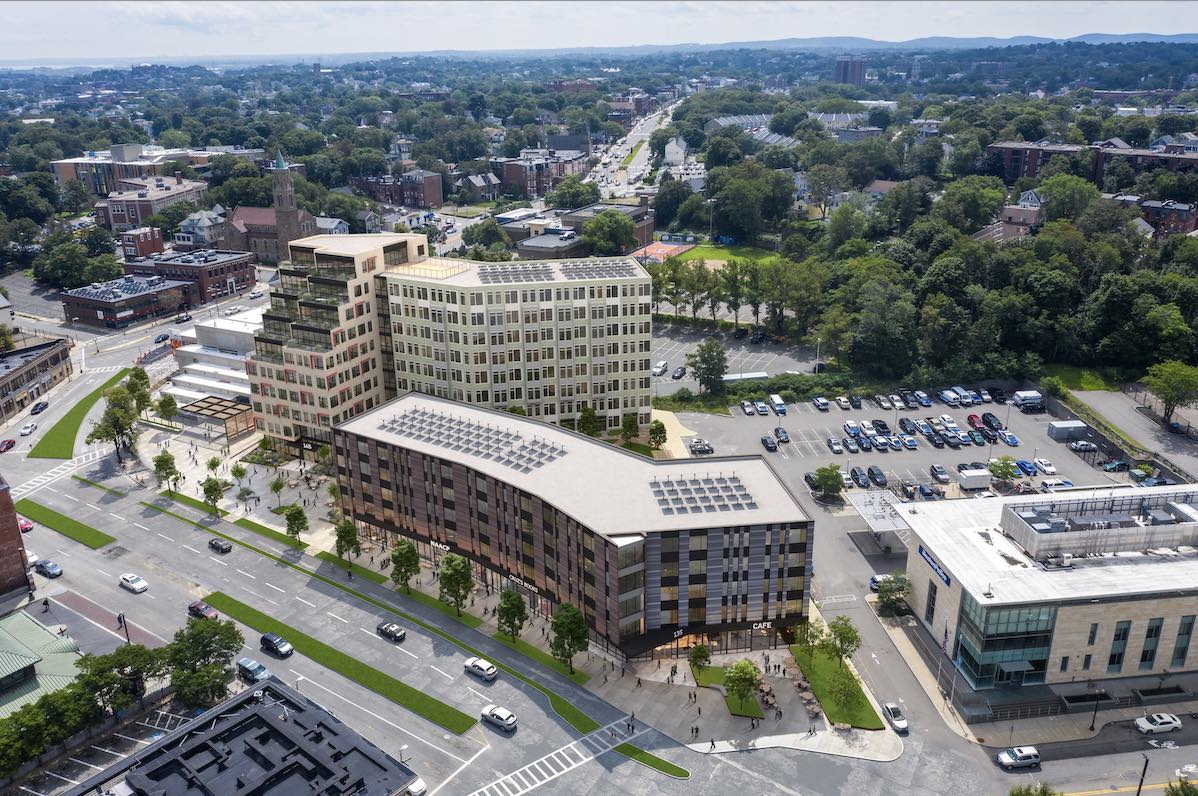
Cruz Companies’ 135 and 145 Dudley in Nubian Square is scheduled to break ground in 2026. Image courtesy of The Architectural Team
At long last, the urgent topics of housing supply and affordability have risen to the top of mainstream discourse across the United States – and to Massachusetts’ credit, the commonwealth has established itself as a housing leader with ambitious development goals and robust public-sector support for multifamily growth.
Much of this attention centers on the rental market, which is an essential foundation of any state’s housing stock. And yet by focusing so intently on rental development and preservation, we also risk neglecting the importance of addressing barriers to homeownership.
In fact, expanding access to homeownership must also be a priority for the Massachusetts real estate industry, for elected officials, and for the public agencies tasked with enhancing livability and affordability in our cities and towns.
Why? Because homeownership remains one of the most powerful paths to wealth creation, financial security, and generational opportunity.
This is especially true in communities of color and in areas where residents are still dealing with legacies of redlining and disinvestment. Studies by the Pew Research Center underscore not only that owned homes are typically the most valuable assets for American households, but also that Black and Hispanic households are dramatically less likely to own homes than their white counterparts.
Big Disparities, Little Opportunity
In 2021, 40 percent of Black households and 47 percent of Hispanic households nationwide owned their primary residences, compared to 70 percent of white households. In fact, according to Pew, “one in 10 Black, Hispanic and multiracial households owned no assets other than a vehicle or a checking account.”
As a third-generation, 100 percent Black-owned construction, development and management organization focused on affordable housing and community impact, our firm sees these realities, and opportunities, firsthand. In work across New England, as well as in the Southeast and mid-Atlantic, Cruz Companies has found time and again that vibrant, equitable communities grow best where there is both accessibly priced for-sale housing and affordable and mixed-income rentals.
But for lower- and middle-income households in particular, data from the National Association of Realtors shows the supply of affordable for-sale housing has dropped precipitously in recent years.
Nationally, a recent NAR study shows a family earning $50,000 in 2025 can afford 8.7 percent of available home listings; in 2019 that figure was nearly 30 percent.
In the Greater Boston area, the same NAR study suggests there is currently a deficit of nearly 8,700 homeownership listings accessible to families earning between $50,000 and $100,000 annually; expand that range to families earning up to $200,000, and the deficit swells above 14,400.
Dudley Street Development Set to Begin
What can be done?
One useful approach is to pursue an affordable housing development paradigm that incorporates – within the same project – affordable and mixed-income rentals alongside for-sale units with prices set at a level that reflects the existing community.
This is Cruz Companies’ strategy for 135 and 145 Dudley at Nubian Square, a two-building mixed-use complex set to rise in Roxbury. With an anticipated groundbreaking in 2026, this project includes 60 affordable rental apartments and 110 condominium units – with 20 percent of the for-sale units to be listed at below-market-rate “workforce housing” prices.

Justin Cruz
This model can make homeownership accessible to a much wider swath of potential buyers with lower household incomes, and we believe 135 and 145 Dudley at Nubian Square will be a transformative development for Boston that can also serve as a catalyst inspiring more projects utilizing this development model.
While these case studies are an important start, more ideas are needed. We would also encourage both government agencies and a diverse array of private-sector leaders to commit meaningful resources and creative thinking in support of expanding accessible homeownership options. Major regional employers, for instance, could provide low- or zero-interest loans to help employees purchase homes.
All too often these days, the story we hear across America is “I can’t afford to buy a house in the neighborhood I grew up in.”
It doesn’t have to be this way, especially in Massachusetts. We have been at the forefront of housing innovation before. Let’s think big once more.
Justin Cruz is the chief operating officer of Boston-based Cruz Companies, a 100 percent Black-owned, integrated construction, development and management enterprise.