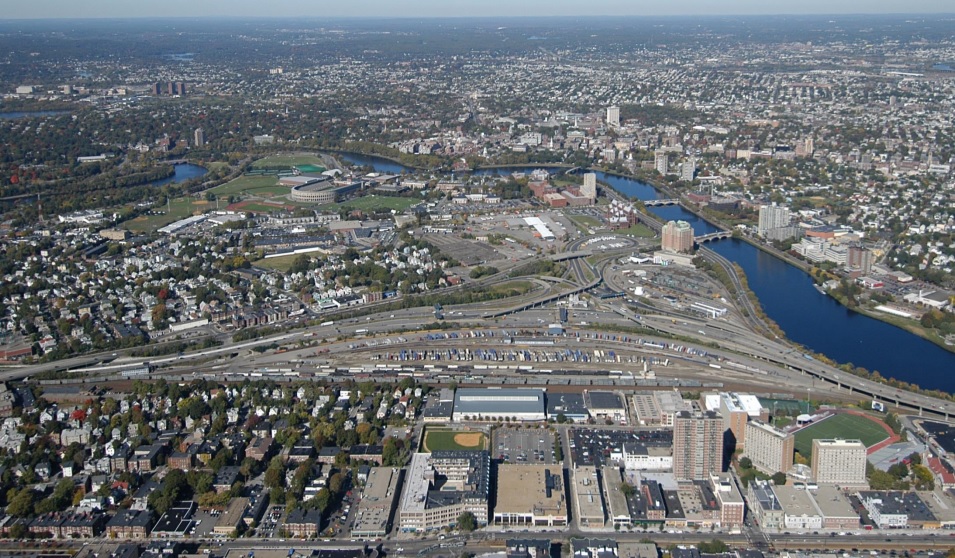
Replacement of the Allston viaduct and realignment of the Massachusetts Turnpike would open up 85 acres of land for development and add a brand-new commuter rail station. Courtesy photo
The massive package of tax and spending cuts President Trump signed into law on July 4 contains a provision that eliminates a federal transportation grant program that set aside $335 million last year for the nearly $2 billion I-90 Allston highway-and-transit project in Boston.
The provision rescinds “the unobligated balances” of the roughly $3 billion Neighborhood Access and Equity Grant program, which included funding for a project that aims to straightening and lowering to ground level the Massachusetts Turnpike as it passes between Boston University and the Charles River. The Massachusetts project, complete with a new MBTA station, would pave the way for Harvard University to construct a new neighborhood on its holdings in the area and help knit together a portion of Boston that had been severed by construction of the Turnpike in the 1950s and 1960s.
State transportation officials issued a statement confirming the federal funding program is being eliminated but said they are still awaiting clarification on what exactly that will mean for the I-90 Allston initiative.
“Every single American relies on transportation. It is essential for quality of life and for the success of our economy. That is why it makes no sense that President Trump and Congressional Republicans just cut billions of dollars in transportation funding, including the Neighborhood Access and Equity Grant Program,” said the statement, issued by a spokesperson for the Massachusetts Department of Transportation. “MassDOT is awaiting clarification from the US Department of Transportation and assessing what impact this will have on the $335 million grant we received for the Allston Multimodal Project.”
The statement went on to say that the state “project team will continue its work on the environmental documents and design for the project. MassDOT will stay in communication with project partners and stakeholders as we learn more.”
The federal grant represents about 17 percent of the total project’s cost. Under the federal program, the funds would only be “obligated” once environmental and regulatory hurdles are cleared. A deadline of September 30, 2026 was set for those approvals.
Officials at the Federal Highway Administration could also not be reached for comment.
Tom Ryan, senior advisor on policy, government, and community affairs at A Better City, a business-backed organization that has lobbied aggressively for the project, said the federal setback isn’t a death knell for the project.
“It’s a piece of the puzzle. It’s not the entire funding,” he said of the federal grant.
But the federal funding was widely considered a key piece of the I-90 Allston puzzle and state and local officials lobbied the Biden administration aggressively for the money. Even after it was awarded, state officials, worried about what a Trump victory could mean for the funding, tried without success to convince federal officials to let them spend a good portion of the money immediately.
The change in administration and the Republican takeover of Congress changed the political equation dramatically. Funding for the Neighborhood Access and Equity Grant Program was provided by the Inflation Reduction Act, which became a target of the Trump administration budget cutters. The grant program also had two other strikes against it – equity, a taboo word in the Trump administration, was included in the program’s title, and the I-90 Allston project was a high priority of both Boston Mayor Michelle Wu’s administration and Harvard University, both of which have come under fire from the president and his administration.
The I-90 Allston project has been talked about for more than a decade and gained significant traction with the federal award in March 2024 and a total of $300 million in funding commitments from the city of Boston, Harvard, and Boston University.
Officials at Harvard and the city of Boston did not immediately respond to requests for comment. Officials at the Federal Highway Administration could also not be reached for comment.
This article first appeared on CommonWealth Beacon and is republished here under a Creative Commons Attribution-NoDerivatives 4.0 International License.