
Capable of housing manufacturing, R&D, storage and office all at once, flex space is now fetching the highest industrial rents across the region. iStock photo
Greater Boston’s commercial real estate sector is closely monitoring a local development firm’s bet that demand for flex/R&D space is hot enough to support speculative construction in the area.
Berkeley Garbe LLC, the new joint venture formed by Boston’s Berkeley Investments and Germany’s Garbe, recently began construction of a new, spec 150,000-square-foot flex facility in Billerica that’s capable of hosting a wide range of advanced manufacturers, from robotics firms to semiconductor makers.
“There’s been very little flex space built in recent years and that’s the niche we’re trying to fill,” said Dan McGrath, senior vice president and director of asset management at Berkeley Garbe. “We’re very confident this building will fill a gap in demand in Greater Boston.”
Flex space, long considered a relatively small and quiet subsector within the industrial real estate world, is definitely hot these days.
Indeed, local flex space – which is basically a facility capable of housing a combination of manufacturing, R&D, storage and office functions – is now fetching the highest rental prices among industrial properties across the region.
With vacancy rates hovering around 11 percent, the average industrial asking price today is about $16 per square foot in Greater Boston.
But flex space has pushed upward to about $21 per square foot in recent years, due to strong demand and lack of available supply, according to a recent Avison Young research report.
In some cases, flex space rents have soared as high as $40 to $50 per square foot, depending on the age, quality, size and location of properties, according to industry executives.
“There’s no doubt demand [for flex space] is growing, and it’s growing fast,” said Mark Bruso, research director for JLL’s New England team. “It’s usually been considered the red-headed stepchild of industrial properties. It’s always been kind of forgotten. But that’s definitely changed. It’s much different out there today.
He noted that a wide variety of robotics, aeronautics, climate tech, defense, energy, material-science and other firms are driving the demand for flex space.
AI-related firms – such as chip makers and data center-component manufacturers – are also hungry for flex space these days.
Modern Designs, Power-Hungry Requirements
Today’s flex advanced manufacturing space is far from the dirty factories of old.
Flex spaces tend to be much cleaner, quieter and more efficient than their industrial smokestack brethren from yesteryear. They often house a combination of technicians, engineers and office workers – as well as blue-collar workers.
But they share one thing in common with old factories: They consume lots of electricity.
“Energy power is the true currency,” Bruso said. “Energy is key to flex spaces.”
Other key features of modern flex spaces: high ceilings and solid flooring to accommodate large manufacturing equipment, as well as room for R&D operations and offices.
Over the years, many older industrial properties around the region have been converted into modern flex facilities.
In addition, some life science facilities have been converted into flex spaces, amid the collapse of demand for life science space across Greater Boston.
Battery Operator Picks Bedford Site
There’s been some new construction of flex buildings in recent years, both build-to-suit and spec construction, such as Camber Development’s 44 Middlesex Turnpike in Bedford.
Fourth Power, a Cambridge-based thermal battery manufacturer that’s received funding from Bill Gates’ Breakthrough Energy Ventures, leased 47,500 square feet at the 147,000-square-foot advanced manufacturing campus.
“Camber is a strong believer in the advanced manufacturing space in Greater Boston,” Tucker Kelton, managing director of Camber, said in a statement. “We have acquired and developed a portfolio of best-in-class innovative industrial properties to serve the needs of tenants in the space and the demand for our properties is strong.”
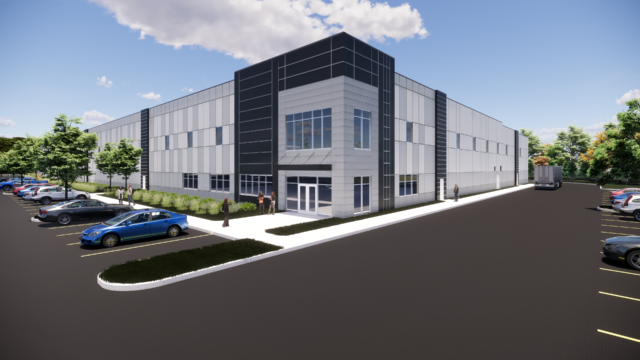
A new partnership between Boston-based Berkeley Investments and German investor Garbe has started its initial project in Billerica: a 150,000-square-foot spec building at 161 Concord Road. Developers are betting on demand from advanced manufacturing and research tenants. Image courtesy of Berkeley Garbe
Earlier this year, VulcanForms, the MIT-born manufacturer of sophisticated metals, also announced it was building a new advanced manufacturing plant at King Street Properties’ Pathway Devens campus.
In all, about 500,000 square feet of new flex space is currently under construction in areas north of Boston, particularly along Route 3 and Interstate 93, according to JLL data.
Among the north-of-Boston projects is Berkeley Garbe’s spec construction at 161 Concord Road in Billerica.
“We’re trying to provide what we’re calling ‘modern flex,’ said Berkeley Garbe’s McGrath.
Among other things, the new BerkeleyGarbe facility will have higher ceilings than average flex buildings – 28 feet versus around 14 feet. The increased height will allow room for taller equipment, more storage and possible mezzanine-level offices, McGrath said.
Scheduled to be delivered next spring, the new facility will also provide more power than what’s available today in most other flex buildings, he added.
Another big plus: it’s simply new.
“The vast majority of [flex space] properties out there are old,” said McGrath. “But tenants’ preference is for facilities with nice curb appeal and a more modern feel.”
McGrath said a number of tenants have already expressed interest in leasing space at the Billerica facility, which is scheduled for completion in April 2027.
“I can’t say we’ll lease it all up by the time it opens,” said McGrath, who declined to disclose projected rental prices and construction costs. “But I do anticipate a reasonable amount of space will be leased [by its opening]. We’re very confident this building will be a success.”
A Cautionary Precedent in Lab Boom
So is spec building the hot new development trend?
The CRE community is closely watching to see how the Berkeley Garbe development and other flex projects perform before declaring that a major new commercial construction trend is under way.
“I wouldn’t be surprised to see a slight uptick in construction,” said Nils Taylor, market intelligence analyst at Avison Young. “This might be the start of a [new wave of construction] because demand for flex space is so strong.”
But he cautioned that it’s too early to tell if there’s indeed enough overall demand to support a flex-space building boom.
Tucker White, U.S. office and life sciences lead for market intelligence at Avison Young, said developers are cautious about jumping on the flex-space bandwagon so soon after building millions of square feet of new life science space in the area – only to see demand for life-science facilities crater in recent years.
Meanwhile, the cost of land and construction – as well as for electricity – is notoriously high in Massachusetts, making it hard to pencil out major new building projects in general, White said.
“There’s a lot of high barriers of entry,” White said. “The demand is there [for flex space]. But it’s not all about demand.”
JLL’s Bruso agreed developers need a bit more convincing before there’s any big rush to build more flex-buildings in Greater Boston.
“We’re at the very, very early stage” of a possible trend, he said. “In a year or so, we’ll know better.”