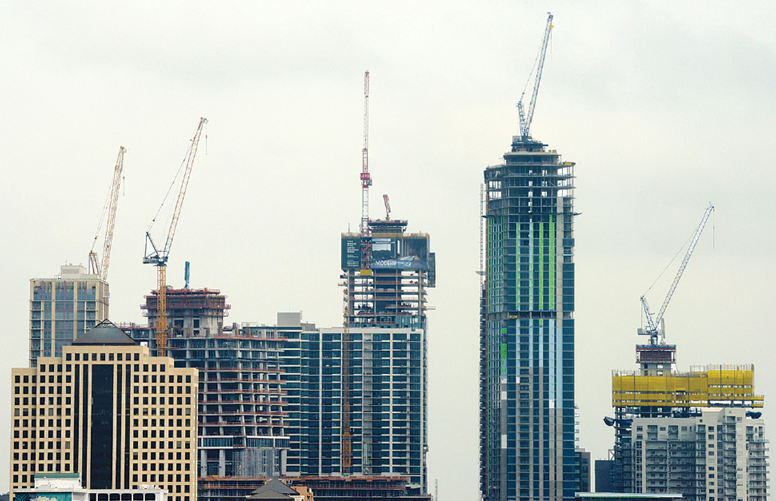
In Austin, Texas, an apartment building boom helped drive down rents across the city. iStock photo
It’s a cost-of-everything crisis, and it has put large swaths of the middle class under financial siege, especially here in Massachusetts.
We’ve had sky-high home prices and rents for years, but now monthly health care premiums have surpassed the mortgage or the rent as the top expense for a growing number of families, while gas and electric bills have also gone through the roof.
And we haven’t even gotten to surging school costs, which are helping drive up property taxes in cities and towns, or the fact that our state school, the University of Massachusetts, will put you out anywhere from $16,000 to $19,000, well above the national average.
Enter The Boston Globe. With the affordability crisis one of the top issues facing Massachusetts and a major story for local news organizations, the paper decided to do a big story, which we just came across, having missed it last fall. Bet you can guess what happens when you assign three Globe reporters to dig into why the Massachusetts middle class is shrinking.
The result was a 3,600-word gem – and yes, we’re being sarcastic – which fingers that favorite bogeyman of progressives, rising “income inequality,” to explain why so many in the middle class are struggling to make ends meet.
Higher earners have reaped the lion’s share of rewards in the Bay State’s increasingly knowledge-based economy, leaving professionals and skilled tradespeople in the middle scrambling to keep up and falling further and further behind, the Globe claims in the piece.
“Driving the squeeze is a stratospheric rise in inequality,” the story contends, offering the rather feeble argument that the wealthy have more money to spend on things and so have driven up prices.
Here’s where the Globe story spells it all out:
“Today, the middle class in Massachusetts is being hollowed out. In 2000, about half of Boston-area households qualified as middle class. Now only 41 percent remain. Most moved into the upper-income group, with about half as many sinking down to the low income group.
Driving the squeeze is a stratospheric rise in inequality. Since 2006, the state’s richest 5 percent have seen their income soar, earning 34 times more than the bottom 20 percent. At the same time, more people at the lower end of the middle class are losing their tenuous grasp and slipping out of it.”
Why Isn’t Boston More Like Austin?
So we guess the teacher struggling to make rent is the fault of the tech guy next door with the big paycheck, not decades of NIMBY opposition that have sunk countless proposals for new housing of all types.
Sure, the growth in the number and overall percentage of high-earners in Massachusetts, which has grown significantly over the last three decades with the tech and biotech booms, has probably added a little fuel to the fire.
Yet if it is upper-middle-class and wealthy professionals that are primarily driving up prices and rents, then Austin, a thriving blue university city in the heart of Texas, would be suffering right alongside Boston when it comes to affordability.
But it isn’t, because Austin has experienced an apartment building boom that has driven rents down after the city dramatically sped up and revamped permitting for new development projects.
This is the kind of boilerplate rhetoric that Democrats and state and local elected leaders have rolled out for years to explain middle-class woes. (Republicans have their own bogeymen and boilerplate rhetoric, but they haven’t been in charge for years.)
It’s also a convenient explanation, shifting blame onto larger, more nebulous economic forces in a way that implicitly lays the blame on Republican policies, which are typically opposed to raising taxes in general and especially on higher earners and the rich.
However, that lets off the hook decades of decisions made by the Bay State’s political establishment, from Beacon Hill on down to local select boards, which have played the leading role in driving up costs for everyone. NIMBY regulations and red tape were allowed to flourish for decades, killing plans for new housing and driving home prices and rents through the roof.
Can’t Blame it All On Trump
Attracted by far less expensive housing costs in other states, middle-class families have been bailing on Massachusetts for years. That does widen the statistical gap between rich and poor, just not in the way that progressives believe is happening.
Decisions made on the state level have also played a major role in rising electric and gas bills and soaring health care premiums.
The cost of our K-12 system has also ballooned, with dubious results, while our state university system is no bargain compared to other states.

Scott Van Voorhis
Yet President Donald Trump is the only elected leader to come in for criticism in the piece. While he has caused more than his share of turmoil in our state’s research-dependent economy, Trump can’t be blamed for decades of decisions by state and local officials.
By blaming income inequality for the shrinking Massachusetts middle class, the Globe gives a pass to decades of blue state misgovernance which, frankly, would be a far more productive issue to focus on.
Scott Van Voorhis is Banker & Tradesman’s columnist and publisher of the Contrarian Boston newsletter; opinions expressed are his own. He may be reached at sbvanvoorhis@hotmail.com.