Merrimack Street, downtown Lowell’s main thoroughfare, in 2023. The city is in the process of forming a business improvement district in the area. iStock photo
The post-COVID rapid response plans and injections of federal funding have come to an end, along with a key state program dedicated to Massachusetts’ downtown vitality.
In the Gateway Cities, self-funded business improvement districts are picking up the slack to keep downtown areas fresh after weathering the pandemic.
Gateway Cities including Barnstable, Springfield, Taunton and Worcester have turned to BIDs in recent decades to support downtown neighborhoods on a long-term, self-funded basis.
Now, Lowell is in the early stages of proposing a new downtown BID, following two attempts that failed to obtain the minimum number of property owners as sponsors.
The latest version narrows its geography to 181 properties located between the Merrimack River and Market Street, and is gaining support among commercial properties, Lowell Director of Economic Development Ali Carter said.
“They are investing in themselves,” Carter said. “With federal funding being questionable and less reliable, it’s really an investment of property owners in their own community.”
And unlike property taxes, BIDs give commercial landlords a direct say on how the funds are spent, through a board of directors that sets policy.
Seeking Sign-Off from Property Owners
State law enables the creation of BIDs, which add special assessments on properties within a designated area, to add services beyond those provided by local government.
Property owners pay for services that generally include security, placemaking, capital improvements, event programming and marketing campaigns.
Designed for primarily commercial districts, BIDs require a vote of property owners to take effect. To launch, they need support from owners of 60 percent of the properties in the district, and a majority of the assessed valuation within the district.
Even business interests in Boston’s Back Bay are pushing for creation of a BID, following those now in place in Newmarket to address the homeless and addiction crisis and in Downtown Crossing following the ongoing office slump.
Progress on the Back Bay BID creation hinges upon support of developer BXP, which has an outsized neighborhood ownership stake as owner of such properties as the Prudential Center, 200 Clarendon and 888 Boylston St.
The Back Bay Association has been lobbying BXP to support the bid without success, according to a Boston Globe report in November. Back Bay Association President Meg Mainzer-Cohen declined comment this week.
The investment pays off for landlords, according to a 2007 policy paper by the Furman Center for Real Estate and Urban Policy at New York University: values of commercial properties within BID boundaries rose up to 15 percent faster than comparable properties in the neighborhood.
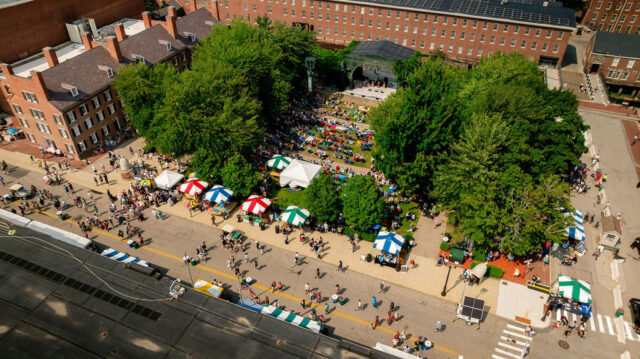
Gateway Cities are exploring formation of Downtown Business Improvement Districts amid waning support from federal and state programs designed to shore up downtown areas. In Lowell, home to an annual folk festival (pictured), plans for a BID district are in the early stages. Photo by Henry Marte | Courtesy of MarteMedia
Lowell Seeks to Sustain Recovery
Lowell’s latest BID attempt comes as outside support for the downtown’s recovery from COVID is nearing an end.
Using $462,000 in ARPA funding as a rent subsidy, the city launched two retail incubators leasing storefronts as incubators for early-stage businesses on short-term leases. Downtown retail recovery from COVID has been steady, with vacancies declining from 11 percent in 2022 to the current 6 percent, following the opening of 31 new businesses, Carter said.
A BID would continue the momentum by focusing on marketing, events and street improvements.
In Hyannis, the BID has helped stabilize the downtown following a pair of threats to its vitality, Main Street Business Improvement District Executive Director Elizabeth Wurfbain said. Property owners pay an annual fee equal to 0.003 percent of their assessed value, up to a maximum $4,000 per year.
The original impetus for its creation in 1999 was to promote Main Street amid rising competition from shopping malls, including expansion of the Cape Cod Mall in the late 1990s.
“There was a group of local merchants that had a loose organization and said, ‘There must be an easier way to get things done in a more predictable fashion,’” Wurfbain said.
Since COVID, it has focused on event sponsorship to drive foot traffic, Wurfbain said, reducing retail vacancies and attracting newcomer businesses such as Mariner Cafe bakery and Poor Decisions wine shop.
Safety and security is another priority for the district because of Hyannis’ cluster of social service providers and its homeless population. A team of 10 community service officers augments the local police department’s patrols during the summer months.
What Will Fill MDI Void?
The rising reliance on improvement districts follows the elimination of one of Massachusetts’ key programs dedicated to downtown stability.
For decades, the Massachusetts Downtown Initiative (MDI) served as a clearinghouse for economic development programs, including money for consultants working on specialized revitalization strategies.

Steve Adams
The program’s $600,000 budget within the Executive Office of Economic Development was eliminated in the current fiscal year.
Its since-retired coordinator, Emmy Hahn, assisted districts in urban centers and rural towns alike on programming and technical assistance for a quarter-century. The program doled out grants used by local communities for programs ranging from marketing to arts and culture programs and wayfinding.
The program’s budget never topped $150,000, Hahn said, but was able to maximize its impact in the period following COVID. Using $10 million in ARPA funding, it helped create 124 rapid recovery plans for downtowns.
“To this day, I have not gotten a straight answer why [it was eliminated], because that would have been the process for continued downtown revitalization,” Hahn said. “But it just wasn’t a priority.”
The Executive Office of Economic Development did not respond to a message seeking comment.
Another state-supported downtown initiative is the Transformative Development Initiative, which is overseen by MassDevelopment. The program sponsors three-year fellowships by economic development specialists in the Gateway Cities, during which they devise strategies for attracting investment in dense, walkable neighborhoods. MassDevelopment also offers grants up to $250,000 for commercial revitalization through its TDI Equity Investment Program.
Now, some of those responsibilities may be assumed by BIDs, or dropped entirely.
“If you don’t have a sustainable entity, you’re back to asking for more money,” Hahn said.